
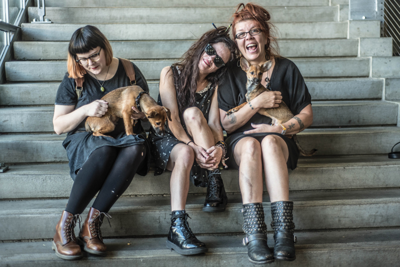

Even after witnessing successful reunions by college-rock legends like Dinosaur Jr., The Replacements and My Bloody Valentine, news that noise-punk trio Babes in Toyland was regrouping still came as kind of a surprise. While Babes' blip on the post-Nevermind alterna-boom radar was certainly substantial, the band's legacy remains objectively underrated, relegated to a cult status that just barely exists online. Nevertheless, this — the story of the grunge era's most strained and abrasive reunion — is also one of the most heartwarming. It's less about a relic of the music world's obscure past coming back to wreak havoc, but actually more about a trio of friends finding their way back to each other after some incredibly difficult years apart.
Talking to the Scene via phone from Minneapolis, drummer Lori Barbero says it was those aforementioned band reunions that inspired her and singer-guitarist Kat Bjelland and bassist Maureen Herman to regroup in 2014. "I saw The Replacements reunion, and I thought, 'If they can do it, I think we can do it,' " she recalls. "It put a bee in my hat, but we hadn't even been in the same room together in, like, 12 years."
Vaguely associated with the Pacific Northwestern grunge scene and often erroneously lumped in with the Riot Grrrl feminist punk movement of the '90s, Babes in Toyland formed in 1987 in Minneapolis touting a sound that was less a nod to the stoner-fuzz sounds of the '70s worshipped by Seattle bands, but instead derived more from the jagged guitars and primal drumming of post-punk legends like The Fall and Public Image Ltd.
"I tried to get musicians that didn't know how to play so it'd be something just sort of organic and original," Bjelland says during a later call. "Like, something out of nothing. Something that wasn't derivative from everything else."
Unimpeded by technical prowess, the band charged through the 120 Minutes heyday with guttural melodies, screeching guitars and a well of angst that predated albums by a wave of all-female contemporaries like L7 and Bikini Kill. The band's commercial high-water mark came when the video for "Bruise Violet" — the practically unmarketable lead single from their 1992 major label debut Fontanelle — got its heaviest rotation inside an episode of MTV's Beavis and Butt-Head, with the hormone-raging, heavy metal-loving cartoon duo proclaiming, "These chicks are cool!" And it went with a main-stage spot on 1993's Lollapalooza tour. The trio split in 2001 after several years of intra-band turmoil, thus cementing their legacy as a dark footnote in one of pop music's strangest eras.
In the intervening years, Bjelland, Barbero and Herman drifted apart, into other cities, and fell completely out of touch. Each separately struggled with personal issues. In 2007, Bjelland was diagnosed with schizophrenia and institutionalized, and was at one time homeless. Herman, who also found herself on the streets, struggled with drug addiction and post-traumatic stress from sexual abuse, all in addition to a debilitating genetic disorder that forced her to leave the band in 1996 and have hip-replacement surgery. It was Herman who persisted in reuniting with her former bandmates; in the summer of 2013 she invited them to her lake house, where she and Bjelland decided almost instantly to get the band back together. With funding from private firm Powersniff — a tech LLC formed by a trio of former Google employees and friends of Herman's — the band members were able to relocate closer to each other, start rehearsing and hit the road in time for festival season.
"People would show me on the Internet all these young fans who wanted to see us, and I felt kind of obligated to play," says Bjelland. "You see people with their moms and even grandmothers coming to the shows together. It's super cool. I'm just surprised at how much people still like it."
In August, Herman parted with the band due to personal differences, and was replaced by Clara Salyer of Prissy Clerks and Whatever Forever. "She's 22 and kicks ass," Bjelland exclaims, reaching the peak of excitement during her chat with the Scene. "She's a really good musician. [She's] kind of a gearhead, which I like. She just fit right in. It was meant to be."
A lot has changed about the band's live shows and life on the road this time around. GPS and smartphones make touring much easier, and Barbero says female fans were never so common back in the day. However, the most important difference — save for differences with Herman — is in the way they get along. "We mean the world to each other," Barbero says. "We didn't use to tell each other that, but we tell each other all the time now. We're older and we're more respectful."
Since reuniting, the band has been ambiguous about any potential plans for new material, but Bjelland seems optimistic. "We started jamming last night," she notes. "I think that's going to happen for sure." She goes on to explain that being older and having a teenage son has steered her songwriting in a much more political direction. "It's less anger about people. Now it's about things that are going on in the world. I've got a whole plethora of songs ready to go."
Email Music@nashvillescene.com



