



Lavender Country
Viewed in profile, Lavender Country founder Patrick Haggerty resembles the fictional country singer Haven Hamilton, one of the characters in director Robert Altman’s 1975 movie Nashville. As played by Henry Gibson in the film, Hamilton sings the ultra-banal country parody “Keep A-Goin’ ” and comes across like Hank Snow — if Snow spouted patriotic bromides and sententious musings on the nature of modern music and the pernicious influence of long hair on American morals.
The resemblance, The Spin is quick to add, stops there: Hamilton is one of Altman’s most conservative, autocratic characters, while Haggerty bucked tradition by writing and recording the anarchic 1973 country album Lavender Country, commonly cited as the first openly gay country record. It’s the kind of populist artistic breakthrough that would have made Hamilton blanch and Altman smile, if Altman had ever heard of it, and Haggerty’s groundbreaking music has become part of country history. Here he was, a short, spare, unprepossessing 73-year-old man, singing his songs in Nashville on Saturday night at The Basement — one of two shows he played in town over the weekend — during the city’s Pride celebrations. As the great Hamilton once told us, “Keep A-Goin’.”

Lavender Country
Haggerty had made history with Lavender Country, which he recorded in Seattle in early 1973 with pianist Michael Carr, guitarist Robert Hammerstrom and violinist Eve Morris. Financed by the city’s Gay Community Social Services, Lavender Country quickly sold out its thousand-copy first pressing, and writer Chris Morris’ 1999 piece on gay country music in The Journal of Country Music extolled the record’s achievement. Following North Carolina label Paradise of Bachelors' 2014 reissue of Lavender Country, Haggerty has been performing it across the country. It’s proven a durable work that lends itself to reinterpretation.

Little Bandit
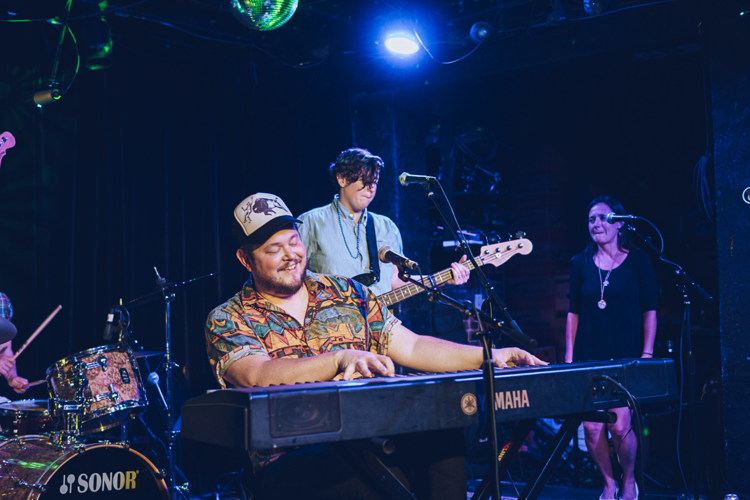
Earlier in the night, we missed Mercy Bell’s opening set but settled in to catch Nashville’s Little Bandit, the country-soul-pop vehicle of singer and songwriter Alex Caress. With his Roy Orbision-meets-Charlie Rich croon and his penchant for modified R&B and country grooves, Caress operates on the edge of country and the precipice of Americana. There’s nothing particularly precious about Little Bandit’s music, and we never get the sense that Caress is seeking to exploit nostalgia by creating David Lynch-style countrypolitan.
With his sister Jordan Caress-Wheelwright sitting in on bass for the set, Alex sang something titled “Comfort Inn,” which recast the conventions of ’80s-style wide-screen pop country. He dug into a 6/8 groove on “Diamonds,” a fine piece of country soul. Little Bandit’s music is emotionally direct — Alex Caress never succumbs to the temptation to camp up his genre explorations, and the result is newfangled Ameri-country that retains plenty of mystery.

Lavender Country
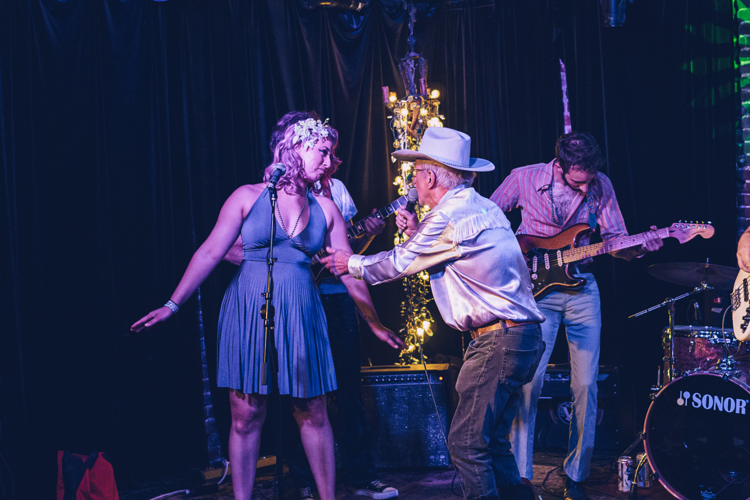
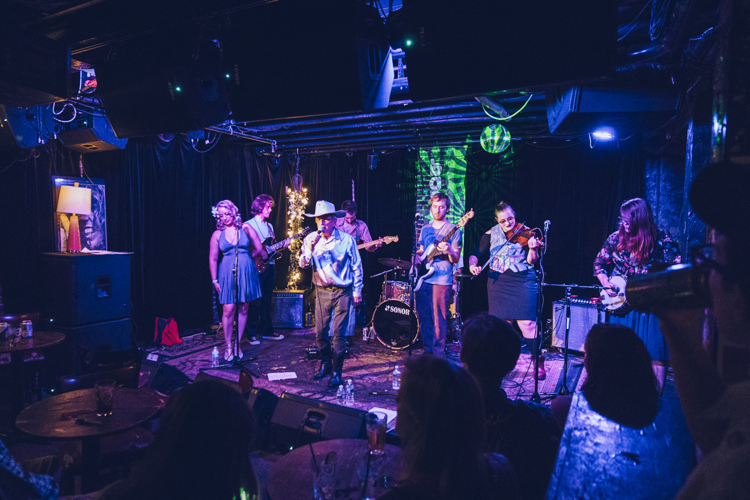
Looking both affable and determined, Haggerty hit the stage wearing a lavender-silver cowboy hat and fringed shirt. He played selections from Lavender Country with a seven-piece band that included Music City guitarist Sean Thompson, who bore down on a series of Richard Thompson-style solos during the set. Thompson functioned as Haggerty’s second voice throughout the night, while his fellow band members superbly recast Haggerty’s ’70s music.
As Haggerty told the audience, they were watching a “radical socialist” sing about radical democracy as it was practiced in the ’60s and ’70s, when gay men like Haggerty learned to live with fear. “I came out a screaming Marxist bitch,” Haggerty said about his experiences in the ’60s, including a stint in the Peace Corps that ended with him being kicked out for being gay.
That was 1966, but Haggerty moves easily in the present. Lavender Country is quintessential ’70s music. Aided by his flexible band, Haggerty kicked through Lavender Country’s centerpiece, “Waltzing Will Trilogy,” perhaps Haggerty’s most successful attempt at rock ’n’ roll. Thompson’s licks decorated a song titled “Gay Bar Blues,” which mentions police repression.

Lavender Country
Like all of Haggerty’s music, “Gay Bar Blues” illustrates the relative freedom of America in 2018 by reminding listeners how complicated, not to mention dangerous, things were for gay people 45 years ago. By all rights, Haggerty should not have had a career at all — after disbanding the original Lavender Country band in the mid-’70s, he stayed in music by performing at retirement centers. Haggerty’s comeback, such as it is, seems tailor-made for the sensibilities of modern Nashville, where all things related to country music receive the kind of loving care administered by no other music center on earth.
What we heard Saturday night may be, in many ways, tangential to country music. “Waltzing Will Trilogy” remains as avant-garde and anti-pop as, say, The Holy Modal Rounders’ 1971 version of Cajun country singer Jimmy C. Newman’s “Alligator Man.” Haggerty’s music is intuitive and unsophisticated, but his lyrics make his case as a true innovator of country music. “Waltzing Will Trilogy” and another song Haggerty performed at The Basement, “I Can’t Shake the Stranger Out of You,” describe social identity in terms of harsh political realities. As far as we’re concerned, that’s a place country music could visit more often, if it had the stomach for it.
See our slideshow for more photos.
In The Spin — the Scene's live review column — staffers and freelance contributors review concerts under a collective byline.



