
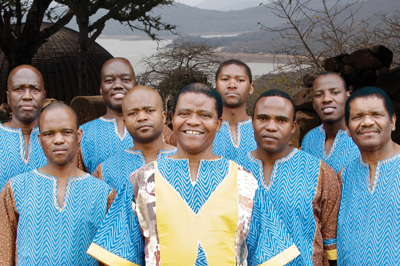

South African choral group Ladysmith Black Mambazo have performed many different types of songs throughout their four decades-plus history, from tunes of freedom and their heritage to messages of faith and salvation. But on their latest project, Songs From a Zulu Farm, longtime member Albert Mazibuka says they wanted to do something different.
"We've done songs of celebration and tribute, we've commemorated important events like the fall of apartheid and the World Cup coming to our homeland, but this time we wanted to have some fun and kind of enjoy ourselves," Mazibuka says. "We've always found a lot of happiness in music, but we've been doing a lot of serious projects lately. So we thought, 'Let's take some songs we grew up hearing as children, traditional Zulu songs, and put them on an album.' "
The resulting 16-track work is a joyous, sometimes boisterous work. (The finale is a rave send-up of "Old McDonald's Farm.") Their voices sweep, intersect and collide, with lyrics in several languages dancing around with the stunning assortment of trills, chants, bird sounds and cries that have made the group beloved around the world. Highlights range from the rousing opening number "Yangiluma Inkukhu (The Birthing Chicken)" to equally intense, energetic pieces like "Imbongolo (The Donkey's Complaint)" and lighter, breezy efforts such as "Ixegezi (Catch The Bird)" and "Vuka (Wake Up Little Children)."
"We heard our parents and grandparents singing these when we were growing up," Mazibuka says. "One thing we have noticed is you don't hear them much in today's society, so we wanted to bring them back and remind the children that growing up is really a celebration of life. We've aimed them mainly at children from 6 to 11, although we certainly hope adults will also enjoy them."
Now in the midst of the first leg of an extensive 2011 tour, Ladysmith also have good news for fans of the group's founder and leader Joseph Shabalala, whose tenure dates back to its first incarnation in 1960, and who last performed with the group on what was then billed as his retirement tour.
"Joseph loves singing and music too much, he would never be happy in retirement, even though he said he was tired and wanted to come off the road," Mazibuka says with a laugh. "When we got back home that year he sat around a few days and then decided he just couldn't quit singing. Now he comes out at the beginning, does introductions and some numbers, then joins us later near the end. ... He would never be content without being in the group, and we're all very happy he's still out there with us."
Shabalala is part of a legacy that stretches back to the ugly era when apartheid restricted Ladysmith's travel and domestic freedom, and limited the reach of their recordings. Following successful releases on the African continent throughout the '70s and early '80s, the group got some attention from European publications after a triumphant track of their vocals was issued on the compilation The Indestructible Beat of Soweto. But it was their 1985 collaboration with Paul Simon on Graceland that provided the breakthrough.
"We are still in touch with Paul Simon," Mazibuko says. "None of us ever thought what came out of Graceland would do for us what it did. But it proved, through the grace of God, the work that really helped bring not just Ladysmith Black Mambazo, but South African vocal music to people everywhere." Graceland eventually sold 16 million copies, and Simon would later produce three albums for the group. While there was some grumbling that both Simon and Shalabala had broken the international cultural boycott, the LP's impact cannot be questioned.
Their fame rose to another level with the fall of apartheid in 1991 and subsequent release of Nelson Mandela. They not only cut a tribute album to him in 1993, but also accompanied him to his Nobel Prize acceptance ceremony in Oslo. As president, Mandela also named them South Africa's cultural ambassadors. Since those magical times, Ladysmith Black Mambazo have become an institution. They currently operate their own foundation, and spend as much time with demonstrations, clinics and workshops across the globe and throughout Africa as they do performing concerts.
As for their musical plans, Mazibuko says, "We want to do some of the songs we used to sing in churches for our next album. These are inspirational and spiritual, and we have done some before but never a complete album. When apartheid fell we experienced real freedom for the first time, and we communicated that through our music. Now we're devoted to letting people hear all the aspects of traditional South African music, see how diverse it is, and how many different things we can express in the songs."
Email music@nashvillescene.com.



