
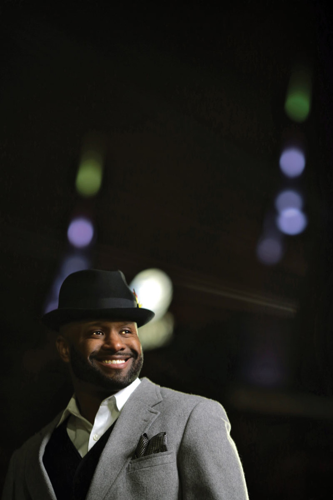
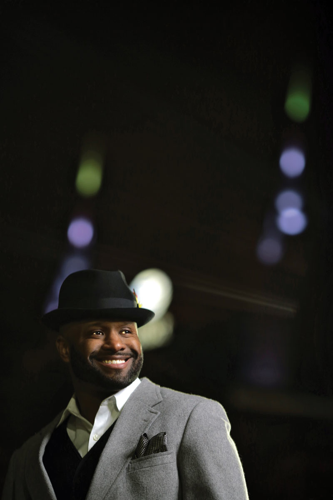

Shannon Sanders had to cram in a coffee shop sit-down between morning and lunchtime business meetings. Such is the schedule of Nashville's leading neo-soul and adult R&B studio guru, who also happens to be president of the Nashville chapter of the Recording Academy. Somehow, though, he seems thoroughly relaxed, in his element and on message, like it's nothing for him to move from one official confab to the next. Only once in an hour's time do his eyes drift over to check the phone buzzing next to his coffee cup.
It's hard to imagine this guy ever feeling locked out of the music industry, or fumbling around for a way in. But there was a time when Sanders, who grew up in Nashville and attended Hillsboro High School and Tennessee State University, still hadn't figured it all out.
"For a long time I felt more a victim of Nashville than a product," he tells the Scene. "I had people threaten to call the police on me for coming into their offices up on Music Row with demo tapes, just wanting to be heard. And as I got older, I understood protocol."
Really, who better to lead an organization advocating for professional music-makers than a mover and shaker who still remembers the uphill climb? Sanders talked to the Scene about what it took to forge a formidable R&B career in Nashville and how he's using his presidential post for good and plenty else.
How's it been leading the local Grammy chapter so far? It's been good. ... To me, it really reflects the diversity of the community. Because here's how this works: Our membership elects the board, OK? The board votes for its officers. So the board is who elected me as president. That board is comprised of all our Nashville big shots, you know? You're talking label execs and a lot of high-ups. So I really feel like my election reflects the real tone of the city. I think it reflects the real mindset of the city, the true diversity of the city. From the outside looking in, you might not look at Nashville and see that it's as diverse as it is. Inside out this is how we see ourselves.
Why'd it matter to you to get involved? As a music industry professional, I always wanted to be part of a professional organization. I said, "OK, when I find the one, I'll really throw myself at it and get involved." You have other organizations that are really focused, like NSAI. They're really focused on songwriters, and that's awesome. At the same time, we do all that. We're music creators. ... Not just songwriters — we are the Recording Academy. We are producers, we are engineers, we're songwriters, we're artists, we're executives, we're photographers — we're the people who are the music industry.
I've been involved a long time, served on several committees. I think the reason they asked me to run for president was because of my enthusiasm. They feel my passion. Anything I've ever done that they've asked me to or that I've volunteered to do for the academy, I've done wholeheartedly. ... People see the Grammy Awards. That's one day, but the other 364 we're really in D.C. and things like MusiCares. We're out here fighting for and advocating for things that really affect all of us.
At this point in my life, I've done lots of things. I've got a couple Grammys, I've got a couple Emmys and I've got a Dove. ... But in my life and in my career, I felt like I'm at a point now where I'm ready to give back in other ways. I try to make myself available to young musicians that have questions. I hate to see people get burned. Doing this was a way that I could make myself more available on a larger scale.
You helped get a diversity committee rolling in the local chapter of the Recording Academy. What was the mission? The diversity committee is an extension of the membership. It's been a real cool way to get folks in and get people to just kind of come into the Grammy family and feel like a part of the big picture, feel like they're part of the Nashville music industry. Because the thing is, because of the kind of music I do, I might not be up on Music Row like that. So I don't really interface with the country boys like that. This gives us common ground.
You grew up here. What were the local hip-hop, R&B and soul scenes like? A lot of people don't know that Nashville was really an urban music mecca, late '50s, early '60s. I'm talkin' early — like '63 it was kinda over.
Are you talking WLAC? I'm talking Night Train to Nashville — that TV show, which was actually the precursor to Soul Train. It was the same guys. When it ran out here, it re-emerged as "Soul Train." Nationwide brand.
When I started doing my thing, hip-hop was new. People didn't really understand it, definitely didn't embrace it. So we had to make our way. It's funny because I don't know if I ever really meant to do a lot of what I'm doing now. I don't know if I really meant to produce people.
You were on the artist track. I was. But there weren't many people around that could make stuff sound the way it needed to sound. So I just kind of had to figure it out. ... It was really like, "OK, if you're gonna record this and make it sound the way you want it to sound, you've just gotta do it." There were pockets of us. There were people who were doing things who weren't necessarily connected. Then we realized that we kinda had a scene.
The thing that country has built is an infrastructure that doesn't exist in any other city where any other genre is just this strong in one city. They built some crazy studios and they've got crazy infrastructure. We're all able to benefit from that. So that's now. We're really able to take advantage of all those things. But for a while, no, there was no opportunity here. There was no urban music business. ... A lot of what I did was go other places, L.A., New York, Atlanta, Chicago, wherever opportunity was. But my thing was, "I live in the greatest creative community in the country, arguably the world. So early on in my career, I'll be wherever I need to be to make things happen." As I became more established in Nashville, it became, "You come to me." And then people come to Nashville, and they see it and they love it.
Why didn't you move somewhere with more of an urban music infrastructure? I started a family young and it was just a better place to be for me, all things considered. I could've gone to Atlanta, L.A., all those places. But I felt like I had a better quality of life here while I tried to get it going on.
What did your professional options seem to be in Nashville? My skill set is varied. So it's not like I've stuck to one thing. ... My entire childhood was spent doing it all. I would play piano and I'd pick my trumpet up and make sure that I could do it, and then I'd turn around and sing it. It would've driven me crazy to play trumpet better than I play keys or better than I sing. It was important to me to make sure it all came up at the same time, so by the time it got to the point where I could do something with it, it was all there. ...The bottom line is I wasn't sitting around waiting for the same phone call every day. ... That's what made it happen for me in a lot of ways, because I made myself available to different people in different communities depending on what they needed.
When did you start your long-lasting creative partnership with Drew Ramsey? I was in college. You're talking early '90s. He just became one of my best friends. ... We had a mutual friend that just based on what he knew of what I did and what Drew does, he was like, "Y'all gotta meet." And he was right.
A lot of it in the beginning was just us doing my stuff, really. We had a computer and some gear. ... We'd write together, record together, make these songs together, and then people would hear those things, and it created opportunity for us to do it for other people too. Even the India.Arie thing, it was just a natural progression.
Those India.Arie albums may have put you on the map, but your collaboration with Ramsey has taken you in other directions too, toward roots pop and CCM. See, there are certain things that are gonna come because of Drew and certain things that come because of me. Drew, he's the white guy in the equation, so there are lots of things that we'll get into because [of him].I mean, there probably would be no me and Jonny Lang without Drew. You see what I'm saying? There wouldn't be no India for him without me. But then we get in a room and [India] realizes, "Oh wow, [Drew's] dope." Then we get in a room and Jonny's like, "Oh, OK. Wow." We've been able to supplement each other in a Trojan Horse kind of way, been able to get certain opportunities with and for each other because of our differences.
What'd those big India.Arie albums do for your career? Her thing wound up being a great business card, because it just made the phone ring a different way. It made people say, "If she can do that, then maybe I can too." ...What they didn't realize was that a lot of what they were really wanting from me was the Nashville way.
The Nashville writing aesthetic, it's just higher than everyone else's. We do it better. That's the thing that's missing in a lot of popular music. Country, I ain't gonna lie — they get it right, I think that the country songwriting community, they're the best at it as a community. Just growing up in this environment where songwriting is taken so seriously, writing with guys like that, that's been something that I've been able to take forward, take into other genres, the high songwriting standard that we have here. I've been able to take that all over the world, take that everywhere that I go. I think that's been one of the great separators for me.
Anybody that knows me outside of here, man, they know I'm South Nashville all the way. I fly the flag high when I'm not here, so it's no secret where I'm from. And it's no switch-up. I don't pretend to do something that I don't. I don't pretend to be somebody that I'm not. So what you get right now is what you get all the time. I talk to everybody the same way.
Email Music@nashvillescene.com



