
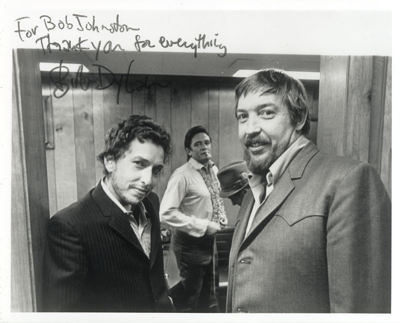

From left: Bob Dylan, Johnny Cash and Bob Johnston
“Is it rolling, Bob?”
With those four words, spoken by Bob Dylan on his 1969 Nashville Skyline LP, record producer Bob Johnston was immortalized for a generation of music fans. Johnston, who died last week at 83, was at the peak of his career then, a career that influenced much of the music that followed and helped transform Nashville at a pivotal time.
The exuberant, strong-willed Johnston played a huge role in changing the musical landscape of Nashville in the late '60s. By bringing Bob Dylan to the city to record Blonde on Blonde in 1966, then again for John Wesley Harding in late 1967, Johnston helped make Nashville a mecca for rock and folk artists looking for a relaxed place to record, and for skilled and versatile musicians to work with.
Before he produced Blonde on Blonde, Johnston had been knocking around the music business for 10 years: as a performer and songwriter in his native Texas, and working for Hill and Range Songs in Nashville, where he pitched and wrote songs for Elvis movies. By 1965 he was in New York as a fledgling producer for Columbia Records.
Never lacking in confidence, or shy about self-promotion, Johnston got the job producing Bob Dylan on Highway 61 Revisited in Columbia’s New York studios. He was keen on getting Dylan to record in Nashville, and with the help of a last-minute virtuoso guitar performance by visiting Nashville session ace Charlie McCoy on “Desolation Row,” he was able to get Dylan to warm to the idea. Johnston did not mince words when stressing the importance of Dylan recording in Nashville.
Desolation Row · Bob Dylan
Highway 61 Revisited
℗ Originally released 1965. All rights reserved by Columbia Records, a division of Sony Music Entertainment
Released on: 1965-08-27
Guitar: Michael Bloomfield
Guitar: Charlie McCoy
Drums: Bobby Gregg
Organ, Piano: Alan Kooper
Organ, Piano: Paul Griffin
Piano: Frank Owens
Bass: Harvey Goldstein
Bass: Russ Savakus
Producer: Bob Johnston
Auto-generated by YouTube.
“The world was changing," Johnston said, "and he was right in the goddamn middle of it, and that put us right in the goddamn middle of it, as far as I was concerned.” Dylan, in his 2004 Chronicles shared his take on Johnston: “… Cheerful as always and full of zest. Few people have it for long, but he’s got a never-ending supply, and it’s not faked.” Johnston also worked here with Simon and Garfunkel, recording tracks for Sounds of Silence and Parsley, Sage, Rosemary and Thyme. In 1968 he brought Leonard Cohen to town to record Songs From a Room, later working on two more Cohen albums and even going on the road as Cohen’s keyboard player. Other folk and rock artists Johnston produced during this era include Ramblin’ Jack Elliot, Pete Seeger, The Byrds, Moby Grape and Dan Hicks and His Hot Licks.
I don't own this, No copyright intended, blah blah
Songs From a Room—1969
For a brief time Johnston was put in charge of Columbia’s country division in Nashville, and though he would have been the first to admit that he was too strong of a personality to play the corporate game, he made an indelible impact on country music. His successor at Columbia was the late Billy Sherrill, whose career was profiled two weeks ago in the Scene after his death Aug. 4. Johnston produced albums by bluegrass stalwarts Flatt and Scruggs, and several No. 1 singles for country veteran Marty Robbins. But one achievement in country music stands out above all others. Johnston gave Johnny Cash the freedom to record the live prison album Cash had long wanted to make. The result was Johnny Cash at Folsom Prison, which garnered Cash a whole new audience. With the hugely successful follow-up At San Quentin, Cash transitioned into that elite group of artists whose appeal crossed genre boundaries, and these albums undoubtedly helped establish Cash as the icon he remains today.
Johnny Cash - Folsom Prison Blues (Live)
Don't forget to subscribe for more Johnny Cash Music !
Lyrics:
I hear the train a comin'
It's rollin' 'round the bend,
And I ain't seen the sunshine,
Since, I don't know when,
I'm stuck in Folsom Prison,
And time keeps draggin' on,
But that train keeps a-rollin',
On down to San Antone.
When I was just a baby,
My Mama told me, "Son,
Always be a good boy,
Don't ever play with guns,"
But I shot a man in Reno,
Just to watch him die,
When I hear that whistle blowin',
I hang my head and cry.
I bet there's rich folks eatin',
In a fancy dining car,
They're probably drinkin' coffee,
And smokin' big cigars,
But I know I had it comin',
I know I can't be free,
But those people keep a-movin',
And that's what tortures me.
Well, if they freed me from this prison,
If that railroad train was mine,
I bet I'd move out over a little,
Farther down the line,
Far from Folsom Prison,
That's where I want to stay,
And I'd let that lonesome whistle,
Blow my Blues away.
Other Information:
"Folsom Prison Blues" is a classic American country music song credited to Johnny Cash. The song combines elements from two popular folk genres, the train song and the prison song, both of which Cash would continue to use for the rest of his career. It has become one of Cash's signature songs.
In the lyrics, the jailed protagonist listens to the whistle of a train outside his cell and recounts his crimes ("I shot a man in Reno/just to watch him die"), imagines the free people inside the train ("They're probably drinking coffee and smoking big cigars") and dreams of what he would do if he were free. "I know I had it coming/I know I can't be free," sings the imprisoned man. "But those people keep a'moving/and that's what tortures me."
“Bob Johnston was a producer that is an artist’s dream," Cash said of Johnston, "smart enough to know that when he gets an artist that believes in himself as an artist to let him run with it.” Johnston was also influential in mentoring musicians and bringing them into the Nashville studio fold, among them guitarists Ron Cornelius and Charlie Daniels. Both are lavish in their praise of what Johnston’s help meant to their subsequent careers.
Bob Johnston has worked with the likes of Bob Dylan, Johnny Cash, and Leonard Cohen over the past fifty years. If there's anyone who understands the inner-workings of the music industry, it's him...and he doesn't think too highly of said industry, as is evident from this interview with BAMM.tv at SXSW.
By the early '70s Johnston’s relationship with both Dylan and Cash had run its course. But he remained a strong presence throughout the decade with albums by Loudon Wainwright III, Tracy Nelson, Mac Gayden and others. Though he remained intermittently active in later decades, he had a relatively low profile in recent years. There’s a film clip of Johnston being asked about why so many non-country artists came here to record, with Johnston replying: “I think it’s the musicians … the people care, they care about what they do; they take pride in it.” There is little doubt that Johnston cared deeply about the music he worked on; he was outspoken and passionate about the records he made and was justly proud of an amazing legacy.
Keep it rolling, Bob.
Provided to YouTube by Sony Music Entertainment
To Be Alone with You · Bob Dylan
Nashville Skyline
℗ Originally Released 1969. All rights reserved by Columbia Records, a division of Sony Music Entertainment
Released on: 1969-04-11
Producer: Bob Johnston
Associated Performer, Guitar: Kenny Buttrey
Associated Performer, Guitar: Charles McCoy
Associated Performer, Guitar: Pete Drake
Associated Performer, Guitar: Norman Blake
Associated Performer, Guitar: Charlie Daniels
Associated Performer, Guitar: Bob Wilson
Associated Performer, Guitar: Johnny Cash
Auto-generated by YouTube.
Johnston’s influence is explored in detail in the Country Music Hall of Fame exhibit Dylan, Cash, and the Nashville Cats: A New Music City, for which Pete Finney served as co-curator. He also contributed liner notes to the accompanying 2-CD volume of the same name.



