
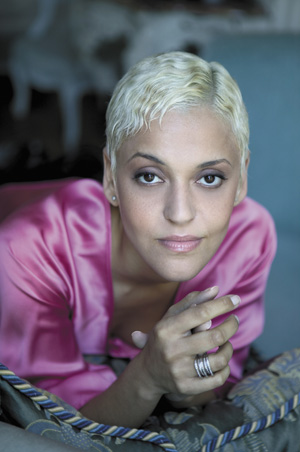
If you know about the Portuguese folksong genre fado, it's probably because of Mariza. Her rich, warm voice and charismatic delivery have made her the best-known of a new generation of fado singers—or fadistas—who have revived the form for their own country and for the world. Since her 2001 recording debut Fado em mim (Fado in Me), she has become a Portuguese national icon and a superstar of "world music," and her take on fado is now among Portugal's hottest cultural exports. In Mariza's hands, fado is a living language—like all the best folk musicians she is propelled forward, not inhibited, by tradition.
The word "fado" is most literally translated as "fate." As for the American blues, with which fado is often compared, the style's name gives a rough but incomplete notion of its subjects and character. The songs are often but not invariably plaintive or nostalgic in tone, and they focus on demonstrative and intense lyrical expression rather than on catchy hooks. The voice is typically accompanied by one or more stringed instruments, almost always including the 12-stringed Portuguese guitar, whose pear-shaped body gives it a more focused and lute-like sound than the American 12-string.
The genre began as tavern (or taverna) music in poor city neighborhoods, but it began to attract aristocratic taste in the 19th century. The traditional repertoire comprised a stock selection of tunes, passed down orally and applied to poetry of the singer's choice. By the beginning of the 20th century, fado was recognized as an important part of Portugal's cultural heritage.
The Lisbon strain of fado, of which Mariza is an exponent, took its modern form with the internationally famous work of Amália Rodrigues beginning in the 1940s. This flowering unfortunately took place under Portugal's authoritarian Estado Novo regime, which censored the lyrics and eventually appropriated a sanitized version of fado as a nationalist emblem. When the regime fell in the mid '70s, the style had taken on the stink of fascism for many young people, and it largely fell out of fashion outside its native tavern environment.
It has fallen to Mariza's generation to rehabilitate and revitalize the form. She explained in a 2006 CNN interview that during the period of censorship, fado "always had a second meaning...revealing feelings and sentiments that couldn't be expressed in an open way." The pre-dictatorship fado tradition actually had progressive associations, and Amália herself snuck lyrics by left-wing poets past the censors.
Mariza is well suited to reclaim a vision of fado transcending narrow jingoism. Born in Mozambique to an ethnically Portuguese father and a black African mother, she moved at age 3 to the Mouraria district of Lisbon, one of the city's oldest regions and one often claimed as the birthplace of fado. Her parents ran a fado tavern where Mariza soon began learning the traditional style. Though she also sang jazz and soul music in her youth, she was devoted to fado by the start of her professional career in late '90s.
She quickly attracted international attention. In 2002, the Boston Phoenix called her the "gold star" of a new fado movement arising in the wake of Amália Rodrigues' death in 1999. Even then, Mariza was no slavish traditionalist; her first recording unconventionally uses piano accompaniment on some numbers and features two original compositions.
Since then, she has become an international star. She's sung at Carnegie Hall and on David Letterman, at the Sydney Opera House and in a duet with Sting for the 2004 Olympic Games. In 2007 she became the first Portuguese artist nominated for a Latin Grammy Award, and the nomination was repeated in 2008. She has been named a UNICEF Goodwill Ambassador and profiled in a BBC documentary.
All the while, Mariza has been opening up the borders of fado, and her latest album incorporates further departures from—or more properly, additions to—the tradition. Its title, Terra, is a kind of pun: It suggests both the earthy, grounded traditional basis of her music and an expansive, global scope of inspiration and appeal. The album explores the ever-broadening range of Mariza's musical experience and enlists an international cast of musicians: Spanish producer Javier Limón, best known for his flamenco work with the likes of Paco de Lucía; notable Cuban jazz pianist Chucho Valdés; English guitarist and Sting-sideman Dominic Miller; Brazilian pianist Ivan Lins.
The album includes traditional fado repertoire, but Mariza reflects her African heritage in a breathtaking duet with Cape Verdean singer Tito Paris. She also gives a sweet and surprisingly jazzy rendition of Charlie Chaplin's classic "Smile." Mariza is by all accounts even more powerful in performance than on recordings, so her Monday night concert at the Schermerhorn Symphony Center—where she will sing with her own small group, not with the orchestra—may help sow the seeds for North America's own fado uprising, and extend the music's vigor for years to come.
Email music@nashvillescene.com.



