
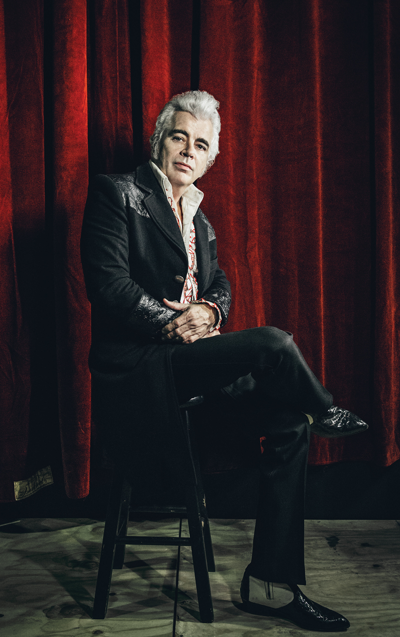
Country outsider Dale Watson has been marching to the beat of his own hillbilly drummer for decades, but it took a few ill-conceived comments by one of country's leading stars for him to finally break with the genre completely. Based on the traditions of honky-tonk, Western swing, rockabilly and outlaw, Watson now calls his kind of music "Ameripolitan."
"It came after that comment Blake Shelton made [in 2013], which is pretty much what the industry thinks," Watson tells the Scene. "He was just saying what they were thinking — nobody wants to listen to their granddad's music, he don't care what them old farts say and you don't have to listen to jackasses. And I think Ray Price had the right response. He said, 'There's not a hat big enough to fit the boy's head, and let's see what his music sounds like in 65 years.' So it was at that point we realized they didn't care about the heritage that they have. They're just throwing it out for anybody to pick up, and by God, we did. Their trash is our treasure."
Heritage is serious business for Watson. You can find it all over his brand-new album, Call Me Insane (produced by famed steel-guitarist Lloyd Maines and showcasing the breadth of his Ameripolitan invention), in his sky-high silver pompadour and in the gigs he books. The Scene caught up with him ahead of his stop at The Station Inn this week.
The Station Inn has its own legendary heritage; do you have fond memories of that place? I gotta tell you, I'll fly in just to see Doyle and Debbie. They're great singers and the show is great, and I love it at The Station Inn. It's just one place you can go in Nashville that is consistently great entertainment.
It's a real no-frills place, which I bet you appreciate, but the neighborhood is growing around it so fast. Yeah, in Austin we have the same problem with condos going up everywhere, and I'm hoping that The Station Inn survives it all. I think it's a connection with old Nashville and very much a roots venue, which is hard to find. I've talked to old musicians, and I've been on sessions with the guys that were here as early as the '50s, and it's tough on them to see all the changes, but there are people who care a lot about keeping the history. And it's not about old guys wanting everything to stay the same, it's about not changing so much that it changes what you're putting out.
Do you feel more comfortable performing in a place like The Station Inn? I'm way more comfortable in a honky-tonk, or a beer joint where people can dance and get loud and not have to worry about being quiet, but I've been playing a lot more theaters over the past few years, and I've learned to tailor a show to that. I don't go by a set list, though, so it really depends on the audience. I don't think my stuff will ever communicate in arenas or bigger places like that because I've got to have feedback from people. I'm pretty happy with where I'm at, and I like playing the smaller venues.
Have you been to many mainstream country concerts lately or watched the awards shows? Does that look like fun to you? I used to watch the awards shows and we'd be on a festival where some of the mainstream acts were there as well, and I'd watch just to keep an informed argument, but since we started Ameripolitan as a genre, I really don't know what country music is doing. I don't even consider myself a country artist anymore. I'm celebrating honky-tonk, Western swing, rockabilly, outlaw — those are the categories I grew up with. So whatever they're doing with country music is their own thing, not mine.
Just yesterday I got my hair cut and people ask you, "What kind of music do you do?" And if I tell them "country music," then by today's definition they're automatically gonna assume Taylor Swift, Jason Aldean, that kind of stuff, and I'm so far removed from that. If they came to a show expecting that, they'd be disappointed and I'd be disappointed, so it was necessity, really.
The new album is called Call Me Insane. Did you try anything new? Well I picked out 30 or 40 songs and gave them to [producer] Lloyd Maines, and I think it's the producer's right to pick the songs to make the album he wants to make, so he picked these certain songs. ... We actually put a horn section on a couple of them, which is something I don't normally do, and it worked out great. I do a honky-tonk swing thing where I blend Dean Martin and Bob Wills' music together with my own, so we used that on the record. But other than that, and thanks to Lloyd, we kept it pretty consistent and made a pretty strong honky-tonk album.
Tell me about the title track: How did that come about? There was a gal that I was sweet on and wanted to be involved with, and she said, "Well, you live in Texas, I don't. And you don't have a good track record." And I said, "Yeah, I guess I'd have to be crazy to try it all again when I'm not very good at it." The definition of insanity is doing the same thing over and over and expecting a different result, so I just applied it to my relationships. That's one of my favorite tunes on the album.
Did you write "Jonesin' for Jones" right after George Jones passed? It was about three days after. I did like most people, break out all the George Jones records and CDs and downloaded what you haven't got, and I got onstage about three days later at the Continental Club in Austin. I mostly write when I'm onstage or when I'm driving, and I told the crowd, "I'll be doing a lot of George Jones tonight, I've been jonesin' for Jones." Right away I thought, "Hey, that's a good idea for a song," so I asked the bass player for a "White Lightning" type riff and we wrote it. Most of the time that turns into a train wreck — probably 90 percent of the time actually.
Email music@nashvillescene.com



