

"I say Mayfly my heart has been down the road and back for you but I am forty eight years old," says Mitch, the protagonist of David Foster Wallace's short story "Everything Is Green." "I got to try to feel how I need to. In me there is needs which you can not even see any more, because there is too many needs in you in the way."
The late Wallace, who died tragically and prematurely in 2008, is of course best known for Infinite Jest, his sprawling, half-million-word novel set in a dystopian land obsessed with drugs, entertainment and advertising. (Some of the novel's early action takes place in the fictional Year of the Depend Adult Undergarment.) But Wallace could be just as powerful and penetrating in a bagatelle like "Everything Is Green," which surveys a world of emotion in just 684 words.
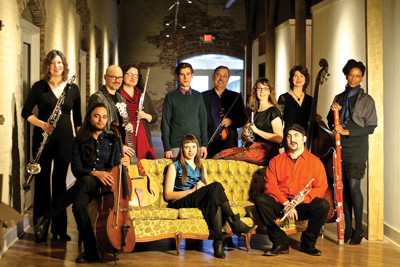
The poignancy of those words inspired the composer Randall Woolf to compose an intimate, deeply felt piece for flute, piano, sampled pedal-steel guitar and electronics, which accompany a pre-recorded narration of Wallace's story. That piece will get its Nashville premiere at abrasiveMedia on Saturday as part of the contemporary group chatterbird's adventurous end-of-the-season program.
Wallace's story is set in a trailer park, where the world-weary Mitch confronts his cheating girlfriend Mayfly. As the flute traces the protagonist's searing emotions, a series of Laurie Anderson-like repeated syllables suggest the presence of Mayfly, who seems to be hopelessly absorbed in her own shallow thoughts.
"This is a bit of a sob story, and Randy beautifully brings it to life," says Celine Thackston, chatterbird's flutist and artistic director. "The country music twang of the pedal-steel guitar gives his piece a real sense of place, and it's exactly the kind of piece chatterbird likes to program."
Founded in 2014, Nashville's newest alt-classical group specializes in works that happily ignore genres, with jazz, rock, hip-hop, avant-garde and country existing in cozy cohabitation with classical music. Chatterbird has a penchant for scores that combine traditional acoustic instruments with electronics. The group has eschewed the stuffy environs of the traditional concert hall, preferring instead bars, lofts, honky-tonks and coffeehouses. It's a practice that has attracted a new generation of listeners.
The millennials who file into abrasiveMedia this weekend will no doubt find much to admire. Ted Hearne's But I Voted for Shirley Chisholm for chamber orchestra and electronics includes sampling from rapper Biz Markie's "Nobody Beats the Biz." And the Dutch avant-pop composer Jacob TV (aka Jacob Ter Veldhuis) mixes soprano saxophone with a postmodern pastoral soundtrack in Garden of Love.
Composer Bryan Clark, however, is going to have some explaining to do before he plays Night Shift. Clark, an electric guitarist who serves as chatterbird's composer-in-residence, has arranged his piece for chamber ensemble and typewriter. Folks born after, say, 1980 may find the latter contraption, used in a bygone century to produce original content in a strangely atavistic, unsharable paper form, to be a real head-scratcher.
"I think Bryan went through some trouble to find just the right kind of old typewriter," says Thackston.
Saturday's program, which will feature matinee and evening performances (3:30 p.m. and 7:30 p.m.), will also include Logan Castro's Sonata for Cello and Piano, Gene Koshinski's Get It!, which is scored for the improbable combination of bassoon and percussion, and Daniel Wohl's Pixelated, which features an equally unlikely arrangement for toy piano, piano, percussion and electronics.
Rounding out the concert will be a commissioned world premiere, Brooke Waggoner's Minor-Born. Waggoner is best known as a Nashville-based singer-songwriter, and she's also served as sidewoman for Jack White. But she is classically trained (she has a degree in music composition and orchestration from Louisiana State University), which made her the perfect choice for a commission from the fusion-minded chatterbird.
Waggoner wrote in her program note that she composed Minor-Born during the frigid days of this past January and February. "I think that season was a perfect one to plunge deep into the psyche of what this work is about — a sadness and stark realization that we are flawed and born into a world of flawed things," Waggoner writes. "Yet our need and dependence on something greater is vital."
Lasting about 10 minutes, Waggoner's piece looks intimidating on paper, thanks to the composer's generous use of polyphonic chords, juxtaposed key signatures and erratic rhythmic elements. But looks in this case are deceiving.
"Brooke's piece is surprisingly tonal and is filled with folk-like simplicity and beauty," says Thackston. "People are going to love it."
Email arts@nashvillescene.com



Post a comment as anonymous
Report
Watch this discussion.
(0) comments
Welcome to the discussion.
Log In
Welcome to the discussion.
Keep it clean. Please avoid obscene, vulgar, lewd, racist or otherwise abusive language. Comments featuring hate speech or threatening or violent content will not be tolerated.
PLEASE TURN OFF YOUR CAPS LOCK.
Be truthful. Don't knowingly lie or mislead.
Be proactive. Use the “report” link on any comment that violates our comment policy.
Share with us. We'd love to hear your feedback.