
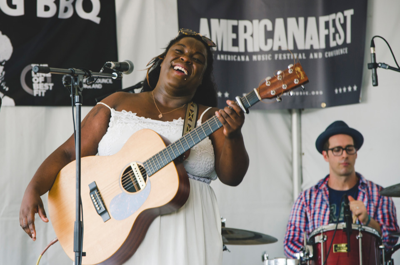


Yola at The Groove during AmericanaFest, 9/16/2017
When you hit play on Yola's debut full-length album Walk Through Fire, it doesn't take long — less than a minute, likely — to realize you're privy to something truly special. Opening track "Faraway Look" is like little else you might expect to hear in contemporary music: Beginning with chiming piano and diaphanous pedal steel, the track builds into an arrangement reminiscent of the Wall of Sound. The chorus lyric that comes at the peak of the glorious crescendo — "That faraway look in your eye / It's getting harder to disguise" — is at once wounded and empowered.
The rest of the album is chock-full of such dizzying, genre-defying gems. In her songs, the U.K.-residing artist charts a difficult period of her life, marked by both a devastating house fire and the end of an abusive relationship. Alongside producer Dan Auerbach (and a murderer's row of guest musicians including Vince Gill and Molly Tuttle), she channels an array of emotions through a meticulously crafted patchwork of ’70s-influenced sounds, spanning the folk-soul of Mavis Staples, the heavenly harmonies of the Everly Brothers, the awesome power of Aretha Franklin, and the classic country and wit of Dolly Parton.
The album is out Friday, and Yola marks its release with two shows in town: an in-store at Grimey's on Friday and a show at Analog at Hutton Hotel on Saturday. In conversation, she's warm, talkative, and quick with a one-liner followed by a hearty laugh. The Scene caught up with her the day after Walk Through Fire debuted via NPR's First Listen series to chat about songwriting, personal epiphanies and the importance of never working with douchebags.
You’re still a week away from your official release date, but the music has been available for folks to stream for a day now. What have the last 24 hours been like for you?
It’s been really exciting to hear how people are connecting to the songs already, like what people are hearing and what emotions are going with it. As a writer, I really want people to feel. In the world, we are low on empathy, so I really want to affect feeling, and for the visceral nature of where I’m coming from to be something that touches people.
I know it's early, but do you have a sense of whether there's a track or two people are particularly connecting to, in that emotional way you mention?
At the moment, we have the bias of having singles out. But people have really been connecting to "Faraway Look." People have been loving that — not just on an aesthetic level, even though aesthetically I think it's a very big part of it — but also just the subject matter. It's a two-pronged thing. You get a "faraway look" when you're checking out of a situation emotionally. But you also get it when you're dreaming about something, or imagining something better for yourself.
Both of those sensations can exist simultaneously: the idea of checking out of your present tense because it's not doing for you what you need it to do, or maybe you're purposely deactivating yourself from feeling every moment of your present situation. … I think the kind of climate we're in right now is one where there are probably quite a lot of faraway looks, a lot of people trying to check out of what's going on.
I think we've reached a point where checking out is, sometimes, a survival tactic.
Yeah, or you can check into a mental asylum. [laughs] Your choice! So people are feeling that one. It's understandable.
Just from listening to the lyrics, I imagined that writing this album could have been a cathartic process for you. Can you tell me a bit about the early stages of the album, and how you began putting these experiences into songs?
I knew that there was going to be this sort of belated break-up record. I'd been in a transition, not just professionally but also emotionally, for quite a long period, trying to build a whole team of people around myself that could help me on the way to living the life I wanted to live. Before you get to that point where you have those people, you're kind of treading water.
On a personal level, I was in this super long [period of being] out of a relationship but not quite ready to be in a relationship mentality, just fixing a lot of damage. That whole process of wanting to write something cathartic was part of the process of mentally reconciling a lot of abuse and gaslighting and stuff that was stifling my creative machine when I started out thinking I needed to be a solo artist. It was important to get to that stage where I could crystallize that sense of transition into a record. … I wrote a song called "It Ain't Easier" on the record. It's got that country kind of sound to it, and that was my present tense. It kind of still is. … It's a record of epiphanies, basically. And it did start with that idea of “It isn't easier," and here's a million songs as to why.
I like that idea of a "record of epiphanies." That makes me wonder — did the epiphanies come first and the songs came after, or did the writing itself inspire the epiphanies?
Oh, the epiphanies came first. If I'm too deep in something, I find it hard to write about it until I have a bit of perspective. Maybe that's why I debuted later than in my 20s or something. It's definitely a process to have an epiphany, because then you have to do something about them! People probably talk about this, but probably not enough, but if you want to create a project that's going to have legs and is going to reach people, it's really hard to do that with a complete team of douchebags. You know?
You really need a high-quality team of awesome people who are quality people and great at what they do. That's the hard bit. The conceiving of the song is the easy bit, if you're creative. It's all the stuff you don't do, that's how you hear about it, how everyone consequently hears about this stuff. If I hadn't had that epiphany, if I hadn't figured out that I needed to make some personnel changes in my life, those changes led me to being in touch with you and everyone else.
Speaking of high quality people, it seems like you found a real kindred spirit in Dan Auerbach, and that you guys were really able to forge a special creative connection. What was it like getting to work together? What do you think it is about the two of you together that seems to work so well?
I think a bit part of why we were so prolific — and we were: We tracked 18 songs, but we wrote in the neighborhood of 30. This wasn't a long writing period. It was two writing blocks, probably three or four days each, tops. We were productive in that time. I still live in Bristol [U.K.] and traveled over to be in the studio. We produced a lot of music.
We started on a mutual love of the Everly Brothers, but I think where we wound up was being very passionate about an era of music and being eclectic within that era. Like, I'm a ’90s kid, so I grew up on Sheryl Crow and Beck and Björk and stuff like that, and loads of pop music, of course, so hip-hop and R&B. But also classic country music. Dolly and Aretha. Mavis [Staples], who wedges herself very comfortably in the middle of folk and soul. That was the stuff I was growing up on.
It dawned on me as I grew up that a lot of the stuff I like existed between ’67 and ’73. Sonically, that specific period motivated me. I think Dan's a similar kind of person in his particular era of fascination. Not only that, but I suppose being very eclectic within that era in taste meant we were going into writing — both not wanting to go in with too strong of a preconception as to what we were going to do, but not putting any pressure on all of that being in any one song. It was important to feel that we could create something that felt like an amalgamation of all the things we loved, as opposed to feeling hemmed in by genre.
You mentioned how people have gravitated to "Faraway Look," and I'll definitely count myself among them. I keep going back to that track. You've touched on the lyrics, but just the arrangement and the sounds on that song really knocked me flat. Can you tell me a little about that song in particular, and how you worked out what it would sound like?
When it comes to the production side, that's definitely Dan's domain. I was very aware of not wanting to deliver vocally, in a way, what felt like too much for a big song. My voice can go too much. [laughs] There's a real "sky's the limit" possibility with intensity and volume. Even on a big song like that, you have to be so nuanced, so aware of what you're saying. You're thinking about every time you're saying a word. You wrote that word and you have to understand why you chose that word, and then deliver it like that. So from my standpoint I have to be super aware of being sensitive to delivering a song like that.
I think it's very easy to sing that song wrong, and just blast through it and for it to sound kind of odd. It benefits from sensitivity and connection. As far as the production goes, outside of the conception of what we wanted to achieve and how we wanted things to be delivered, Dan's the master of that. I was more than happy to throw my hands up in the air and go: "My hands are off this when it comes to production. You, my dear, are the producer. Go ahead, do you, boo." He's very good at making things sound pretty. You may have noticed.
It also must have been special, too, to have so many musicians with so much experience come together to lend their talents to songs you've written.
It's about as validating as it's going to get! A lot of these songs were co-written, granted, but what is also really satisfying is that there's a song I wrote all by myself. There's no dip in quality or, "Oh, there's the dud," or anything. I was just interested to see whether a song that I wrote on my own could stand up in comparison to my collaborative self, writing with the "legends," as it were. I never thought I'd be in the room with the man that wrote "Do Right Woman" [Dan Penn]. He was like, "Oh yeah, Aretha!" Like he can just reference that person, like it's someone he's going to bump into. It's all so casual. That entire process was fiercely validating.
You mentioned earlier that you were making your way back and forth from Bristol to Nashville for the recording sessions. I know you spent some time prior to making this album playing in the U.K., like your work with Massive Attack. But so far, how have the two experiences compared? How does it compare playing and making music in the United States to what you were used to before?
Well, it seems very different. Maybe not the experience of the United States so much as just Nashville itself. It's a city that lives, survives, thrives on its production of music. I don't know if there are many places in the world you can go where music is taken so seriously. … There are a number of times you're in a different place on tour and you talk about being in music, and their assumption is that you must be failing, because music is really hard and you're not one of the three people they've ever heard of. It's not seen as a real job or taken desperately seriously; it's more like some cute hobby.
When you're here, specifically when you're in Nashville, you say to, I don't know, someone at Macy's, "Oh, I'm in music" — it's like you told someone you're a doctor, or a lawyer or something. They assume it's going really great for you. There's no where else in the world you could tell someone you're a musician and they'll assume things are going great for you. That's not a thing that happens. Everyone else goes, "Oh. Poor you."



