
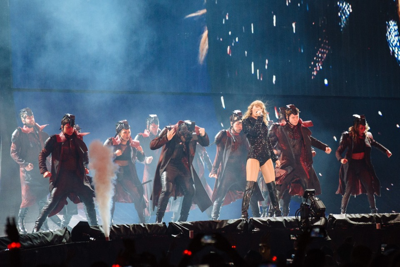


Taylor Swift at Nissan Stadium, 8/25/2018
Following a year that included robust commercial performance for her album Reputation, a highly successful world tour for which she pulled out all the stops and a noteworthy increase in her use of her platform to speak out on social and political issues, Taylor Swift has announced a major business move. Per a post on her Instagram this morning, the pop star has left Nashville enterprise Big Machine Label Group, with which Swift has been working since the beginning of her career, and inked a deal with Universal Media Group and its Republic Records label.
As my Nashville Post colleague Geert De Lombaerde points out, Swift praises Big Machine chief Scott Borchetta and his team for their support through a decade-and-a-half of growth and change, during which she altered course from mainstream country to pop. She also expresses her excitement for building on her professional relationship with UMG CEO Lucian Grainge and Republic founder and CEO Monte Lipman, who already had an alliance in place with Big Machine.
The move to UMG/Republic makes sense from the perspective of artistic alignment, as the label works with Ariana Grande, Lorde and The Weeknd among many others (some are signed to Republic, while others’ labels have distribution deals with Republic). Big Machine’s other big names include Reba McEntire and Florida Georgia Line. According to sources who spoke with Billboard, multiple entities (including UMG) are considering purchasing Big Machine, which retains the rights to Swift's first six albums.
Swift’s post also mentions that her new contract includes two key provisions. First is ownership of master recordings that she makes as part of the multi-album deal. The second is an agreement, which she says “meant more to me than any other deal point,” that any proceeds from the sale of shares that UMG holds in Spotify will be distributed among the label’s artists.
The streaming service became a publicly traded company in April with an initial valuation of just under $30 billion. Swift removed her music from the platform in 2014, but reinstated her catalog in 2017. Artists who don’t operate at the level of Taylor Swift (or higher — though she posted a substantial rating equivalent to 769,000 albums sold, streamed and downloaded in Nielsen's mid-year report, she was not among the top 10 artists ranked by on-demand streams) tend to make very little money from streaming royalties, but fairer compensation for artists from streaming platforms is among the goals of the Music Modernization Act, which was signed into law in October.



Post a comment as anonymous
Report
Watch this discussion.
(0) comments
Welcome to the discussion.
Log In
Welcome to the discussion.
Keep it clean. Please avoid obscene, vulgar, lewd, racist or otherwise abusive language. Comments featuring hate speech or threatening or violent content will not be tolerated.
PLEASE TURN OFF YOUR CAPS LOCK.
Be truthful. Don't knowingly lie or mislead.
Be proactive. Use the “report” link on any comment that violates our comment policy.
Share with us. We'd love to hear your feedback.