
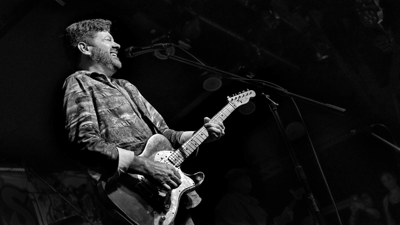


Ace Louisiana guitarist-vocalist-bandleader Tab Benoit has long championed an assertive, highly individualistic sound that's deeply rooted in the regional influences he loves, yet also has consistently resonated with national audiences. The son of a musician, Benoit's been a fierce guitarist and powerful singer since he was a teenager the 1980s. At that time, he began jamming with Louisiana blues heroes like Tabby Thomas, Raful Neal and Henry Gray at Tabby’s Blues Box, a nightclub and cultural center that Thomas opened in Baton Rouge.
Since that time, Benoit has blossomed into a major blues star, and an outspoken advocate for preservation of the wetlands of his home state. His voice has a husky, very soulful quality, helping him to deliver any type of blues from swamp to Delta to electric Chicago styles, as well as more intense rock-tinged fare.
His continued environmental efforts for the wetlands have led to some classic recording dates, most notably Wetlands in 2002, and a pair of celebrated LPs featuring the all-star ensemble known as The Voice of the Wetlands All-Stars. An array of incredible Louisiana musicians — including fellow singer, songwriter and bandleader Anders Osborne and Meters members Cyril Neville and George Porter Jr. — joined him not only for these recordings, but periodic tours as well.
After years of recording for other labels, Benoit co-founded one of his own, Whiskey Bayou Records, whose roster includes Eric McFadden, Damon Fowler, Eric Johanson, Jeff McCarty and Dash Rip Rock. Big plans for 2020 were derailed by COVID-19, but Benoit is cautiously launching a socially distanced winter tour on Friday at the Ryman, where rising blues champion Samantha Fish will support. A limited audience will be able to watch in person, but you’ll be able to stream the show as well — see the Ryman’s website for details on ticketing and coronavirus precautions.
Benoit recently took a few minutes off from preparation to discuss the tour with the Scene via phone.
How does it feel to finally be back on the road? Is this your longest layoff ever?
Without a doubt. We had all kinds of things planned — European tour, the whole works. And then the pandemic hit and boom, all that's gone. I'm used to being on the road most of the year, sometimes more than 200 shows. Now I've kind of become an expert at carpentry and home repair. But sure, I've missed most performing in front of an audience. That is really what drives me, playing live — much more than in the studio.
What made you choose the Ryman as a destination to launch the tour?
Well, it's certainly one of the great places for any musician to appear. It's the Mother Church of Country Music, but it's also a fantastic place to play, and Nashville's one of the nation's premier music cities. When we were putting this together we had to look for locations where we could go via bus, because trying to put anything together right now with planes and airports is very dicey and almost impossible logistically. Then, we thought about what places would be able to handle doing the kind of show we wanted while also having the COVID-19 protocols in place. Finally, it became, “What venues are even having shows at the present time?” The Ryman was ideal in every way.
Of course we're also hoping we can be part of helping to bring live music back so far as touring and concerts. None of us out here ever anticipated the kind of hit that we're taking in terms of clubs, live acts, tours, the whole business. It's been devastating, and we also recognize that we're only part of the greater disaster that the virus has caused to the country. If we can do some successful shows, give people something else to enjoy and think about, then we've done our job. This is a time when we need live music more than ever, to express things and help people get some joy and pleasure in the midst of these really hard times.
Have you worked with Samantha Fish before? Why did you choose her as an opening act?
That one's easy. She's fantastic. We've followed her career and heard her and she's really one of the really special performers and artists out there today. I couldn't think of anyone better to do the type of show that we want this to be, and she's going to be so great on this tour. If there's people out there who haven't heard her or don't know who she is, you are in for a treat. Those who do already know how fantastic her music sounds and what a great performer she is.
After making all sorts of outstanding records for different labels, you decided to go into the label business yourself. You also play the role of producer. How does it feel being a part of that end of the business?
Number one, I'm not a businessman or an executive. But for many years I've heard artists talk about how they don't get to make the kind of records they want to make for whatever reason. Much of the time it was due to constraints or situations involving their label. I just finally decided I wanted to kind of specialize in making records that came as close to capturing my live sound as possible. I've never been much of a studio guy anyhow. I've always been more like, “OK, let's line up and play it like there's an audience, only the audience is the mics and engineers.” So that's how I approached that part of it.
As far as the production part goes, it's really more about me making sure that the musicians on the label are comfortable, and again, that we're coming as close as we can to replicating a live performance. The acts that are on the label are all people I really admire, and people whose music I greatly respect. My goal is to make certain that whatever we release is true to the spirit of the artist and their music. That's way more important than any concern over things like sales, radio airplay, whatever.
Not that I'm opposed to that. Who wouldn't want to sell a lot of records? But I'm not putting that ahead of doing the kind of records I'm proud of and the people on the label are proud of as well.
You've performed with large bands and small groups. Do you have a stylistic preference?
Not necessarily, but much of the large band stuff has been the Wetlands projects. I'm most concerned in any situation with what's the best way to communicate, what am I trying to say with this song, and how do I get it to work in whatever setting or configuration that we're working in or with.



