
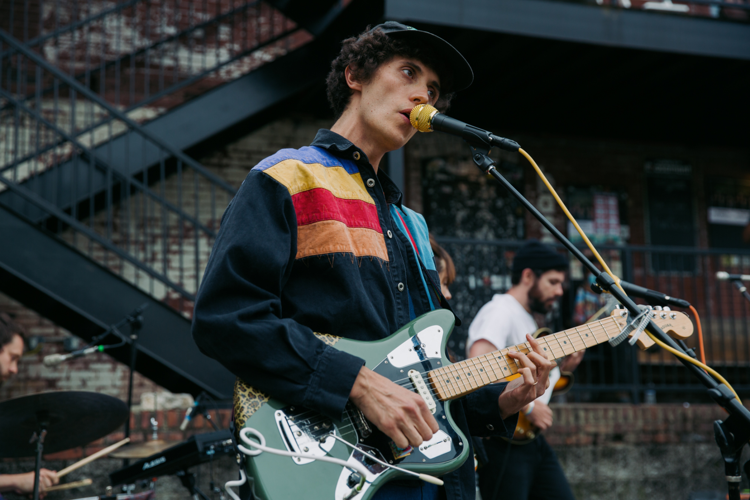
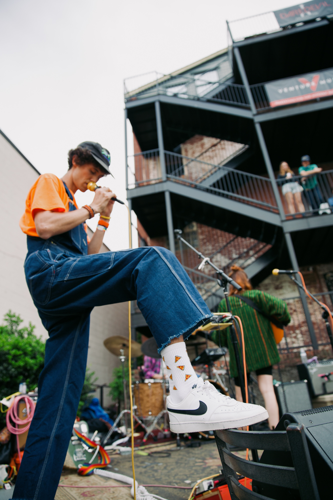


Ron Gallo outside The Basement, 5/15/2021
When we last caught up with thoughtful songwriter and dynamic rock ’n’ roll frontman Ron Gallo in early 2021, he was just about to release Peacemeal. It is an album-length reflection on strange and difficult times he encountered — even before COVID turned most people’s lives inside out. Gallo gave Scene contributor Charlie Zaillian the full background, but the highlights include Gallo and fellow musician Chiara D’Anzieri getting married in her native Italy in 2019; because of visa issues, Gallo was barred from the country and forced to return to his then-home in Nashville shortly thereafter, where he wrote and recorded most of Peacemeal all by himself. Ultimately, D’Anzieri joined him here and made some contributions to that album as well. But by the time of its release in early 2021, they’d pulled up stakes and settled in Philadelphia, where Gallo grew up and spent the early part of his career before coming to Nashville circa 2015.
Though the pandemic isn’t over, the quarantine phase is fading into memory. Meanwhile, all manner of serious issues have been exacerbated, while others that have been there for a long time have taken a prominent place in the public discourse. While it’s a good thing that more people are paying attention to major social, political and economic problems — and the underlying systemic issues that are ultimately responsible for many of them — the stress can be overwhelming. These are some of the concerns driving Gallo’s new LP Foreground Music — his first for Kill Rock Stars — which features D’Anzieri and drummer Josh Friedman. Gall is also about to publish his first book; titled Social Meteor, it’s a kind of behind-the-scenes look into his brain, a peek at the thoughts he cataloged as he wrote the songs that became Foreground Music.
Gallo’s tour will bring him back to Nashville, where he’ll play Tuesday, April 11, at The Basement East, with support from The Weird Sisters and John Roseboro. Ahead of the show, I caught up with Gallo by phone. Our interview has been edited for length and clarity.
You and Chiara have been back in Philadelphia for a couple of years now. Have you been able to spend some time there between tour dates? What’s it like?
I'm from Philly, so I'm sort of used to what Philadelphia is. And then the move from Nashville was a bit impulsive. You know, it was pandemic-brain, and feeling isolated and far from family. So it was just sort of impulsive — gravitate towards comforts. But now that the dust is settled a bit, we're kind of like, “Philadelphia, I forgot what Philadelphia is.” You know, it's a chaotic, dirty, gritty, angry city. And it's just funny: Coming back here, I think it played a huge role in making this new album. I don't know if I could have made this album anywhere else. I think maybe we’re missing Nashville a bit. [Laughs] …
It gets very real, very fast here, and I like that about it. But I also think that, you know, everyone's a little bit on-edge here. And I think what that did was — it kind of got me back to the place that I originally started making music from, which is a pretty frustrated-with-humanity observational stance on the things that I think we — as a collective humanity — are kind of struggling with. So being here feels [like] that, for sure. This is where I lived when I made the first album Heavy Meta — I feel like this is almost a full-circle moment, because I'm back to that creative space. I think it's more difficult to live in, but maybe it makes for a better contribution creatively. … When you're more comfortable, and you're in your little bubble, it's hard to sometimes see some of those things.
Over the past decade or so, it got progressively easier to insulate yourself in that social bubble. But then there’s been COVID, amid many other major things going on since the pandemic started, that have broken those bubbles open a bit for some folks.
Of course. And it's interesting too, because Nashville is having no shortage of, you know, hugely infuriating issues politically and socially right now. And when I think of Nashville, it's like, you think of it as a nice, kind, warm place, but to see these things happening there — it's just, it's crazy. But I guess that's the state of the world. [Editor’s note: We spoke April 4, after the Covenant School shooting but before Republicans in the state House of Representatives ousted two of the three members it sought to expel for leading anti-gun protests.]
Turning to the record: Foreground Music is more of a collaborative effort than Peacemeal. Were there some things that you carried over from working mostly by yourself on that previous album?
The biggest thing was just a little bit of self-belief, which I'd lacked before in terms of recording. I always came from a standpoint of: “I need other people to make a convincing recording, I don't even trust myself at all.” And Peacemeal is the beginning of, like: “No, I can do this. I can record stuff at home, I can produce stuff at home. I'll learn, I'm gonna teach myself. And I have plenty of time to do it.” And then with this record, it was great to be able to do that again, with a little bit more confidence in it and like a little bit more skill.
One of the thematic threads running through Foreground Music is the havoc wrought by capitalism and commercialism. In “San Benedetto,” you visit a place in Italy where it seems like they’ve got their priorities figured out. Yet you didn’t just drop out and move there — you’re singing to us about it. Has making music become a natural part of the way you process and explore ideas?
Definitely — I mean, using it therapeutically. Especially with everything going on, and just my own internal general state of anxiety and fear and all these things that are rooted in things happening in the outside world. The way that it all feels, sometimes — life in 2023 with constant connection, hearing about all the insane shit that’s going on all the time. And then, like, being able to step back and process that —music has been the biggest thing to be able to make sense of it all.
With that song specifically, it comes from being able to spend time over in Italy, which I've been very fortunate to be able to do because of Chiara. And basically just seeing the impact of going there and experiencing that lifestyle, that culture, the way that people live — you know, a much bigger general sense of peace that's not driven by the insane, capitalistic, constant burnout of productivity. Like, seeing a place that is structured in a different way. And then, coming back here, it just is like: “Whoa, we are doing shit all wrong. Because I was just over here, and I saw the way these people are doing it. And then I came back, and it makes us just look like a bunch of psychos — just spiraling in to complete crumble.” [Getting] that perspective, to shine a light on what it is to live in America, I guess. Something about becoming aware of it, it’s eye-opening.
I think it's kind of like what we were saying earlier: Seeing it gives you a way to start to work through it. That's what this record is all about, is pointing out all the shit that I think is fucked up and frustrating and putting it out there. … And then that is a way to, like, deal with it better, or find a way to laugh at it.
Another theme that stands out in Foreground Music is the sort of dance we do with nostalgia. Buying into it wholeheartedly, always looking backward, is something you do at your peril. But also, as you sing about in “Yucca Valley Marshalls,” memories can be comforting in times of cosmic-scale loneliness.
I guess that is the dance. … It's so weird. I don't know if it's just me and, like, there's something wrong with me. But it's just interesting to have. Like, for example, today: It's a beautiful day. It's the first sign of spring in Philly, the sun's out and it’s warm. And then you could just, like, see something really fucked-up walking down the street. Or just have an intrusive thought or an anxious thought. It's just so funny — they're like, these two completely different things that are always right there, at all times.

Ron Gallo outside The Basement, 5/15/2021
It’s all part of the process of trying to live on Earth.
Which no one knows how to do, I guess. There's no guidebook. … It's a mystery.
Is there a point when you see yourself doing something that isn’t music?
It's actually something that I've thought a lot about. … For a long time, it was like tunnel vision on music. But one big thing is, I just finished my first book, and I printed it. And I actually have it in boxes downstairs, and I'm gonna bring it on tour. And something about holding the book in my hand — when I got them a week ago, it was kind of a revelation. Like, “Whoa, I've made albums before and held them, but this is kind of a different thing.” When I was working on doing some of the writing for it, I felt a joy around that kind of work that maybe music [gives me] sometimes, but hasn't been that way in a while. So the long-form answer to the question is that I'm pretty excited about having a book, and I want to make a lot more of them. This one, it specifically coincides with the record, but I'm pretty pumped on having that outlet as well. … And with music — I don't know, I mean, give it five more years now, and I'll just disappear, maybe.
And who knows, if you do decide to disappear from the music world for a while, whatever you do might then inspire you to make more music.
It can always change. I think ultimately it's just about going with whatever feels good. From a musical standpoint, to get back on tour … there's just something about that, that doesn't really match anything else. Especially when you get into rooms with people, you're like, “Ah, this is why we do this. This is worth all of the shit that you have to go through.” You know, when you have those moments with people in a room, and it's just, “Yes.” So that's enough to keep you going. I think. As long as people show up.





Post a comment as anonymous
Report
Watch this discussion.
(0) comments
Welcome to the discussion.
Log In
Welcome to the discussion.
Keep it clean. Please avoid obscene, vulgar, lewd, racist or otherwise abusive language. Comments featuring hate speech or threatening or violent content will not be tolerated.
PLEASE TURN OFF YOUR CAPS LOCK.
Be truthful. Don't knowingly lie or mislead.
Be proactive. Use the “report” link on any comment that violates our comment policy.
Share with us. We'd love to hear your feedback.