
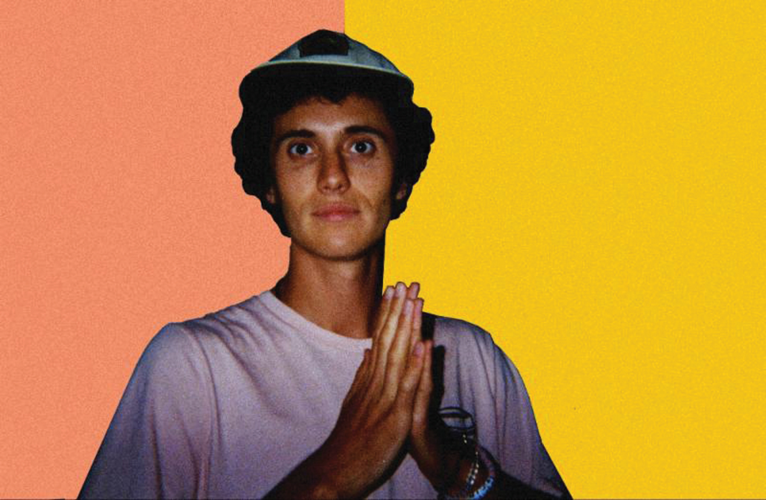



On the endless path to self-enlightenment, Ron Gallo pauses to make a record. Stardust Birthday Party, out Oct. 5 via New West Records, is an album of nervy garage-indebted rock that teems with energy as Gallo addresses his transformation of consciousness, if you want to get into the tenets of Buddhism. On Stardust, a record that the 30-year-old Gallo says “is as much about everyone else” as it is about himself, the musician urges listeners to shed their “old conditioning” and work together to create a more compassionate world. Talking with Gallo at High Garden Tea under a canopy of neatly placed dried plant matter, the Scene gathers the details of Stardust Birthday Party.
“The most important thing is what inspired the material,” says Gallo. “It’s about a pretty heavy shift that I’ve gone through these last few years, which stems from some larger life occurrences.”
Rewind three years to when Gallo was living in Philadelphia with his then-girlfriend, who was struggling with mental health and drug-related issues. Combine two years of a toxic relationship with 10 long years living in Philly and one deep frustration with humanity, and you get a very broken Ron Gallo. That’s the man you hear on his 2017 record Heavy Meta, on tracks like “Young Lady You’re Scaring Me” and “Put the Kids to Bed.”
One morning, the relationship suddenly ended, and the two cut off contact for a year. She went to a holistic treatment center in Guatemala, and he was left alone in their old apartment. But he didn’t stay for long. “For the first time in my life, I felt truly on my own,” says Gallo. “I thought, ‘It’s time to go.’ So I left everything behind and moved here.”
If you move to Nashville for personal or professional reasons, you’ll probably find out pretty quickly that this city won’t offer any magical solutions to your problems. (Gallo’s EP Really Nice Guys, released in January, looks at this in relation to the music business.) He cites his move as a positive step, but says that talking with his ex-girlfriend after her treatment is what really inspired him to look inward. What did he find? Blaming the world for his unhappiness was easier than taking responsibility for his own actions and thoughts. But it wasn’t solving anything.
“If you don’t like your life, look at yourself,” says Gallo. “Stop looking at everyone else. No one can really make you feel the way you do, or act the way that you’re acting. Get control of your shit.”
He says thorough self-examination is the first step in overhauling a negative perspective. Dissolving his old angry outlook in favor of a more self-aware and compassionate worldview, Gallo strikes a gentler chord with Stardust than he did with Heavy Meta. “This record is my realization that it’s all about perspective,” he says. “My internal situation is always going to be reflected on the outside.”
On the first side of Stardust, Gallo stages a raucous self-confrontation. The track “Do You Love Your Company?” asks pointed questions: “When you drink with yourself / Self-help book on the couch / Do you love your company?” On the slow-burning “ ‘You’ Are the Problem,” Gallo suggests his audience take ownership of their bad nights and breakdowns, singing: “If you wake up feeling awful / Look to the night before / If you can’t remember who else was there / Look to the one that was there for sure.”

Ron Gallo at Bonnaroo 2018
Jabbing at our tender egos, he urges us to dig deeper into our minds and destroy the negative self-constructs that keep us from engaging with the world around us. As Gallo sees it, accepting yourself ultimately leads to being more compassionate toward everyone else. If we accept ourselves as simply human, we might start treating each other as such.
“Do good to yourself and get yourself right,” says Gallo. “You will start to see that maybe the world is not all that bad. There’s actually a lot of beauty in the world, and it’s right here all the time.”
This part of Gallo’s ideology is manifested in “Love Supreme (Work Together!),” a ’70s-inspired art-funk banger that nods at John Coltrane. Projecting his vision of a world united under the common goal of compassion and inclusivity, Gallo leads a choir of voices in singing, “God loves it when we work together.”
Where he used to offer deep and intense criticism, the new Gallo celebrates humanity for its oneness. “Fear, frustration, anxiety, bliss, happiness, joy, love, hate … you need to remember that all this shit lives in all of us at all times,” he says. “We are all capable of everything. Compassion is accepting that anyone that acts in an evil way is not doing it because they are evil, but because of their own internal pain.”
On the record’s downtempo finale, “Happy Deathday,” Gallo wishes his listeners a “happy deathday to everything you know.” The “deathday” doesn’t represent an ending, however.
“It is an endless path to untangle yourself from all the trauma in your life,” says Gallo. “But sometimes, you have these times where you get a glimpse of what’s possible in your life. I’m all about sharing that now.”



