
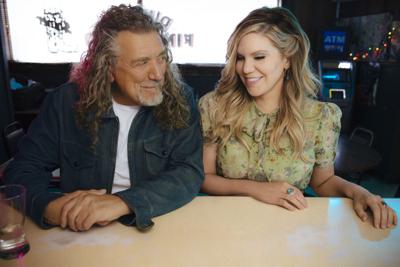


When Alison Krauss and Robert Plant released their second album Raise the Roof in November, it had been 14 years since the pair electrified the music world with their first collaboration — the platinum-selling, double Grammy-wining Raising Sand. Plant and Krauss hadn’t intended to wait that long to record a follow-up to Raising Sand, but because of their successful solo careers, that’s how long it took. When they finally did return to Sound Emporium Studios in 2019, the magic was still there.
With producer T Bone Burnett back at the helm, Plant and Krauss again were joined by the core of musicians who backed them on Raising Sand: multi-instrumentalist Marc Ribot, bassist Dennis Crouch and drummer Jay Bellerose. To broaden their sound, they brought in some additional musicians during the sessions, including Krauss’ brother and bassist Viktor Krauss, guitarists Buddy Miller, Bill Frisell and Colin Linden, pedal-steel man Russell Pahl, multi-instrumentalist Stuart Duncan, accordion player Jeff Taylor and Los Lobos’ multi-instrumentalist David Hidalgo. Ribot, Crouch, Bellerose, Duncan and Viktor Krauss are all part of the pair’s touring band. JD McPherson, who opens many shows on Krauss and Plant’s tour, also joins them on guitar during their set.
The record was close to being completed at the end of 2019, but production delays due to the pandemic pushed back the release date by more than a year. Plant and Krauss embarked on a tour in support of Raise the Roof at the beginning of June, including a stop at Bonnaroo. The tour returns to the Nashville area Wednesday with a show at FirstBank Amphitheater. Speaking by phone with the Scene from Denver last week, the duo discussed the making of their new album and what their fans can expect at Wednesday’s show.
First, congratulations on another highly successful collaboration. Are you surprised that 14 years after Raising Sand people have responded to the music in the way they have?
Robert Plant: Well, to be honest with you, we don’t really have a window [into] how it’s really doing. In the old days, you put a record out, and there would be the normal knee-jerk responses of radio and media stuff. There’s been good critique. … When we play every night, we play a lot of the new stuff, and it’s received well. But you can bet that 80 percent of the people most likely have never heard it, you know. But what we’re most proud of is that we’ve actually taken the songs and developed them into something quite a little bit more exciting live-wise, I think. And it feels really good.
The new album speaks to the undeniable musical chemistry that the two of you have. But if I remember correctly, you didn't initially know if it would work. Can you remind the Scene's readers how you first came together a decade and a half ago?
Alison Krauss: Sure. Somebody had shared some of my records with Robert. And then he invited me to come do something with him at the [Rock and Roll] Hall of Fame, when they were inducting Leadbelly into the Hall of Fame. And we played up there, and that was fun. We had a lot in common as far as where songs came from. I know the Stanley Brothers’ version of a Leadbelly song and things like that. [Laughs.] And it was very interesting to hear Robert talk about what he knew about bluegrass music, too. I can’t remember how long after that he said: “You know, let’s go in the studio together. If it works, then that’ll be great.” But he goes, “If it doesn’t, we’ll say goodbye until the next time.”
RP: Ha!
AK: I remember talking to my manager at the time, and I said, “I don’t want to produce it,” and Robert said, “I don’t want to produce it." And so we talked about T Bone, and that just seemed like a natural fit, and it ended up being that. So everything just kind of aligned and was one big surprise. There weren't any expectations of how anything would end up or or what we would do with it. So everything was just icing on the cake, really.
RP: And from my angle — coming from the U.K. and coming from what you would think would be a radically different music form — we did have so many places where we had common appreciation. … So we would stumble upon these songs together, and they were already part of the core of music that we loved. It’s just that they were being transposed differently by different cultures.
So I think we’ve got a lot in common and just playing up there with Odetta and Harry Belafonte and Gatemouth Brown — I mean, we were in great company, and it set a precedent as to how we should present the music. With Alison’s prowess as a player and singer, and me coming from this other place, it looked like it was going to be some fire and brimstone, which there kind of is in a beautiful way.
Regarding the new album, how were the arranging decisions made? Is that something that developed organically in the studio with the players? Or are you and T Bone mapping that out in advance?
AK: It’s pretty natural. Usually, we’re listening to a recording of us sitting around singing it. Then Jay kind of starts figuring out what he’s going to do, and it pretty much falls into place. … They’re never over-arranged or arranged meticulously.
RP: And that way you can actually get to the root of it pretty quick. And that is the personality of the whole project.
Once the process got under way, how many songs did you consider before narrowing it down to the dozen that you included? Did you record more than a dozen and some not make the cut?
RP: We toyed with other ones, with other pieces of music, but I think we were looking for a weave between the songs, if you like; a pathway through, an empathy between the various forms that we created. So we knew what we’d got when we got it, and that was enough. No point in elaborating. We knew we’d got the weave. So that’s enough. Don’t do any more.
Unlike Raising Sand, which was all covers, Raise the Roof includes one original, “High and Lonesome,” which you and T Bone wrote, Robert. How did that song come about?
RP: Well, T Bone’s still slightly querulous as to how he was involved in it. I said to him, “We did a good job.” He said, “We did? I thought you did it all.” I said, “No, no, no. You created that riff.” … There was a minute between things where T Bone had a really great old baritone guitar around his neck, and started playing a riff, and I had these lyrics I carry around with me — so boom, there it was.
Checking out some of your set lists online, it looks like you're doing about eight songs from the new album and four songs from Raising Sand, and then a few Led Zeppelin covers and a Ray Charles cover. Is that what people in Nashville can expect at the First Bank show Wednesday?
AK: We may move it around. [Laughs.]
Since it's kind of a homecoming show, will you be having some special guests?
RP: No. I mean, there may be special guests somewhere wandering around, but the stage is set. It’s what it is. It’s very difficult. I’ve seen some of my contemporaries get up and play a solo that lasts 20 minutes, and that’s just not what this is about. This is all-consuming.
After a second successful record, do you think you might get together and do this again in, like, 2034, 2035?
RP: Well. [Laughs.] Geez, I’d like to think we could do it a little bit earlier than that because I’m starting to get a bit decrepit now. [Krauss laughs in the background.] I don’t know how many afternoon naps you have to have in a day when you get to that time of life. But no, we’ve got loads and loads of songs spinning around in the air in our ambition. … So if we’re able to, and we continue to have a really lovely time together, I’m sure that we won’t have to wait until I’m 86 or something.



