
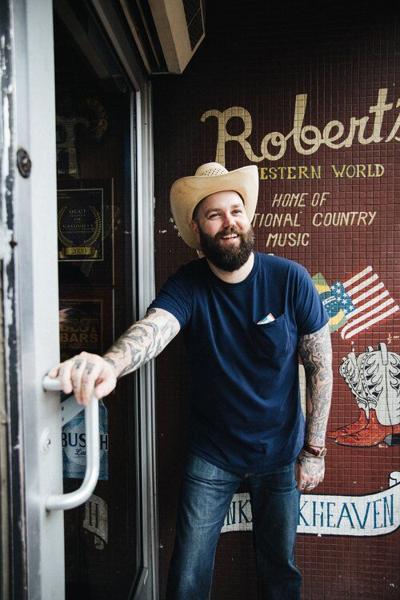


With the release of his 2018 debut album Mr. Jukebox, Joshua Hedley — a top-notch musician familiar to patrons of much-loved honky-tonk Robert’s Western World — emerged as one of country music’s most-buzzed-about new voices. He channeled the sound championed by the hitmakers of the 1950s and ’60s into his own material, attracting country fans who wanted an alternative to the pop-leaning production found at the top of contemporary charts.
Hedley took his time crafting a follow-up, but his new LP Neon Blue is out on Friday via New West Records; you can preorder or pre-save it via this handy link. On the new album, Hedley takes a deep dive into another of the genre's most beloved and pivotal eras: the ’90s. The project came about as Hedley opened new chapters in several different areas of his life, and he drew inspiration from a different kind of nostalgia. Ahead of his record release show on Wednesday, April 20, at Eastside Bowl — Megg Farrell opens, and advance tix are available for $15 — we talked with the seasoned performer about taking new creative risks, the evolution of Lower Broadway and how to define “real country music.”
Neon Blue has a very different sound and vibe than your debut record, Mr. Jukebox. What made you take a different approach?
Mr. Jukebox is such a bummer of a record. I like it, but the songs are so fucking sad. I just felt like after the last couple years that we've all had collectively — the craziest of our lifetimes — I wanted to put out something fun and something that made people feel good.
The sound of Mr. Jukebox was heavily anchored in country music from the 1950s and ’60s. Your new record reaches back to the neo-traditional sound from the early 1990s. What motivated that sonic shift for you?
It all kind of started when Joe Diffie died. I started listening to a deep dive of his catalog and it kind of spread out into the rest of that era from there. It just made me feel good and took me back to a more carefree time in my life when I was a kid. I wasn't worried about how I was gonna pay my truck payment or when I was gonna get to work again. If you look at who listens to my music and who buys my records, it's mainly people my age. And so I figured, if this is making me feel this kind of way, I bet everybody feels that when they hear this kind of music.
What prompted you to start working on a second album?
I didn't really think that I was going to do another record. I thought Mr. Jukebox was kind of a one-and-done situation, and I'm back downtown performing, that's fine. When New West approached me to put out an album, I was immediately like, “Hell yeah!” But then I realized I didn't have any songs ready.
How did you get inspired to start working on new music?
I got hooked up with this guy named Carson Chamberlain, who was Keith Whitley's steel guitarist for his entire career, and then he tour-managed Alan Jackson during the ’90s. He wrote a couple of hits during that time too, like “Love's Got a Hold On You” for Jackson and “The Best Day” for George Strait. We hooked up to do some co-writing and just clicked. He brought in Zach Top and Wyatt McCubbin, and I would come to them with an idea, and we would just sit down and write it. That process was mind blowing to me because I've never done a proper Nashville co-write like that.
What was that experience like? Was it way different than how you write on your own?
The people who write songs like that on Music Row are insane. I've never seen anything like it — their brain works on, like, a whole other plane. They just spit out these incredible songs like it's nothing. And when you have three good writers in a room, it's impossible to not write a song. I don't think any song on this record took longer than 30 minutes to write.
You brought back Skylar Wilson and Jordan Lehning, who worked on Mr. Jukebox, to produce Neon Blue. What was your thought process when you went into the studio?
I knew I wanted to let them produce me without too much of my own input on that part of it. Once we were in the studio I had ideas, but prior to that in the pre-production stage, I was just like, “You guys can just go. Just do your thing.” They put together this band of session players who are the same people who are playing on a lot of the Top 40 radio stuff right now. It was like the same deal as writing the songs. I just gave them a work tape that was just vocal and acoustic and they listened to it. They looked at the chart, made some notes and went in and just laid down the track. It's wild to watch those folks work. The whole making of this record was a completely new experience.
Are you ready to get back to touring regularly?
I want to get out there. I've been stuck at home since before the pandemic, just chilling and working downtown. I did SXSW this year and after the first couple of shows, I was like, “Man, why does this feel so foreign and weird?” And then I realized that I haven't played outside of a 10 mile radius of my house in two years.
You've performed at Robert's regularly for years, so you've had a front row seat to how much downtown has changed. How different is it now compared to five or 10 years ago?
Robert's is and will always be the same. It's like a bachelorette repellent. They come in there and go, “What the hell is this?” We're not playing Blink-182. I kind of live in a bubble, but I'm also 37 years old. You could not pay me to go down there on a Friday or Saturday night. It feels like the vibe has changed down there. It used to be, people came to Nashville, and specifically to Lower Broadway, to hear country music. Now it just seems like people think it's like Bourbon Street.
What are the biggest differences when it comes to performing your own show versus a set on Broadway?
I'm used to playing downtown and being the background noise for people's good times. That's what most of my life has been. It's strange to have to talk about the songs more than just, you know, “Here's a Merle Haggard song.”
The new record has so many great originals, but you chose to end with a cover of Roger Miller's “River in the Rain.” What made you add that to the track list?
There used to be a door guy at Robert's named Brett Marker. … I once saw him slap a man in the face with his own flip flop. He was a badass. But he always used to ask me to cover that song and I never learned it. When I was thinking about what cover to put on the record, I thought about him, and Roger Miller is one of my favorite writers ever. I feel like most people know him for his humorous or demented songs, but he wrote about a lot of serious subject matter, too. I put a lot of thought into what cover would make the album, and it came down to either that one or “The Sweetest Thing” by Juice Newton. But “River in the Rain” fit my vocal range more.
In your song “Country & Western” you mention being called an “Americana troubadour.” How do you feel about being put under the label of Americana versus country music?
When I released Mr. Jukebox, no one had ever written about me before, and the first thing I noticed was people's aversion to calling it country music. I have no beef with Americana or anything, but I think when you take these genres — like country music, folk, blues, Cajun and this and that, and you group 'em all together into one thing called Americana, it takes their identity away and erases some of like the history of those genres.
If you listen to The Carter Family and you listen to Ronnie Milsap, they don't sound like the same music at all. But both of those things are still called country music. So I don't know why Luke Bryan can put out what he puts out and can I put out my music, why both of those things can't be also called country. I play country music. You can call it whatever you feel like calling it. But at the end of the day, I'm going to call it country music because that's what it is.





Post a comment as anonymous
Report
Watch this discussion.
(0) comments
Welcome to the discussion.
Log In
Welcome to the discussion.
Keep it clean. Please avoid obscene, vulgar, lewd, racist or otherwise abusive language. Comments featuring hate speech or threatening or violent content will not be tolerated.
PLEASE TURN OFF YOUR CAPS LOCK.
Be truthful. Don't knowingly lie or mislead.
Be proactive. Use the “report” link on any comment that violates our comment policy.
Share with us. We'd love to hear your feedback.