
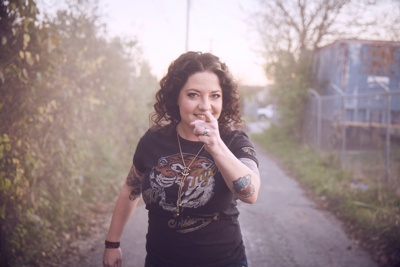


Ashley McBryde's debut album Girl Going Nowhere, released March 30, is one of the year's most potent country statements. Like fellow fantastic-damn-songwriters (who also don’t seem to be able to get through the thick skulls of dumbass radio programmers) Brandy Clark and Angaleena Presley, McBryde writes smart, compassionate story-songs about small town life and big time dreams. Though she's been trying to make it as a musician for 11 years now, McBryde is still, to many, a "new" artist. With major accomplishments like appearing on the Grand Ole Opry, a feature in the New York Times and touring with acts like Little Big Town, her status as a new face is already giving way to that of a favorite.
The Scene caught up with McBryde the morning after she played the famed Red Rocks Amphitheatre in Morrison, Co., with Little Big Town and The Brummies. She's set to play Marathon Music Works Thursday night with Dee White opening.
Let’s start with some good news you got recently — Garth Brooks plans to include his take on your song “Girl Goin’ Nowhere” on his upcoming live album. Tell me about how that came together.
The first time I heard from Mr. Garth was a text message. You know how iPhones do — like if you text me, it would say “Maybe Brittney” — and I get this text from “Maybe Garth.” It said, “Ms. Ashley, is this the correct contact information for you?” He says, “It’s Garth Brooks.” I was at the Q Prime [artist management] office and I laid in the floor laughing, thinking, “This joker thinks they can trick me into thinking they’re Garth Brooks.”
But I said yes, and he asked if he could call the next day. He called me and he said, “Hey, I wanna talk to you about a couple of songs, ‘Bible and a .44’ and ‘Girl Goin’ Nowhere.’ I wanna know who you wrote them with, and where you were in your life when you did it. I really love those songs.”
We talked for a little bit, and he’s gotta be one of the nicest humans on earth. He wanted to know all about my family and my parents. A few months later, somebody sent me a video of him in Tacoma [performing his version, which he retitled “Boy Going Nowhere”]. I texted him and told him thank you for covering that song. I love it and it means a lot to me, but it means something different to everyone who hears it — and so many more people were hearing it when Garth was doing it. What really matters is that messages like that get out there. He’s such a huge champion and a huge mouthpiece for positivity. It’s been really humbling and it’s still weird. I saved his number as “Maybe Garth” in my phone.
I saw, too, that you recently got to perform at the ACM Honors. I’m wondering what it meant to you to get to honor Matraca Berg, but also, too, to get to be part of one of the bigger mainstream country-sanctioned events that happens each year.
I really didn’t know the difference between ACM Honors or smaller awards shows. But when I got the phone call that I was going to be able to honor Matraca Berg, that was huge to me. I was like, “Whoever decides that, how did they know I’m a huge Matraca Berg fan?” When I was 23, I think, it was my birthday and I was making plans to move to Nashville. There was another songwriter — I was living in Memphis — at my birthday and she gave me this card and she said she wanted to give me something that has meant the most to her. After I read the card, she handed me a very used Matraca Berg CD. It was her favorite record ever and I just bawled.
Soon after I moved to Nashville, that same songwriter called me and said, "Matraca Berg is playing at the Hall of Fame today. We have to go.” So we went. She said one of the most important sentences that I would hear in my young songwriting years: “Say whatever you want in the verses. Give them a chorus they can sing to.” I never forgot that. I got a signed Matraca Berg Hatch Show Print poster that day. “Wrong Side of Memphis” played a huge role for me because I was a ’90s kid. The songs of that era had a huge hand in forming what I would write like. Then I got the phone call that I was going to be able to perform, number one, at an awards show, and two, to honor Matraca. I got to meet her and hug her neck. That was full circle, especially in a place like the Ryman. That was priceless.
You get to meet and honor one of your heroes, and you’re chatting it up with Garth and have had all kinds of accomplishments over the last year or two — everyone dreams about that kind of thing. But did you ever anticipate that this is how things would turn out after you released your debut album?
I moved to Nashville to write songs and hopefully to be an artist. I was going to be performing whether I was an artist on a label or not. I love to make stuff up and then present it. So after doing bars for 11 years and doing it so frequently that I didn’t get to spend a lot of time at home, getting a publishing deal and being able to stay home was something I worked toward.
Then I made this record with Jay Joyce, and I’m so proud of it and my management team is so wonderful, and it seems like I’m putting eggs in their basket and getting chickens back. It’s all based on keeping your head down and doing the work. Don’t drink your own bathwater. Good music is good music, period, and it finds its home. Then we found a home at Warner where they don’t try to change the record or anything. It’s a little bit surreal, because this is why I came to Music City. The chances of things going well for any artist are really, really slim. And here it is after 11 years.
I did say, at first, how lucky I am to be doing what I’m doing. I’m not lucky. I am fortunate that I have the work ethic and the stubbornness and maybe even the naiveté to just keep going and just keep doing it. We won a battle of the bands at the Goats Music and More Festival — I’m not sure what more there is than goats and music — and we got to open for Johnny Lee and the Urban Cowboy Band.
He asked me over to his bus and he came down with his scotch in his hand and said, “I wanna tell you something. I watched you play tonight and you’ve got the bug. Try to do this for the rest of your life. If you never make it big, nobody’s going to care. But I tell you one thing. If you quit before the day you die, it’ll matter to you the rest of your life.”
Given that you’ve been playing live for years now, what has it been like to now have the opportunity to tour around to this wider audience, and go to other cities and have people sing your lyrics back to you?
Some people dream of a big house and a white picket fence. And some people dream of being the CEO of a large company. For people like me, it’s having people sing your lyrics back to you on a stage. I’ve said before, I’m so glad that that feeling doesn’t come in a pill or a bottle because I would be just trash. I’m glad you can only access that feeling in little moments on a stage in person with folks. It’s like falling a little bit in love every night.
You have Dee White on the road out with you on this tour. He’s fantastic. How did you guys get connected, and what are you looking forward to about getting to play some shows with him?
I was at the office at Q Prime. I guess they would be called meetings for other people but I love to just go in and sit and talk to everybody. I’m always asking if there’s anything new they’re working on. John Peets said, “Dan Auerbach has started working with this kid. He’s 19 years old, from Slapout, Alabama. Check him out.”
And I was like, “Wow, it’s like Roy Orbison and Dwight Yoakam had a kid, this is amazing!” Then Dan asked if I’d come sing a duet with Dee. When we decided to do this tour, they said, “Why don’t you consider taking Dee?” He’s 21, he has more shows under his belt, he has a killer band. He’s like me when I was out with Jon Pardi way back in the day. He’s soaking it all in, changing something every night and honing it every night. It’s super cool to be the chick that gets to watch him do that.
It must be really meaningful to get to headline your own tour, too.
Oh, absolutely. Even just picking out rugs for the stage — I’m like, “I get a say in what the stage looks like?” [laughs]
I know, too, you’ve gotten to do some festivals, and I read recently that you were the only woman on the bill at this year’s Red, White and Boom Festival. With the conversation that’s been happening in recent years round women’s representation in music, how have you grappled with the gender disparity?
I stopped trying to make sense of it. I believe that if you have something to say, then say it loud. And if you want an opportunity, then raise your hand. I’ve always lived that way. So I’ve stopped trying to make sense of this whole lack of chick representation, because we do have something to say and we say it rather well and we do seek opportunity and do raise our hand.
It was on this tour, the first week I was in the club on a sold-out night. I didn’t realize how butthurt I am about this whole thing until I called my manager and I said, “Hey man, I’m in the venue right now and I’m looking at the posters of upcoming shows and every single poster is up except for my show. Every single poster on the wall is men headlining. I’d like you to call the promoter and find out why the hell there are no women on the wall. It’s not freaking fair.” He calls me back and he’s like, “Hey, I just wanted you to know I talked to them and your show sold out so fast that they didn’t need to put a poster on the wall.” Oh, sit down, Ashley, and be quiet.
That’s a fair question, though.
It is a fair question. Even if I was a fan looking around the venue and I’m like, “I know women play here. Why are there only men on the wall?”
I’ve run into it at radio. Radio is another thing I’m learning in real-time how to adjust to. I didn’t realize it had so little to do with music. It broke my heart when I found out how things work, but that’s how things work. This is the machine I want to run alongside. I’ll do whatever I got to do, whether I’m on the chart or not.
I didn’t know coming into this, but the women of this industry are so of the mindset that we get farther together. Everybody embraces each other’s music. And it’s pretty vastly different across the board. When my record came out it was the same day Kacey Musgraves’ record came out, and there were people putting on Instagram: “Kacey Musgraves or Ashley McBryde?” Apples and oranges. [Musgraves’ Golden Hour] is a great record, and I listened to it the whole way through the second it came out. And we are more likely to buy each other a drink sometime than to ever pit ourselves against each other.
But man, being the only chick in a three-day festival? There are so many great female artists right now. How am I the only one that was on the ticket? It’s ridiculous.
It seems like, despite the odds being against you by the very fact that you’re a woman, that you’ve found a way to sell out shows and land in the New York Times anyway.
Yeah, all we can do is write good songs, perform them well and put together shows people like to see. And that’s enough. I want to play on the boys’ baseball team, but none of that really matters. What matters is being there for fans and putting on a good show.
To that point about writing songs, I know it’s only been six months since the album came out, but I imagine it’s been much longer since those songs were actually written. Have you started thinking about or working on anything new yet?
We started choosing songs for the second record the week after the first record was done. We had a huge pile of songs that we felt deserved to be considered for the next record. Then I was still writing all year. This year, I went from writing five days a week to writing one day a month. Once you get in the writing room, it’s either everything is pent up and ready to come out or you’re just going to write complete garbage. That’s what I’m adjusting to right now. But I’m going to take some time off — five or six weeks — because writing with road-brain is impossible.
So you have your tour and time off on the horizon, but is there anything else between now and the end of the year that you’re looking forward to?
I have some writes coming up the rest of this year that I’m really excited about. Jennifer Wayne from Runaway June hollered at me and I can’t wait to write with her. And Laura Veltz, who wrote “I Could Use a Love Song” with Maren [Morris]. And then Matraca Berg asked to write. So that’s huge.



