
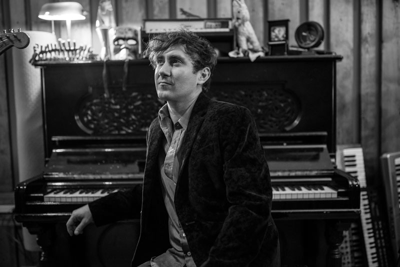
"Why can't there be a Moog solo at the end of a country song?" wonders Erik Deutsch. The jazz pianist delves into that confounding question on his new album, Outlaw Jazz, and clearly he has the qualifications to ask. Deutsch forged a career as a sideman backing the likes of Norah Jones, Antony and the Johnsons, Citizen Cope, Charlie Hunter, Nels Cline and others. But he's also worked with country artists like Rosanne Cash and Shooter Jennings. On Outlaw Jazz, Deutsch takes the psychedelic soul-jazz sound of his previous two albums and points it toward Music City.
Deutsch grew up mostly in Washington, D.C., but he spent four pivotal grade-school years in Nashville. While attending Ensworth School he befriended a young Shooter Jennings, who was a friend and classmate of his younger brother. Deutsch remembers going to Waylon Jennings and Jessi Colter's house. Those childhood memories left a lasting imprint.
"One major moment for me," he recalls, "was when my brother's whole kindergarten class from Ensworth was asked to be a part of a PBS kind of TV show production. It was from the Performing Arts Center and we went there as a family to watch the taping. It included Willie Nelson, Johnny Cash, Kris Kristofferson, Dolly Parton and Brenda Lee. That was probably in... 1983 [or] '84? That'll always be burned into my memory."
Deutsch reconnected with Jennings in New York City in 2011, when he assembled the country crooner's touring band, played on two of his records and hit the road for what would become an informal crash course in country music.
"It's not like I was completely separate from country by the time I hooked up with Shooter again," Deutsch explains, "but we'd spend all day listening to it on the bus."
Deutsch admits he's being playful with the outlaw-country reference he's making in the album title, but he's serious about applying country harmonies and rhythms to a jazz framework.
"It's actually not much of a stretch between the harmony and rhythms of the two," he explains. "But it might sound that way because we're long separated from the time where a swing beat defined jazz music." Reintroducing country swing to jazz, Deutsch says, actually came quite naturally. "I specifically studied some records," he continues, "like Waylon Jennings, and borrowed beats from them." The lead-off single, a cover of the Shel Silverstein-penned "Whistlers and Jugglers," features the younger Jennings singing lead on a tune his father cut on 1978's I've Always Been Crazy. Fittingly, Deutsch and Jennings slowed the tune down and aimed for a decidedly more brooding kind of vibe.
Mostly, though, Deutsch and company keep a spring in their step, like on the Dixieland-infused "Pickle" and the rollicking "Dearest Darling" — an up-tempo, horn-driven number bound to get audiences on their feet and twirling in the aisles. The song also features the sparkling lead vocals of Victoria Reed, who graces the band's Nashville appearances this week with her sultry pipes and charismatic presence. As a longtime sideman, Deutsch understands the value of letting his lieutenants shine.
"I was just listening to a podcast with Kobe Bryant," he says. "That guy's such a lone wolf. That's not me. I'm a collaborator."
That thirst for collaboration motivated Deutsch to sign with Cumberland Brothers Music — the Nashville indie label founded by his fellow Ensworth alums Nick Worley and Chenault and Jake Sanders.
"What I've been missing all these years," says Deutsch, "is a sense of community. So Cumberland Brothers just made sense."
In very concrete terms, Deutsch's lingering affinity for his local roots is what got him to this point in his career. Describing his rapport with Jennings, Deutsch laughs and says, "It feels kind of the same talking to him now as it did in grade school. Of course, he's got a lot of hair now, so he looks a lot different. But that's what's funny about the Nashville connection. Almost everyone at Ensworth was from a Nashville family. There weren't that many transplants, so I was an exception. But my mom was a Nashvillian. She went to school with most of my friends' moms. So even though I only lived there from kindergarten to fourth grade, whenever I'm back, I run into people I grew up with, and everybody seems the same. And everybody remembers everybody too."



