
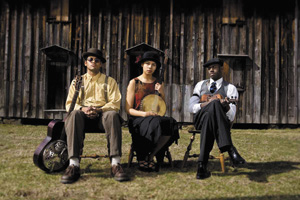
A raw, high-stepping fiddle kicks off the Carolina Chocolate Drops' version of the traditional gospel tune "Starry Crown," conjuring a sound that could have pealed through an Appalachian holler in 1868 or a Cajun dance in 1918. Such a sound could have been expected in those settings. In 2008, though, a dancing fiddle set against a hard, unrefined banjo strum is an anomaly relegated to folk festivals and old-time music gatherings.
The Carolina Chocolate Drops would like to change that perception. Even amid a string-music revival, with several young bands building reputations playing unamplified and drum-less music, the Chocolate Drops stand out for how primal and close-to-the-source they sound.
But see them live or listen to their latest album, Dona Got a Ramblin' Mind, and it's clear they are no museum piece. The music is too visceral to value merely for what it discloses about another time. This trio from Chapel Hill, N.C., may keep their ears attuned to the echoes of the ages, but their hearts are fixed on convincing listeners that their music belongs to the future, too.
The Carolina Chocolate Drops are an anomaly for another reason, too. Nearly all current string bands are white. The three black members of the Chocolate Drops serve as a reminder that string music has a multicultural past. The banjo, of course, first traveled to America on African slave ships, and up until World War II, black fiddlers and banjo players were common.
Rhiannon Giddens, Justin Robinson and Dom Flemons—all multi-instrumentalists who share vocals—are acutely aware of that history. Giddens, a charismatic performer who has studied classical voice, says she was drawn to string music because it connected her with ancestors in ways contemporary music doesn't. "Since I've delved into this aspect of black music, I've learned more about my history than I ever expected," she explains. "It is home to me."
She met her partners at Appalachian State University, an institution steeped in folk studies. Giddens helped start an organization, Black Banjo Then and Now, where she met Robinson, a thrilling folk fiddler. Flemons, an acoustic guitarist drawn to folk and blues, traveled from Arizona to participate in an Appalachian State music festival. From the first impromptu jam session, the three felt an immediate kinship.
They spent a year studying with fiddler Joe Thompson, now 90 years old and one of the last living black fiddlers. Thompson's style is rooted in Piedmont folk music, a lively style built on banjo and fiddle. The band's name also has old-school ties: It comes from a Depression Era black string band, the Tennessee Chocolate Drops.
Many young string-band players make the mistake of re-creating old-time music too carefully or, conversely, bang it out with a wild abandon that disregards technique. The Chocolate Drops avoid both traps. The trio show plenty of talent, but it's the tightness and ferocity of their interplay that gives them an animated spirit that overly academic or sloppier bands can't sustain.
They step outside the Piedmont style at times, as in the jug-band stomp of "Ol' Corn Likker," the folk chant of "Tom Dula" and the a cappella work on "Another Man Done Gone." Each is a welcome diversion, and, in typical Chocolate Drops fashion, they manage to take those familiar songs and perform them in a manner unlike the thousands of previous versions.
In the long run, the sources of their music matter only after they put their bows and picks down. When they're kicking up their heels on "Little Margaret" and "Old Cat Died," they rouse a musical ruckus as danceable as any bass-thumping club hit. And when a crowd starts shaking it together, genre boxes get booted out of the way.



