
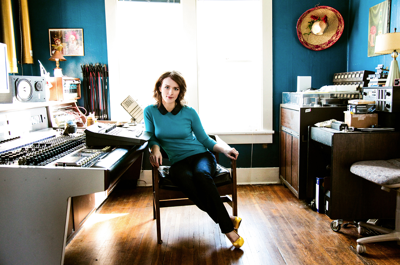


Laura Cantrell
Nashville-born New Yorker Laura Cantrell released No Way There From Here via Thrift Shop Recordings last week, and
it's an evocative, finely crafted record full of smart songwriting and subtlely compounding instrumental layers. It was recorded with Mark Nevers at the Beech House studio and features the talents of, among others, Caitlin Rose, William Tyler, Paul Niehaus, Jim "Americana is whatever Jim Lauderdale says it is" Lauderdale, Kenny Vaughan, Michael Cerveris and Paul Burch. Last week, Cantrell talked to the Scene about the recording process, her love of country music, collaborators and the influence of Nashville on her New York state of mind. This interview has been edited some for length and clarity, but not that much.
Cantrell plays two Nashville dates: an in-store tomorrow (Feb. 7) at 6 p.m. at Grimey's, and a show at 7 p.m. Saturday (Feb. 8) at The Basement.
Could you talk a little about how this record came about, and how you started working on it?
Well, the Kitty Wells record [2011's Kitty Wells Dresses] was my first experience recording in Nashville. Clearly, I've, y'know, had pals recording there for many many years ... so that was something that I've kinda always had on my to-do list, but living in New York I hadn't really come up with the right opportunity for it before the Kitty Wells record, and I really loved that experience. It was just ... a combination of a nice laid-back vibe at Beech House and openness to things that are country in origin, maybe, but can also go off in their own weird directions. ... I thought from that record — it was one of my favorite things I'd ever made, and I really wanted to come back and work in that atmosphere again, but I knew bringing my own original tunes would be a different kind of experience, just because they were going to need different instrumentation, and more space to just figure out what kind of recordings they should be.
But I also knew from Nevers' history, and his experience with a lot of different artists, that he was comfortable going through that process with people, and adding in his talent for finding sounds that suit what you're doing and taking elements that, again — some can be country and some aren't — and I think about the Lambchop records with pedal steel and vibes on them and how cool that sounded when I first heard it, and how unusual and atmospheric; it took these kind of country sounds and elements and just did different things with them. I just loved that he knew how to do that with a variety of different instruments and players in the community in Nashville that he works with, and I felt very confident that we could figure it out. So, that was why I wanted to come back.
But it's one thing to bring Kitty Wells' music; it's very defined in people's minds as to what it is, what the style is and what it should be. My mission with that record was just to do it justice and not mess it up too much, you know? [laughs] With my own songs, it was a bit more of a journey of figuring out, what really should this sound like?
Is there a particular song on the record you feel took the longest journey from ... where you started with it to how it wound up on the album?
"Driving Down Your Street," when I brought it in, it was a simple two-beat, train beat kind of song. ... Sometimes when you assemble a room of musicians together and just play it out straight, the elements kind of fall into what you're all used to hearing, so — "Oh, it's a train beat, that's great for a pedal steel solo, and let's put the fiddle on here," and you can kind of get pretty far into defining the sound of the song without ever even second-guessing, like, "Is that really what it should be?" [laughs]
And just from a weird happenstance, I ... took my basic tracks of that back to New York, and was fiddling around with them and realized I wanted to sing it in a different key. So we ended up just keeping the drum track and layering out all the stringed instruments, starting with a new guitar part that was in the key I wanted to sing in. And when we did that, I was like, "Wow, this sounds much cooler than what we sort of started with" — this template that, you know, could've been an Emmylou copy [laughs]. ... You know, when we started messing around with it, I was like, "Wow, it sounds really cool without the bass on it at all, what else could we do with it?"We've got lots of different kinds of percussion on it that took it out of sounding like straightforward train beat, and messed with all of that.
You know, it's funny: I can hear it, and I know it's different and it's not your standard little alt-country song in that regard. Some people when they hear it might just hear a little country song [laughs]. But to me, I felt like we were able to mess around with the elements in a satisfying way that made it something that both referred to country music that I love but also felt like something more original, too.
You use that term, "alt-country"; a few years ago this publication ran a review of one of your albums that called it an "impressive piece of alt-country," and went on to say, "unlike many Americana artists attempting country. ... " How do you see view those terms, and how they get used?
I'm someone who does like country music, so I'm not ashamed to use that term, but I think there are some people in the Americana world who aren't comfortable with 'country' for whatever reason, and I understand why that might be. And then, you know, they like something broader that references country stuff ... there' a lot of terms that have been ... batted around, and I don't think... I don't pay attention to them that much. Ten years ago, everyone was talking about alt-country, now it's Americana. Next, who knows? But I do think Americana is a great catch-all term for things that aren't alt-country. You know, things that could be blues and folk and other strains of American music. That makes more sense, I think.
You mentioned music that makes country references and allowed a little more room to experiment. Do you feel like that's what you were going for, and were able to get, on this record?
Yeah, I felt like I was able to let my songs determine the sound. When you make a few records, you realize that something you tried to do the first time you made a record might feel like a really obvious choice, a few times in, so I wanted to have the instrumentation be a bit evolved from what I've done before, so we ended up using more keyboards and piano and horn parts here and there, as well as the things people might expect — pedal steel and fiddle and upright bass. So, I think the palette's broadened a bit, and that certainly came from an impulse to do something I hadn't done before. Not so much trying to bust out of one genre or another, but just trying to expand my own experience.
Was that reflected at all in the choice of co-writers on this record? Or was that not a conscious choice, but who you were working with at the time?
Well, you know, because it's been a while since I made a record with my own original music on it ... I wouldn't say that I set about picking collaborators thinking about making a record, because it was pretty spread out — I had songs that I worked on shortly after the birth of my daughter, in 2006, 2007; I had worked with my friend Amy Allison on the Kitty Wells record ... and she's co-written a few of the songs on this album as well. I think more so it would be accurate to say I was trying to get to be better as a collaborator and also just as a writer who could finish things [laughs]. I was pretty — precious isn't the right word, but particular about finishing a song, and I had a lot of unfinished songs.
I think when you have a kid, or your schedule changes, you realize, "I don't have time for this." To some degree, working with other people and getting their perspective was really helpful. I think it helped in a couple ways. One it can help to finish work that's already underway. But finishing more work led me to be more decisive when I was writing on my own. Sometimes just clearing the queue of ideas that you have that you haven't finished — if you can get a few of those out of the way and resolved, then it leaves space for new ideas to come up.
I had a lot of that experience when I was working toward having the material ready for a record. Some things, I will say, it was really helpful, I've worked some with a group of friends in New York called the Radio Free Song Club, and in fact when I came to Marky Nevers at the Beech House getting ready to record these songs, I had all these recordings I'd made of the songs in kind of a first-draft version with this group who are basically just songwriters in New York that gather once every couple months, and you bring something you've written recently, and instead of being a writers group where you critique each other's work, you just present it by playing it with a band, and then we record it and share it like a radio show, so it's radio free, because it's a podcast ... but having that kind of community to show up with and test-run the songs with was really useful.
There's a line on the record about listening to an "old Southern song"; do you have a particular song in mind when you're saying that?
Actually, I did write that based on a conversation I'd had with someone after seeing a show. ... A friend of mine here in New York was doing a piece of classical music that was written with lyrics from Death in the Family, the James Agee novel. Words from that novel were taken to make lyrics for a Samuel Barber classical composition, so listening in the concert hall — I had probably read it in college, but I do remember it's about this family in Knoxville in the '20s, and the setting of a little boy remembering this traumatic event that happened in the family, but remembering the time that was broken up by this event. So basically, I'm referring to the "Southern song" in quotes, because I was really thinking of this James Agee passage. But the James Agee novel is a lot about figuring out who you are and where you come from, and what your memories are, how real are they, and all that stuff works into "No Way There From Here." And it's funny, because we'd been playing around a little bit live, because on the record there's like a little reference to 'Hey Jude' but we've been playing around with it live and doing different references
That line kind of struck me — it kind of reminded of some of the vibe in Rosanne Cash's record about revisiting your Southern identity as someone who lives in New York. Was that resonating through there at all? Going back to your childhood in the South?
Yeah, I definitely feel like there was some of that. There were a lot of folks preceding me and Rosanne, who left the South and realized there was something really interesting about it after they were gone [laughs]. That becomes something you can kind of fixate on or romanticize or if you fled form it, you can be anxious about it. For me, my family is still in Nashville, and I have a 7-year-old daughter, and after she was born I started coming to Tennessee more frequently to see Grandma, and so it brought me into contact with that kind of transition back and forth between the there and the here. And ... I just felt like that worked its way into a song. It's maybe in the song it came out sounding kind of sad, but that can also be a source of pride and inspiration and, certainly when I think about how much I've invested in my own interest in country music, it's really a proud thing for me, too. There's many layers to those experiences.
But man, that Rosanne record is so lovely, and the way she traces around her history, her family's history, going down to Arkansas and Muscle Shoals is really cool.
What can we expect for the Nashville shows?
We'll have some of the folks who played and sang on the record come, hopefully. I have Mark Spencer ... as well. They'll all be along. It'll be kind of like a souped-up version.
So there's a chance of reaching Lambchop-like numbers of people onstage?
It won't be that much ... but maybe some more familiar faces — to Nashville folks, at least. I really did enjoy working at Beech House, and hoping it's the first of a few things we can do down there. But I'm proud of this one, and how it came out, so I'm glad the Scene is covering it. Thank you.



