
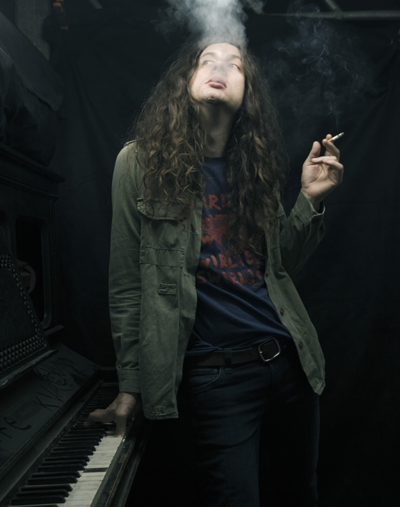


Tomorrow night, Philly psych-folk songster Kurt Vile will headline Marathon Music Works (tickets are still available via this link). The show was initially slated for Marathon's sister club, Exit/In — a room with about one-third the capacity of MMW — but was moved due to demand. As hot-ticket Exit/In shows are wont to do.
If you pick up a copy of tomorrow's dead-tree edition of the Scene, you'll find my feature on Vile, wherein I explore the singer-guitarist's latest record (last year's well-received b'lieve i'm goin down) and more. But why wait until tomorrow when I can give you a little teaser right now? I caught up with Vile by phone a couple of weeks ago just after the completion of some of his Australian tour dates. He was still Down Under, on holiday with his family and jamming with some pretty rad Aussie artists. More on that shortly.
After the jump, see the full transcript of my chat with Kurt Vile — we talked Nashville, stage production, recording, reading your own reviews and much more. Thanks to Scene intern Amy McBrayer for her help with transcription.
So you guys are in Australia at the moment? How’s that been going?
It’s been going good. The tour is over, the band has all gone back, retreated back home. But I’m here with my family on holiday. It’s been great, yeah.
Just taking a minute of time off before you have to return to tour?
Yeah. Totally.
So, your Nashville show’s going to be at a spot called Marathon Music Works. That room’s about three times the size of where you were first booked, Exit/In. It seems like the further you go along you’re playing these bigger and bigger rooms. What’s different for you in playing these larger rooms? Are you changing the approach to anything? Is it any different from when you’re playing smaller clubs?
Do you know what capacity is at Marathon?
It’s 1,500.
Oh, cool. Yeah, we’re definitely always trying to better the set and tighten things up. We’ve gotten, like, the actual musical things more or less together, you know. In the past couple of tours, you know. All the early sold-out crowds had the luxury of watching us essentially play a sold-out rehearsal, you know? [Laughs] Now it’s hopefully a little tighter that way. And we’re definitely thinking of ways to better the stage show all the time, and I’m thinking, at least, about kinda upping the stage show. But more important is the music, you know? So yeah, by the time we get to you it’ll definitely be an oiled-up rock show. I don’t know if we’ll quite get to the pyrotechnics by the time we see you, but we’ll definitely give you our best musical performance we can at the moment, you know?
So I read your interview with Kim Gordon a couple of months ago. One thing you mentioned to her was that the lyrics on the latest record, b’lieve i’m goin down — not necessarily the songs themselves, but the lyrics — are a little bit darker. Do you know why that is? Are you coming from a darker place or is it just a different way of writing these days?
Well, I regretted saying dark, because it’s not quite dark, you know? It’s more like a melancholy, a realistic thing, little bit of everything. But even so, I think that I was at times — songs like “Pretty Pimpin’.” I definitely was feeling — there was some kind of darkness in my brain, some kind of brain fog going on. And I feel better. I feel better now, you know? [Laughs]
Maybe having expressed that stuff helps with it?
Yeah, you gotta exorcise the demons, you know?
One thing I noticed on this record — and it seems like you’ve always kinda done this, but maybe more so here — is that your track lengths were passing five, six minutes here. Is that a conscious decision to explore certain sounds for a longer time and let them unfold organically?
I think that if it feels good to play, to keep going and get lost in it. Like some sort of hypnosis. Not for the sake of it, not for like, art. Not for, like, faux art. I will say, I think I reached a peak with the long songs, or some kind of revelation. You know, some kind of epiphany with the long songs on Wakin’ on a Pretty Daze, that album. Because those songs, like “Wakin’ on a Pretty Day” and “Goldtone” — and maybe a couple others, but mainly those two — they were like basically 10 minutes long. I think I saw that when I was jamming them at the time, I was like, “Well, I’ll just cut parts out.” But it just felt like I didn’t need to. When I heard them back, it didn’t seem necessary. It all felt so good that I didn’t cut parts out. And I think for this record, honestly, I would go long, and we didn’t end up editing stuff out, they were even longer. I feel like I did the long thing, and there’s always gonna be a few long songs, but part of me thinks I might be starting to shorten lately, or thinking that way. But I never know until I start playing. What happens is it feels good to get lost in it and jam out. You decide later if you want to clean that up or not.
I read that you tracked this record at 10 different studios. Is that right?
Yeah, about that, yeah.
Do you like changing it up like that? Do you feel like that gives you creative freedom to try out different stuff? What’s the benefit of that as opposed to digging in at one spot?
Yeah, I’ve gotten used to that, for sure. But also, a lot of it’s logistics. I’ve always been a last-minute person. So to find out who’s actually available, and then logistically, let’s say a gig ends and I go to LA, where I have people I like to play with, and we find out what studio’s available. Same when I go up to New York where my bandmate Rob [Laakso] lives, we see what’s available. Basically, it’s finding out who is around tomorrow or next week, which was a big reach, and I didn’t make big plans on who was gonna [be] a constant producer or something this time. Because a lot of times those people are just more busy. [I didn’t] make a plan pretty far ahead. I just want to not really think about it, so once the inspiration strikes, I just want to be recording tomorrow somewhere. … Honestly, if you book an actual studio months in advance, it means that you’re trying to say, “Oh, on that date, I’m going to be inspired.” It just doesn’t work that way. In general, I was just pretty much recording all the time, after a certain point. But it’s like a domino effect, and inspiration just sort of ricochets, and then you’re like, “OK, well then, let’s get another studio, this one’s available next week.”
So mostly LA and New York though?
I would say for this record it was mostly LA and New York. But Peter Katis in Bridgeport, Conn., he really rescued [the record] at the end. He just mixed it though. But he is sick. I definitely would like to work with him some more some day. Maybe even a little recording. … By that time we were so behind schedule, and the record still needed to be mixed. We started some mixing in LA with Rob Schnapf. He definitely did a good job. We couldn’t finish it all. And we were also mixing really slow there. A lot of it had to do with me just not knowing exactly what I wanted or leaving options open. And then all of a sudden it was like Code Red and we needed somebody on the East Coast to help us finish this. And Peter Katis, he was mixing like two songs a day, and they sound incredible. That’s the way, ideally, I want to work, is quick. It’s easy to overthink every little thing, and just mix the song for days.
Do you tend to pay much attention to critical reception of your records? Do you find it’s sort of better to not read the reviews or the attention, and just stick with what you’re doing? To follow what it is you’re inspired to do?
I definitely read all the reviews at first, and at first it’s exciting. But then it sort of turns my mind into a swamp. Because also today, on message boards or whatever, haters love to talk shit. You read those things, and at first and you laugh, and then they do sink their claws in. So I think I’ve finally reached the point where I feel like every time I have a new record I’m going to read the reviews at first. But I definitely stop reading — there are certain sites where people are notorious [for being] shitty, you know? I think I officially, like, know not to even read them anymore. Unless I want to, but I’ve definitely gotta know a little bit what the general consensus is. And then I think it’s healthy to stop reading after a certain point.
Often you’ll do an LP and then maybe an EP before the next one, kind of back and forth. Do you have any plans to do that sort of thing? I know you’re busy with tour, do you have any plans for what you’re doing now recording-wise?
Well, I’ve done a lot of collaborations, uh, lately. I’m not guaranteeing anything will turn into an actual release. I imagine one day. But I came with that band Endless Boogie right while I was finishing mixing the record, and I want to jam with them a little more. Over here in Australia I’ve been jamming with Mick Turner and Jim White from The Dirty Three, and also Courtney Barnett. So I’m getting real Australian-cultured over here. Just having fun.
But we definitely have tons of material that didn’t make the record. I’m sure we’ll do an EP one day, but it’s fun. I would prefer almost to do an EP. Where my mind’s at now is I would prefer to do an EP, where I just walked into the studio now and laid down some stuff and put it out, as opposed to it going in the archive. I know I’ll do that one day, but at this point I’ve got so much in the archive that — I just don’t have it in my brain, to fix it all up. Kinda get in the past and patch it up and put it out there. I kinda keep thinking forward. Eventually both of those types of scenarios will happen, but I have no idea when.
Have you spent any time in Nashville outside of just coming here for the occasional gig?
No, but it’s funny you mention it, ’cause I’m obsessed with Nashville right now. So I plan to. I plan to come and hang out. … I definitely would love to check out the studios. I worship John Prine, for sure. I read George Jones’ autobiography, and then I read the Tammy Wynette one, just ’cause it was written by the guy [Jimmy McDonough] who did Shakey [the Neil Young biography]. And I’ve been reading this Michael Kosser book, How Nashville Became Music City, USA. … That book’s really good. I know a lot of people in Nashville — well, some people — think the country part overshadows the other part. I don’t know which side of the coin you are on there. And it’s funny too, because I don’t really make country music. But I’m inspired by it. And all the pop music that came out of [Nashville]. I just like the idea. But anyway, I wanna come over there, I wanna soak it in somehow, you know?



