
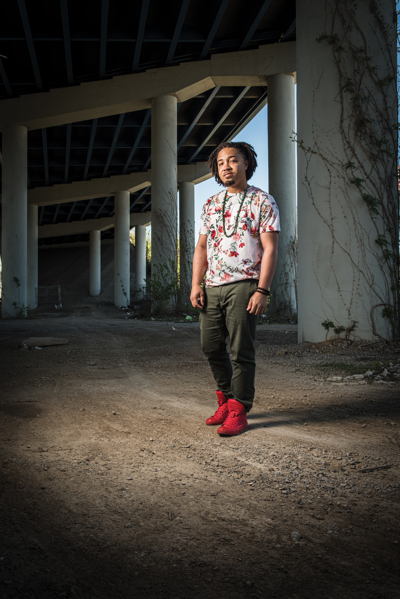

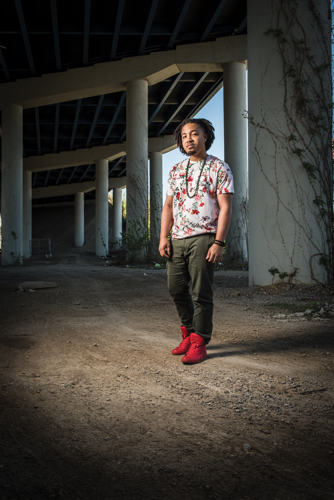
If you ask Virghost when he became a rapper, he won’t tell you about the first time he wrote 16 bars, or even the first time he stepped to a mic. Instead, he’ll tell you about the release of Trial N Error, an hourlong 17-track stunner that dropped in September 2012. The album was actually the MC’s second full-length, but he says it was the one that got people to take notice.
“I was hungry and on my grind because I really wanted to be noticed as a rapper, and you can hear it in the album,” Virghost tells the Scene by phone. “People really started taking me seriously as a rapper, and I started taking myself more seriously too.”
To be clear, people were already taking Virghost seriously, even if not as an MC. Before turning to hip-hop, he was a poet who honed his performance skills as a spoken-word artist in his native Memphis. (He moved to Middle Tennessee a few years back and currently lives in Murfreesboro.) Back then, his material was more conscious in nature, a rhythmic exploration of politics, religion and other goings-on in the world.
“I didn’t see many rappers doing the kind of music [I wanted to],” he says, “but I did see a lot of poets.”
So he took to Memphis stages, transforming from Durand Somerville the poet into Virghost the spoken-word artist, refining his lyrical skills and perfecting his stage presence all the while.
“When you do spoken-word,” Virghost says, “it’s just you and your voice. You’re either going to get your point across or not. With rap, you still need to have a good performance, but you have the beat to kind of complement you. So if you’re not that great of a performer, but you got a good beat, sometimes you may get a pass by the crowd.”
This is the foundation that underscores Virghost the rapper, the confidence that shines on tracks like “Disrespectful” from 2019’s Summer in September III and “Pharaoh” from his June 5 release, Ghost Tape.
For a rapper who cites Jay-Z and Nas as his favorite MCs and credits their 2001 “Takeover” / “Ether” beef as a defining moment in his own artistic development, this bravado is understandable — expected, even. But for every measure of cockiness Virghost displays on record (from “Pharaoh”: “Ooh, man, you niggas in the way though / Had potential at the start, but you lost it O.J. Mayo”), he serves up an equal measure of vulnerability. Now a decade into his career, Virghost’s musings on the external have been replaced by deep introspection, his pen now a pick he uses to mine the details of his own life.
“I talk about a lot of stuff that most artists, I feel, would not feel comfortable saying,” he explains. “I’ve been through a divorce before; I completely talked about that in my music. There was a time when I couldn’t pay my rent; I made a song called ‘Rent Song’ that did really well. There’s stuff that I felt was embarrassing, but to get over that, I just put it out to the public through my music.”
On Ghost Tape, Virghost’s most personal track is “Throwback.” The song, set to a spare, piano-tinged track, is about a man in a struggling romance who’s reminiscing about better days.
“It may sound like a fun song, but it definitely wasn’t fun going through what I was going through at the time,” Virghost says. “It wasn’t super serious, just regular relationship stuff, but I put that in song form because that’s what I was going through at the time. There’s nothing fabricated.”
Virghost wants this openness and authenticity to rub off on his fans — and he hopes they will in turn feel comfortable being themselves in our curated world of online avatars and Photoshopping. He also hopes it will help him take his music to a wider audience.
Though, like other artists, he’s been hampered by the COVID-19 shutdown, Virghost says his No. 1 goal for the foreseeable future is to garner national, if not global, attention with his music. He’s got the team. His crew at Capitol Minds, the label he co-founded, includes two fellow rappers: engineer Joshua Jacob, aka Kxng Klxpsy, and manager Soulman Snipes. And with the release of Ghost Tape, he believes he has the product.
Meanwhile, Virghost goes hard for the local hip-hop scene, hosting a long-running series of showcase concerts called Villematic with an intent to raise the profile of all area hip-hop artists. He counts rappers like Memphis’ Hippy Soul and Omega Forte as well as Chattanooga-born Isaiah Rashad among the region’s best. And he doesn’t believe that a desire for commercial success sullies his image, or anyone else’s. He wants people to know it’s OK to value art and commerce.
“People try to act like if you want to make money off of rap, you're selling out,” Virghost says. “I don’t like that narrative, like you can only be a dope rapper if you’re broke. No. I can be true to myself and still make money.”



Post a comment as anonymous
Report
Watch this discussion.
(0) comments
Welcome to the discussion.
Log In
Welcome to the discussion.
Keep it clean. Please avoid obscene, vulgar, lewd, racist or otherwise abusive language. Comments featuring hate speech or threatening or violent content will not be tolerated.
PLEASE TURN OFF YOUR CAPS LOCK.
Be truthful. Don't knowingly lie or mislead.
Be proactive. Use the “report” link on any comment that violates our comment policy.
Share with us. We'd love to hear your feedback.