


Modern jazz can have a tendency to feel inaccessible to listeners on the outside looking in. This is by no means the fault of its current purveyors. It’s more a product of long-held perceptions of the genre as overly formal, buttoned-up and governed by traditions when compared to punk rock, hip-hop and other idioms younger people gravitate to — despite those genres’ own tendencies toward establishing and adhering to norms.
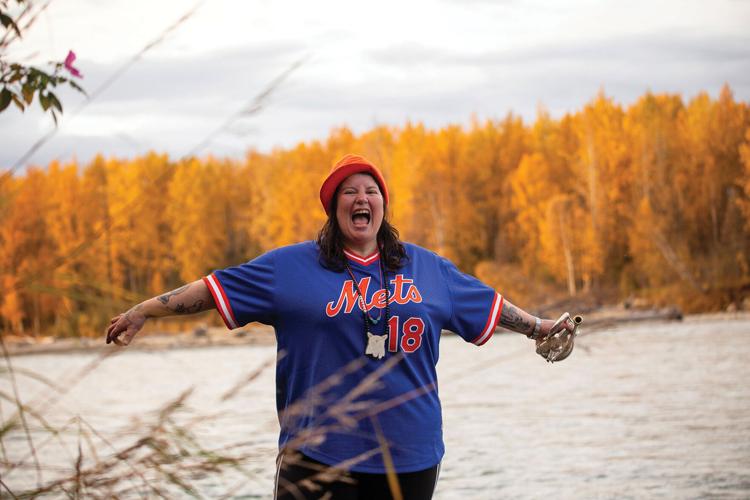
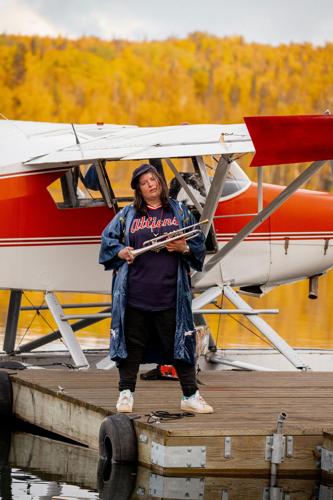
Jaimie Branch is an artist here to explode these and other judgments. The New York-born, Chicago-raised jazz trumpeter extraordinaire — whose go-to stage garb of comfy Adidas tracksuits and vintage White Sox ball caps is more consistent with classic hip-hop than, say, Wynton Marsalis — headlines The Blue Room at Third Man Records on Wednesday. One among a raft of artists gracing Nashville with stand-alone gigs ahead of Big Ears Festival in Knoxville, Branch will be accompanied by a group of co-conspirators known as the Fly or Die band, with Jason Ajemian on bass, Chad Taylor on drums and Lester St. Louis on cello.
They’ll bring to life a project that’s spanned five years and spawned three progressive, politically charged LPs: 2017’s Fly or Die, its 2019 follow-up Fly or Die II: Bird Dogs of Paradise and the 2021 stopgap Fly or Die Live, all issued by Chicago’s International Anthem Recording Co. When the world stopped in March 2020, the band was on the road, with several more months’ worth of dates on the itinerary.
“If COVID hadn’t happened, we definitely wouldn’t have put out that live record,” Branch tells the Scene. “It just wouldn’t have been on our radar — we’d have just been continuing plugging along. I think it’s a really beautiful document, and I’m glad it’s out there in the world. But it was never part of the plan. We had a lot more touring to do on that record.”
As many resourceful musicians did, Branch spent quarantine breaking her own mold, developing what she calls “a deep solo practice.” That meant gaining proficiency at mbira, an African thumb piano that plays a key melodic role in several places on the Fly or Die records. Taylor, who played the instrument on the tracks, gave Branch lessons. “You don’t have to do much — just hit it, and immediately get this beautiful sound back — but it’s very spiritual,” she explains. “It’s worked its way into my solo projects, along with 808 trap beats, stuff like that.”
Branch, who’ll turn 39 this year, has been a known commodity in the experimental-improvisational world since her early 20s. She caught the music bug growing up in suburban Chicago, where her family moved when she was 9, and she developed simultaneous fascinations with Nirvana and Miles Davis. Aside from a detour to Boston to attend the New England Conservatory from 2001 to 2005, and a stint in Baltimore later on, the Windy City served as both Branch’s classroom and playground until she moved back to NYC in 2015.
“Chicago is open in a way that isn’t necessarily the case in other places,” she says. “There’s endless fractal growth — overlapping sorts of styles, and juxtaposition of styles — and a ton of musicians. Even when I was a good 10 years younger than everyone I was playing with, and the only female in the room, there was never any attitude about that. They took me as my playing dictated.”

The Fly or Die trilogy marks a significant first in Branch’s career. Across the records, she puts down the trumpet and — on potent tracks like “Prayer for Amerikkka Pt. 1 & 2” and “Love Song (For Assholes and Clowns)” — sings out against border violence, white supremacy, the prison-industrial complex and other horrors that surround. Even when Branch & Co. aren’t explicitly spelling it out, the music never fails to match the subject matter’s intensity. Throughout its three volumes, the foursome revels in extremes — busy and sparse, aggressive and atmospheric, agitated and relaxed.
When I ask Branch if she thinks contemporary jazz has grown more political in light of recent years’ calamities, I can practically hear her furrowing her brow over the phone. She sets the record straight about how — from jazz to blues, avant-garde, hip-hop and beyond — it’s always been that way.
“You look back and have Max Roach and Abbey Lincoln records happening … The Art Ensemble of Chicago in the ’60s, they were political for sure. They left the U.S. and went to Paris because they weren’t getting the respect they deserved here. And then you have someone like Nina Simone, who was also overtly political, about race especially. What we’re doing is just part of a continuum. I think of music as more a circle than anything linear.”



