
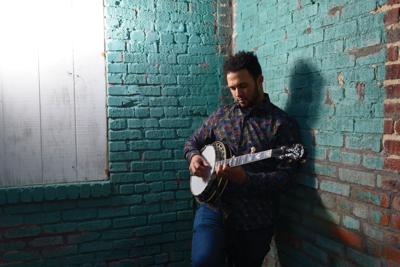

Tray Wellington
Tray Wellington has long been drawn to musical innovations. On his 2022 full-length debut Black Banjo, the virtuoso picker delivered a stellar fusion of jazz and progressive bluegrass. He continued to push the boundaries of banjo music with his 2024 follow-up Detour to the Moon, which features a rootsy cover of Kid Cudi’s “Pursuit of Happiness” — an affirming anthem for an artist who refuses to be boxed into a genre.
“I’ve been a banjo player for a long time,” Wellington tells the Scene. “So for me, no matter what I do musically, that’s going to be a part of it, because it’s such a big part of my early musical identity.”
His latest project Heart on the Table, out Friday, blends R&B and hip-hop production with three-finger banjo and rap. Wellington co-produced with fiddle wiz and fellow Nashvillian John Mailander, and he says he was influenced by his grandfather’s classic country records, the R&B and hip-hop his mom had on repeat as he was growing up, and artists who shaped his adolescence like J. Cole, Kendrick Lamar, Lupe Fiasco and Kid Cudi.
“One of the biggest revelations I had doing this was when I was writing these songs and I realized what the connectivity between all the music is,” Wellington says. “[When] we typically think of folk music, we think of acoustic music — acoustic guitar, banjo, mandolin, bluegrass, country all fall into this branch. A lot of times R&B and hip-hop get left out of it because it’s not considered under that [branch]. When you really look at it, you realize hip-hop and R&B are the newest forms of folk music. Because when you’re thinking about the stories, hip-hop has been telling the story of Black America primarily for a long time.”
Wellington, who was awarded the Steve Martin Banjo Prize in 2024, grew up in the Southern Appalachian mountains of North Carolina. He began playing electric guitar in middle school, but after hearing a Doc Watson album from his grandfather’s CD collection, Wellington became enamored with acoustic guitar. Soon after, he joined a class that taught traditional folk music.
“Two or three months into the class, the teacher pulled out a banjo and started playing the tune ‘Salt Creek,’” he recalls. “I remember just being like, ‘What is that?’ I was captivated.”
As a teenager, Wellington became a staple of bluegrass festivals and conventions around Southern Appalachia.
“I was lucky enough to grow up in an area where traditional music is so big and so prevalent,” he says. “When you start to look at the different jam sessions around the world, whether it be a bluegrass jam session or a jazz jam session, you start to see a lot of similarities in terms of how learning music is like listening. … I was able to listen to a lot of music in those settings, and I was able to see how people were improvising and see how people were fitting a musical style.”
Wellington joined Jake Blount, Kaïa Kater and Nelson Williams in a Black string-band supergroup called New Dangerfield (which went on indefinite hiatus earlier this year). He collaborates with several of his peers on Heart on the Table, including Lizzie No, Sierra Hull, Elora Dash, Demeanor, AG Sully and Kater. The album serves as a diary of the past 15 years of Wellington’s life. Opening track “False Idols” finds Wellington looking back on his life at age 15, while the songsmith describes “Last Days” as a snapshot of the “tailspin of my last days up to this moment.”
“It’s the most vulnerable I’ve ever been on an album with telling my individual story,” he says. “I’ve always put my all into my music, but I’ve never really told my story with [my] words.”
Looking forward, Wellington says he wants to keep tapping into the childlike creativity that’s always driven his art.
“When it comes to genre blending specifically, I love so many different styles of music, and I think I adapt myself to be able to play those types of music — by thinking of it not as like, ‘Oh, this is bluegrass, this is R&B, this is hip-hop,’ but thinking of it as, ‘This is all music.’ I can adapt and add my voice to it. Duke Ellington is a really inspirational music figure. If you look at all the things he did in music — he had an album playing Eastern music. … He had all these different albums from different parts of the world, but you could always hear it and be like, ‘That was Duke Ellington.’ That’s kind of what my mission is, looking at all these kinds of music that I’m getting involved with and all these new fusions I’m making. … I want people to hear it and be like, ‘That’s Tray Wellington.’”





Post a comment as anonymous
Report
Watch this discussion.
(0) comments
Welcome to the discussion.
Log In
Welcome to the discussion.
Keep it clean. Please avoid obscene, vulgar, lewd, racist or otherwise abusive language. Comments featuring hate speech or threatening or violent content will not be tolerated.
PLEASE TURN OFF YOUR CAPS LOCK.
Be truthful. Don't knowingly lie or mislead.
Be proactive. Use the “report” link on any comment that violates our comment policy.
Share with us. We'd love to hear your feedback.