
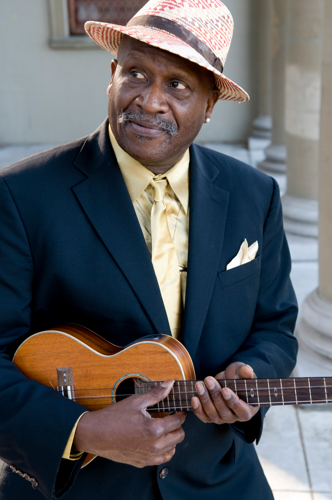


Taj Mahal
It’s hard to find any musician whose career has successfully encompassed as many idioms and genres as composer, guitarist, vocalist and bandleader Taj Mahal. Long before any marketer or critic came up with such terms as “world music” or “Americana,” Mahal was constantly exploring and playing music from all over the nation and the globe. Throughout an exemplary career spanning more than five decades, he’s made albums spotlighting traditional and contemporary blues, reggae, music from Africa, India and the South Pacific, early jazz, folk, and rock.
But whatever strain he’s exploring, every song and album becomes highly personal, extremely memorable and distinctive. Mahal, who’s coming to City Winery on Friday, credits his family background with piquing his interest in many styles at an early age.
“I guess the easiest way to describe my influences would be — it’s a mix of New York, the South and the Caribbean,” says Mahal, speaking with the Scene by phone. “The blues are certainly the foundation, especially traditional blues. But then I kind of go around the world and get things I mix into the framework. For me, it’s ultimately all about the music, and all about what I hear and want to communicate to people — not so much about concern over labels or categories.”
Mahal, born Henry Saint Clair Fredericks in 1942, is a multi-instrumentalist who plays guitar, piano, banjo, trombone, harmonica and more. Some of his earliest musical experiences came from singing in a doo-wop group in high school, and he learned the blues through guitar lessons from a neighbor in North Carolina. But at one point Mahal thought he might become a farmer rather than a musician. As a teenager he worked on a dairy farm in Palmer, Mass., not far from Springfield. He became a farm foreman at 19, and even studied animal husbandry at the University of Massachusetts at Amherst.
But the lure of music proved too great. His college R&B band Taj Mahal and the Elektras became the first of numerous ensembles he’d lead, and ignited what’s become an incredible career. He eventually relocated to the West Coast and began amassing an astonishing list of achievements that continues to the present day with his current quartet, trio and other ensembles. Mahal spent several formative years in the mid-1960s working with Ry Cooder and Jessie Lee Kincaid, and in the late ’60s, he released breakout solo albums Taj Mahal, The Natch’l Blues and Giant Step/De Ole Folks at Home, which included collaborations with players like guitarist Jesse Ed Davis. It was crystal-clear from this early work that Mahal was a monster talent, and he’s continued to prove that time and again in a catalog that includes some 30 studio LPs.
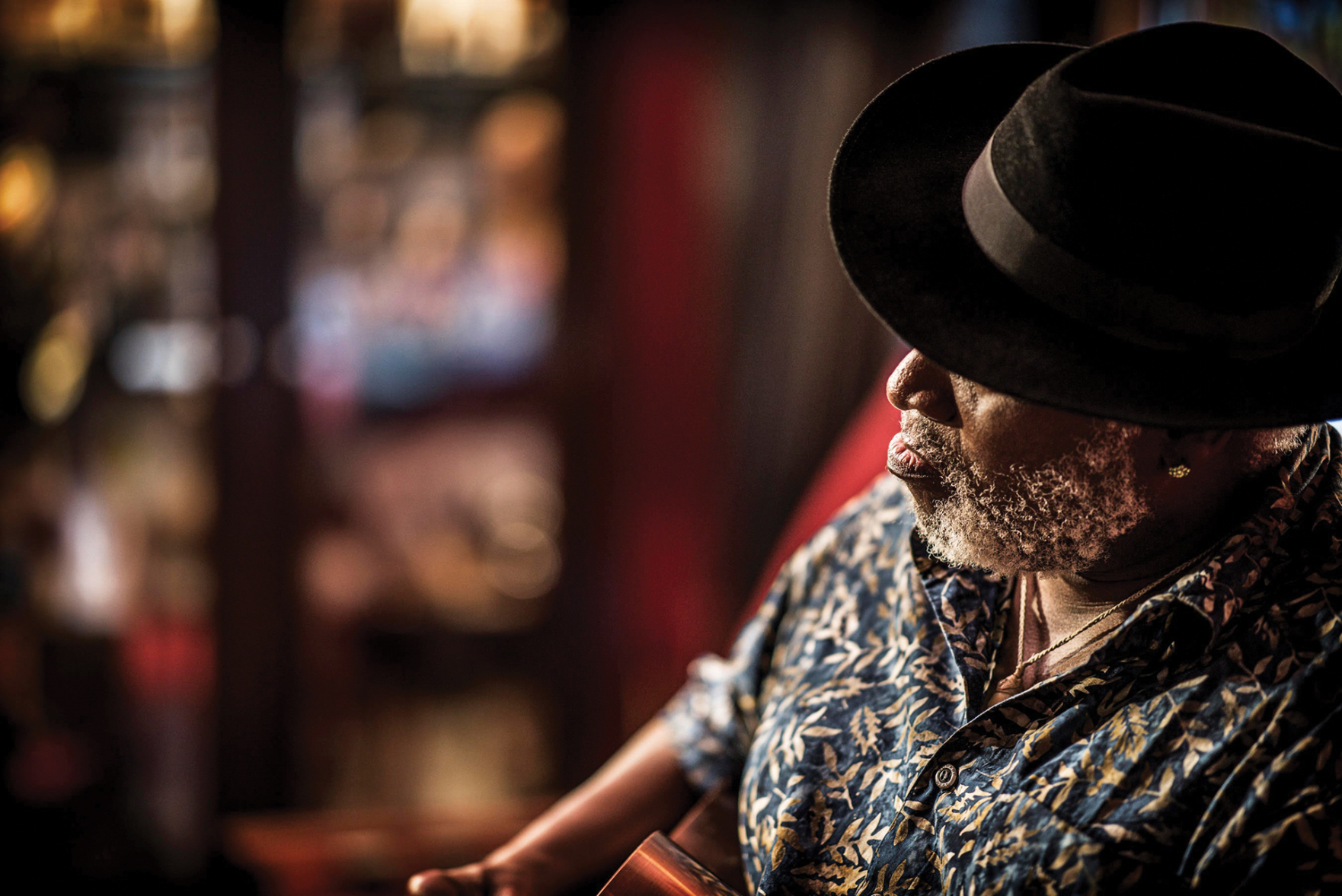
Mahal has mastered an unusual playing style, using his thumb and middle finger with his guitar pick rather than index finger, and his rhythms and chord voicings reflect both a close study of blues legends and additional ethnomusicology studies. He’s pioneered and developed a sound that can be prickly, engaging, surprising and often unorthodox in terms of tone and melody. But it’s always exciting, energetic and satisfying. And even if you can’t quite tell a performance is his from the playing alone, once the voice comes in, it’s unmistakable: His trademark vocals can be rough and cutting one moment, elegant and alluring the next.
Mahal is the winner of three Grammys (out of 14 nominations) and a Lifetime Achievement Award from the Americana Music Association. He cites among his all-time favorite projects a recent collaboration with Nashville blues ace Keb’ Mo’. Their 2017 collaborative album TajMo won the Grammy for Best Contemporary Blues Album, and Mahal recalls that the pair’s working relationship was an easy one.
“People were always coming up to me and saying, ‘You guys have to do something together,’ ” he says. “When we finally did, there were no issues about billing, who’d do what in the studio, none of that stuff. It was just great fun. We sure may do something else together down the line soon.”
Mahal still leads multiple ensembles, and will be bringing his quartet for the Nashville engagement. The lineup includes bassist Bill Rich and drummer Kester Smith, both of whom have been working with Mahal for more than 40 years, as well as steel-guitar ace Bobby Ingano, who joined in 2019. On Friday, world-class bluegrass duo Rob Ickes and Trey Hensley will join in as special guests.
“Each group that I have kind of lets me do a particular thing, and it’s really about what I might be feeling or hearing at any one time,” says Mahal. “Right now for the songs that I’m hearing and feeling, the quartet’s the right vehicle. I’ve worked so long with Bill and Kester, we really can get into a good feel pretty quickly — and Bobby’s joined us and fit right in, so it’s a great situation for me.”
Though it seems hard to believe that there’s anything he hasn’t yet done that he’d still like to do career-wise, Mahal says he does have one wish.
“Believe it or not, I’d love to have a hit record,” he says. “The average kid on the street today, they’ve never heard of me. There’s lots of folks out there who know and admire and respect my music, and I’m really thrilled and happy about that, and about how things have worked out for me. But yeah, I would like to have that hit, and have that kid on the street recognize me.”



Post a comment as anonymous
Report
Watch this discussion.
(0) comments
Welcome to the discussion.
Log In
Welcome to the discussion.
Keep it clean. Please avoid obscene, vulgar, lewd, racist or otherwise abusive language. Comments featuring hate speech or threatening or violent content will not be tolerated.
PLEASE TURN OFF YOUR CAPS LOCK.
Be truthful. Don't knowingly lie or mislead.
Be proactive. Use the “report” link on any comment that violates our comment policy.
Share with us. We'd love to hear your feedback.