
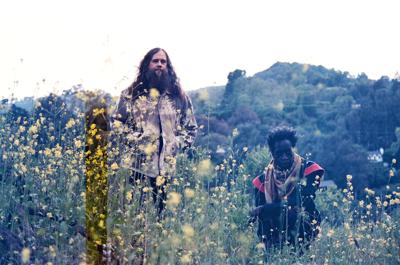


Carlos Niño and Saul Williams
One of the great pleasures of music journalism is talking to musicians who are brimming with joy. It can turn your whole day around (even if, say, your government has launched an illegal war, it’s committing war crimes in your name with your tax dollars, and all you want is some health care and maybe a moment of stable prices). That is exactly what happened when the Scene caught up with poet Saul Williams and percussionist Carlos Niño ahead of a stop at The Blue Room at Third Man Records on the tour following their debut collaborative album. Saul Williams Meets Carlos Niño & Friends is a gorgeous confluence of improvisation, ambience and sociopolitical engagement recorded live at TreePeople in Los Angeles in December 2024 and released last year.
“I feel like somehow the album has become a catalyst for this additional lane,” says Niño, whose expansive sound covers the more outré corners of electronic and improvisational music (including, as one very well-known part of a lengthy career, André 3000’s New Blue Sun record and tour). “Our freeway is expanding. The circuitry, the pathways. … Sun Ra used to refer to that as Interstellar Low Ways.”
The first date of a short run that includes a trip to Big Ears Festival in Knoxville and a residency at The Blue Note, Tuesday’s show marks a liminal space between two releases for the longtime friends: There’s another project already in the works. They can’t spill the details, but there’s a tug-of-war between their consummate professionalism and the unbridled excitement of artists who want and need to share this thing that they are very proud of. It is incredible energy to be in the middle of, even when you are thousands of miles from being in the same room with the people generating it.
“I think what [Meets Carlos Niño] did for us — and I’d love for you to share this with everyone — it really created a new, pretty beautiful and radical lane for both of us and our music community in the world,” says Niño. “Saul and I have been friends for a long time. I’ve been a really big fan of Saul’s for a long time. [Early in both of our careers, I presented] Saul here in Los Angeles, and we became real friends.”
Williams’ career stretches back to the ’90s, and his publications and performances have integrated seemingly disparate genres, formats and styles in ways that make them feel like they were always together. He underscores the fact that this collaboration has been a long time coming.
“Carlos and I, we’ve been lucky enough to share not only that one night,” says Williams, on the video call from Paris. “We were able to take that on the road, and we were able to dig deeper into our own connection and the connection with the community of artists that have shared the stage with us. Everything has just been aligned. I think we’re both extremely excited about and proud of something [bigger] that I know takes this first step … in terms of the TreePeople album and how that felt like a sort of a necessary or useful contribution to the moment.”

The Atlanta artist and his improvisational group hit Nashville with an whirlwind woodwind performance
One of the draws of what Max Roach called American instrumental music and its improvisational frameworks is that it feels eternally of-the-moment — because the artists participating in it are so in-the-moment. There are few better examples of this than Saul Williams Meet Carlos Niños & Friends. These are fellow travelers listening and conversing. The interplay — between poet and musicians, musicians and instruments, the band and the crowd and the trees — is mindful, open, aware. But the record is also balanced. There is darkness in the world, and it is acknowledged, but the doom is held at bay by fellowship and the free flow of musical ideas.
“And to have a stage, a platform to be able to work through these moments, alive and aloud, and to realize that music has many capacities,” Williams continues. “It’s there to heal, it’s there to help, it’s there to uplift, it’s there to inspire. … Music is a gift to us all.”
The practice of listening is such a big part of the Williams-Niño team-up, and such a big part of the structure of their performance that you might miss it entirely. Instruments wander in and out, verses assemble and scatter, moments coalesce and disperse — it’s coactive rather than reactive. It feels like an approach to handling the arch weirdness of the 21st century.
“We are focused, determined, we are involved, we are active, we are conscious, we are considerate, caring, loving,” says Niño. “And you can see in each of the places that we go how we come together and we activate even further and we kind of energize each other, and we peer counsel and we help each other.”



Post a comment as anonymous
Report
Watch this discussion.
(0) comments
Welcome to the discussion.
Log In
Welcome to the discussion.
Keep it clean. Please avoid obscene, vulgar, lewd, racist or otherwise abusive language. Comments featuring hate speech or threatening or violent content will not be tolerated.
PLEASE TURN OFF YOUR CAPS LOCK.
Be truthful. Don't knowingly lie or mislead.
Be proactive. Use the “report” link on any comment that violates our comment policy.
Share with us. We'd love to hear your feedback.