
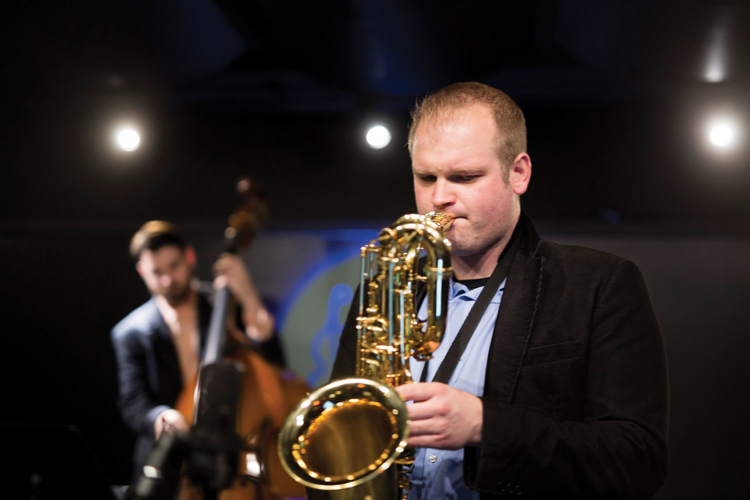


Ryan Middagh performing at Nashville Jazz Workshop in May
When Ryan Middagh arrived at Vanderbilt’s Blair School of Music as director of jazz studies in the fall semester of 2014, he had some enormous shoes to fill. Along with Nashville’s jazz community as a whole, the school was coping with the February 2014 death of Billy Adair, remembered not only for his role as the program’s director and founder of the Blair Big Band but also as a much-loved colleague and mentor.
“No one could replace Billy Adair,” Middagh tells the Scene. “I simply have the privilege of being his successor.”
With help from dedicated students and faculty, Middagh has spent the past three years re-energizing the jazz program, and his hard work is paying dividends. Soon, the Blair Big Band will have completed its first studio album. A large library of Adair’s arrangements continues to be part of the group’s repertoire, and one in particular — an arrangement of Ray Noble’s wistful 1934 classic “The Very Thought of You,” famously recorded by Billie Holiday, Bing Crosby, Elvis Costello and others — is one of the record’s highlights. It features a guest appearance by Adair’s widow, eminent pianist Beegie Adair.
“I feel it is a great gem of the record,” says Middagh. “That was very important to the students and to me.”
Middagh is an accomplished musician, composer, arranger and scholar, with a doctorate in jazz studies from the University of Northern Colorado. Jazz instructors view their daily battle as striking the right balance between theoretical knowledge and professional experience, but there’s an additional, somewhat more ephemeral component that Middagh wants to emphasize.
It came to the forefront in the spring, when the school hosted a master class with jazz winds player Dave Liebman (whose more than five decades of performances include work with Miles Davis and Chick Corea and who received a Jazz Masters lifetime achievement award from the National Endowment for the Arts in 2010).
Liebman sums up the balance perfectly, says Middagh, when he describes jazz as “equal parts thinking, feeling and doing.”
“If any of those aspects are lacking in a jazz musician’s practice, playing or writing, the music will fall short,” Middagh continues. “Music schools have always done a great job in emphasizing thinking and doing, but can occasionally overlook feeling in the music. I encourage my students, and any musician, to play with feeling [and] heart, and to put all of themselves into their music.”
With that desire to mold well-rounded musicians in mind, Middagh is excited about developments that are expanding the program’s horizons. Though jazz is only one of 11 departments within Blair, Middagh says Dean Mark Wait and the rest of the administration are big supporters of the program and the direction he’s pushing it. Revamping the department’s suite of jazz combos, with the goal of helping students get more out of performing in an intimate group setting, is high among Middagh’s priorities, as is further diversifying ensemble offerings — salsa and New Orleans brass are among the potential candidates for expansion within the jazz realm. Middagh is also interested in establishing a commercial music ensemble, a feature you can find in the music schools at Belmont University, Tennessee State University and Middle Tennessee State University, but not currently at Blair.
The school’s adjunct faculty reads like a who’s-who of Music City jazz, from Nashville Jazz workshop co-founder Roger Spencer to renowned vocalist Christina Watson (who leads the school’s jazz choir, founded in 2015) and Grammy-winning reed-instrument polymath Jeff Coffin, who also leads the Nashville Jazz Composers Collective. As the jazz program’s artist-in-residence, the collective offers students the chance to interact with superb professional players who are also working to expand the traditions of jazz by writing new original material.
Middagh and his colleagues have the utmost respect for Adair’s legacy. The way they show it, through broadening the vision Adair had for the school, helps ensure that jazz will remain an important part of Nashville’s musical vocabulary for years to come.
Email music@nashvillescene.com



Post a comment as anonymous
Report
Watch this discussion.
(0) comments
Welcome to the discussion.
Log In
Welcome to the discussion.
Keep it clean. Please avoid obscene, vulgar, lewd, racist or otherwise abusive language. Comments featuring hate speech or threatening or violent content will not be tolerated.
PLEASE TURN OFF YOUR CAPS LOCK.
Be truthful. Don't knowingly lie or mislead.
Be proactive. Use the “report” link on any comment that violates our comment policy.
Share with us. We'd love to hear your feedback.