
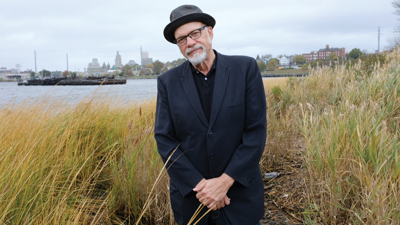


If you’ve followed the career of musician, songwriter and longtime Emmylou Harris sideman Phil Madeira, you might see the title of his brand-new album, Providence, and anticipate an examination of the trials of a socially progressive Christian trying to find his place in our nation’s current religious landscape. After all, that was the theme of Madeira’s 2012 multi-artist project Mercyland: Hymns for the Rest of Us, which featured performances by Harris, Buddy Miller, Carolina Chocolate Drops and North Mississippi Allstars, to name a few. (A second volume of Mercyland was released in 2016.) And considering Madeira’s résumé — a sought-after pianist, Hammond B3 player, accordionist and guitarist who’s played on records by Harris, Miller, Garth Brooks and Toby Keith, and a songwriter who’s had cuts by Brooks, Keith, Alison Krauss and Keb’ Mo’, not to mention co-writing The Civil Wars’ Grammy-winning single “From the Valley” — you’d probably expect the new album to include some twangy Telecasters and country-tinged Americana arrangements.
It would be completely understandable if you made those assumptions, but you’d be wrong on both counts. The title Providence doesn’t so much refer to the concept of divine guidance as to the capital of Madeira’s home state, Rhode Island, whose role in Madeira’s life provides the album’s lyrical subject matter. And musically speaking, there’s not a track on Providence that even remotely suggests country music. Nor does it sound much like Americana, though Americana radio programmers will likely claim it — because the album is so good, and Madeira has deep ties to that world. (He is a showcasing artist at this year’s AmericanaFest, as well.)
No, this is unmistakably a funky, jazz-inflected soul album, and a truly exceptional one. In conversation, the self-deprecating Madeira might have you thinking he’s some sort of piano hack (or more specifically, a jazz piano hack), but this is some of the best — and funkiest — piano music to come out of Nashville in recent memory. It doesn’t hurt that he has the rhythm section from Harris’ backing band The Red Dirt Boys, drummer Bryan Owings and bassist Chris Donohue, holding down the fort. There are some great contributions from an esteemed roster of guests, including Red Dirt Boys guitarist Will Kimbrough, Roland Barber on trombone and trumpet, and Dana Colley on sax, not to mention one of the most revered living jazz guitarists, John Scofield — but regardless, this is essentially a piano trio record.
If you want to know if Providence is for you, you need only listen to the first 10 seconds of the opening track, “Wicked Job.” Madeira, Owings and Donohue kick into a greasy groove that might as well be a flashing neon sign exclaiming, “It’s all about the feel!” And it gets funkier from there. The next song, “A Rhode Island Yankee on Jefferson Davis Court,” musically nods in the direction of New Orleans, thanks in part to John Mark Painter’s horn arrangements.
Other highlights include “Crescent Park,” a tune about an East Providence amusement park, which features a terrific Scofield solo on the outro; “Gothenburg,” a sweet nod to Madeira’s immigrant grandfather; and “Dearest Companion,” a touching ode to his longtime romantic partner, the respected writer Merrill Farnsworth, who was battling cancer at the time and died several months after the song was recorded. Throughout, Madeira sings in a reedy, lilting, occasionally behind-the-beat style that is the perfect vocal complement to his piano work. If you were ever a fan of Mose Allison, Ramsey Lewis, Les McCann or even Randy Newman, you’re likely going to dig this record.
Madeira, who plays Friday at The Basement, spoke with the Scene recently from his Belmont Boulevard apartment, where a 1962 Stratocaster and paintings of Clarence White, Doc Watson, Muddy Waters and Son House hang on the wall.
Who are you some of your piano influences? I’ve seen you mention Mose Allison in print. Do you like Les McCann?
[McCann’s] “Compared to What,” to me, is one of the desert-island things. And Ramsey Lewis. He would take Beatles songs, pop songs, and he brought jazz vernacular to a kid like me. I wouldn’t have known what to do with [Thelonious] Monk in sixth grade. But with Ramsey Lewis, it was like, “Oh, I know this song.” He kind of reminds me of that Les McCann thing, where there’s jazz, but there’s also this huge soul element too.
I wouldn’t sell yourself short as a piano player, because that’s some really phenomenal piano on the new album.
Thank you. Just like on guitar, I’m untrained, and I just do what I do. I don’t theoretically know what I’m doing, but when it’s just piano, bass and drums, then harmonically I can jump off the cliff, as long as I’ve got Chris and Bryan hanging in there.
How long were you and Merrill Farnsworth together?
We had a thing for about a decade. She found out she had cancer in December of ’16. We went in to record in February of ’17, and the first day we went in, we cut five tunes. The second day we were going to cut another five, and I threw one of those out and wrote “Dearest Companion.” It was not an easy time. I’m sure this is the case with people who have someone who is terminal in their lives. Of course, we are all terminal, we just don’t realize it. But I think for me, I was so desperate to make her a part of it. So when we recorded that tune, we go in that morning — I had texted them the night before, “Here’s something we are going to do.” It was in 4/4, it had sort of a swing to it. And Chris heard it, and he just said, “This is a waltz.” God bless him, and thank God I’m old enough to actually listen to people now, because 30 years ago I would have said, “It’s going to be this way!”
On “A Rhode Island Yankee on Jefferson Davis Court,” you sing, “The South reached out to me / Cast its spell.” When did that start?
My mother says I came out of the womb drumming. I think rock ’n’ roll really starts down in New Orleans. I mean, I love a lot of stuff that came out of New York, jazzy stuff, Miles Davis. You can regionalize stuff, but at the end of the day, jazz started in New Orleans. There’s no question. When Bryan’s playing the second-line on “Rhode Island Yankee,” that’s right out of the New Orleans playbook. That’s not off the Grand Ole Opry stage.
Yeah, there’s a lot of that New Orleans thing throughout the album. New Orleans is so fundamental to everything, when you think about it. The first music I ever heard was probably Mahalia Jackson, which isn’t New Orleans, but it’s part of that African-American fabric of music. I’ve always liked Little Feat, or any of these piano players out of New Orleans. Even a backdoor route to that would be Harry Connick Jr. You go really far back and it’s Louis Armstrong, which is not piano, but just that feel. That march-y feel. I think the ultimate New Orleans tune is “Just a Closer Walk With Thee.” You hear it at a funeral down there. They’re starting out slow. Then next thing you know all hell’s breaking loose, and they’re partying.
Speaking of gospel songs, I know that Christianity, at some level, has been important to you, but that your version of Christianity is perhaps lost in the current direction of American Christianity.
To me, I feel like American Christianity is lost. The Mercyland stuff really came about during the 2008 campaign for president. Until the George W. Bush years, I would have described myself as politically middle-of-the-road. I was always going to look at a candidate, no matter what party, as an individual. As I was hiking this morning at Radnor, I had this crazy thought: The idea of taking the lord’s name in vain came to me. I’m fairly free with G.D.-ing this and that, but you’d be hard pressed to hear me say, “Jesus Christ!” But I thought, what does it mean to take the Lord’s name in vain? Now I don’t usually think this religiously. But this just came to me this morning while I was hiking — these folks like Jerry Falwell, or Jerry Falwell Jr., or Billy Graham’s son Franklin Graham, who is such an anti-love version — these guys are taking the Lord’s name in vain. To me, this idea from the Old Testament, “Thou shalt not take the name of the Lord thy God in vain,” I don’t think it’s anything to do with tossing off this name in a moment of exasperation. For all I know, somebody yelling, “Jesus Christ!” might be a prayer. But what about just the idea of “Don’t misrepresent the story”? And that, to me, is what American Christianity is doing. For me, I’ll go occasionally to the Episcopal church — Becca Stevens’ church [St. Augustine’s].
Your dad was a minister. Was he Episcopalian?
No, he was Baptist. He was a very conservative person. But he was a man of love. He may not have had as liberal an opinion as you and I have about gender stuff. But he would have loved whoever that person was. He lived it. He’s really the only tether for me. If I had not had my father in the picture, I don’t know what I’d believe. He was great. I remember him preaching against Vietnam. And he wasn’t even what you’d call politically liberal, although now he’d be considered that. He and my mother were both very pro-civil rights, but they didn’t think of themselves as activists. They were just people who loved Jesus and saw how he lived. And let me ask you this: Why does that not make sense to the American church? Why are Christians, or at least people who call themselves that, why are they so into guns? Why are they so into America in a way that makes me uncomfortable? Now this record is not at all a religious record. People want to ask me if the title Providence is religious. It’s not.
What instruments do you play in the Red Dirt Boys?
With [Emmylou], I split it up between accordion and piano and guitar, and occasionally some lap steel. And there’s a Red Dirt Boys project that she’s put her blessing on, and we’re almost done with that record. I’m pretty much half and half, piano and guitar, on that. And that’s a blast. And Will [Kimbrough] and I split the vocals and writing. It’s fun. It’s a pretty big love fest between the four of us, so I went to Emmy and said, “Hey, we’re going to keep making music together.” She had put us on what she called “hiatus” when she went and started with Rodney [Crowell], and we really didn’t know that we’d ever be back. We are back with her for the moment. But I went to her, because she’s such a great friend and person, and I said, “The four of us are going to keep making music together. We want to make a record, and we want to use that Red Dirt Boys name, but we want to have your blessing on that.” This is so typical of this woman: She said, “Only if I can sing on it.” So she’s on two tracks. She’s a dear. She’s the greatest.



Post a comment as anonymous
Report
Watch this discussion.
(0) comments
Welcome to the discussion.
Log In
Welcome to the discussion.
Keep it clean. Please avoid obscene, vulgar, lewd, racist or otherwise abusive language. Comments featuring hate speech or threatening or violent content will not be tolerated.
PLEASE TURN OFF YOUR CAPS LOCK.
Be truthful. Don't knowingly lie or mislead.
Be proactive. Use the “report” link on any comment that violates our comment policy.
Share with us. We'd love to hear your feedback.