
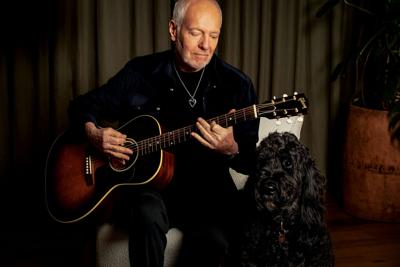


The seeds for singer-songwriter-guitarist Peter Frampton’s inspired new album Carry the Light, which hits stores and streaming services Friday, were sown during the pandemic years. At that time, the Rock and Roll Hall of Famer was living in a high-rise in downtown Nashville.
“I loved living downtown because I would get up, make my coffee, and I had a 280-degree view of downtown,” recalls Frampton, who now lives just outside the city. “I was on the ninth floor, just looking down and seeing it all going on and realizing that things were going from bad to worse. So that was the start of my being realistic about where we were each time I sat down to write lyrics.”
In the ensuing years, Frampton worked on a number of new songs, and by 2025, he had more than enough compositions in the works for his first album of original material since 2010’s Thank You Mr Churchill. He and his son Julian Frampton, a well-regarded singer, songwriter and musician in his own right, went through all the songs and selected some for further development.
“Last year, my son came here every month from L.A. for two to three weeks, and we would spend that time finishing [songs] or writing something new, or whatever we needed to do for the record,” Frampton explains. “Our motto was, ‘We are not going to settle for anything.’”
As the title suggests, Carry the Light is an uplifting record — a counterpoint to what Frampton was seeing outside his window. The album opens with the title track.
“It’s about, ‘Carry the light, and let’s not forget the past,’” he says. “That’s why we have a memory — don’t leave your wisdom behind.”
The song begins with stomp dance chants provided by members of the Absentee Shawnee Tribe of Oklahoma. Frampton’s guitar tech Nick Gibson is a member of the tribe and recorded the chants during a visit to Oklahoma for a celebration.
“Nick said, ‘I’m going back to see the elders,’ and my brain went, ‘Gong!’” Frampton recalls. “I said, ‘I really want this to have a Native American feel at the beginning,’ and he told us about the stomp dance.”
So Frampton and his son made a percussion loop for a guide, and Gibson recorded the chants heard on the song during his trip.
“When he brought it back — with the crickets at the beginning and everything because it was done outside — it was like the perfect album starter,” Frampton says. “It fit right in, and if you notice, it kind of comes back in the background every now and again.”
Working with his son and Chuck Ainlay as co-producers, Frampton cut the album’s basic rhythm tracks at his Berry Hill recording facility The Studio Phenix with bassist Glenn Worf and drummer Chad Cromwell, whom he had worked with previously, as well as keyboardist Michael Rojas. Frampton tracked some guitar during those sessions, but the bulk of his rhythm guitars, guitar solos and vocals were recorded at his home studio.
In addition to the all-star rhythm section, Carry the Light includes contributions from guitarist Pat Bergeson, percussionist Eric Darken and vocalists Vicki Hampton, Angela Primm and Gale Mayes. It also features the Kristin Wilkinson Strings and a children’s choir conducted by David Wise and Laura Cooksey.
A number of special guests make appearances on the album as well. Former Tom Petty and the Heartbreakers keyboardist Benmont Tench adds his exquisite work to “Buried Treasure,” a tribute to Petty’s SiriusXM radio show of the same name. Graham Nash adds poignant harmonies to “I’m Sorry Elle,” Frampton’s lament about not being able to visit his new granddaughter in person because of COVID. Sheryl Crow duets on the midtempo rocker “Breaking the Mold.” Tom Morello contributes some explosive guitar to the angry protest song “Lions at the Gate.” Bill Evans, the saxophonist who played with Miles Davis in the 1980s, adds his artistry to the spacey, jazzy “Can You Take Me There,” as well as “Tinderbox,” a piece inspired by Marvin Gaye that unfolds over several movements. And H.E.R., aka Gabriella Sarmiento Wilson, trades guitar licks with Frampton on the beautiful instrumental “Islamorada.”
When Frampton began work on the record, he knew how he wanted it to begin and how he wanted it to conclude. “We knew we had a starting point with ‘Carry the Light,’ and we knew we had the end with ‘At the End of the Day,’” he says.
“At the End of the Day” is the second instrumental in the collection. It’s an inspiring track recorded at Blackbird Studios whose message is that, in spite of all the turmoil, everything is going to be all right.
Julian Frampton considers the album a reflection of the here and now. “It captures how my dad feels about the world,” says Julian, “the changes happening around him and the way he’s evolving with it.”
To Ainlay, who has worked with Frampton for more than two decades, Carry the Light may be the best album the legendary British rocker has ever made. Frampton agrees.
“As far as a studio record, yes, I believe it is,” Frampton says. “Because we didn’t settle. … I didn’t care how long it took, we weren’t going to put anything out there that wasn’t absolutely 110 percent.”



Post a comment as anonymous
Report
Watch this discussion.
(0) comments
Welcome to the discussion.
Log In
Welcome to the discussion.
Keep it clean. Please avoid obscene, vulgar, lewd, racist or otherwise abusive language. Comments featuring hate speech or threatening or violent content will not be tolerated.
PLEASE TURN OFF YOUR CAPS LOCK.
Be truthful. Don't knowingly lie or mislead.
Be proactive. Use the “report” link on any comment that violates our comment policy.
Share with us. We'd love to hear your feedback.