

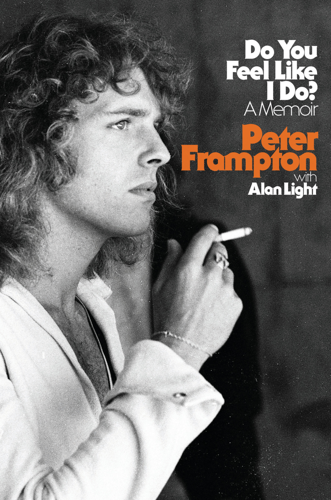


Do You Feel Like I Do? is a catalog of musician Peter Frampton’s life and career, told by Frampton himself for the first time. Frampton’s renowned gift for songwriting translates to storytelling, and his vivid, conversational style lends this memoir the intimacy of a coffee shop chat — just you, Peter Frampton and the pressing question: “Do you feel like I do?”

We learn in short order the many things that Frampton feels. He experiences a sense of shared humanity: “We’re all the same; we just do different things for a living, you know?” But he also knows the angst of aging and illness. He recounts his 2015 diagnosis with inclusion body myositis, a progressive muscle disorder, and writes, “Will I be able to play as well tomorrow as I did yesterday?” — a question we have all asked ourselves, in one way or another.
The book, which was co-written with Alan Light, opens with Frampton’s early years in England, offering brief histories of his parents’ lives just before his birth. The tastes (Spam), sights (broken glass) and sounds (air raids) of the Framptons’ World War II experience orient us to Peter’s beginning. Straightaway, we see the makings of a maestro, with scenes of young Frampton receiving his first stringed instrument — a vaudeville banjolele. He soon graduates to a “generic, no-name acoustic.” It is from this nameless guitar that he launches a musical career spanning five decades. As he puts it, “And from 3:30 in the morning on Christmas when I was eight years old, I haven’t stopped playing since.”
Do You Feel Like I Do? continues in this fashion, juxtaposing the larger political and social backdrop with Frampton’s multisensory vignettes. The resulting effect is a memoir that is not divorced from time and place, reminding the reader that music is not created in a vacuum. Frampton and his lengthy cast of bandmates (in The Herd, Humble Pie, et al.) invent themselves by listening to other musicians and listening to the world. As Frampton describes, this broad listening is critical to his development as an artist.
Frampton’s black 1954 Gibson Les Paul plays an important role in the memoir — essentially taking on its own story. The guitar’s presumed destruction and journey through Central America are captured in several departures from the main storyline. These scenes are bracketed, almost as though they are in a photo album. The language here is particularly vivid. “It had been a fireball crash,” Frampton writes of the 1980 plane crash that separates him from his beloved instrument. “The plane’s tail had broken off.” The guitar is found, a generation later, on a small island. In these snapshots, the fate of the Les Paul (dubbed “The Phenix”) becomes symbolic of Frampton’s own journey. Frampton — now based in Nashville — is known everywhere in the world, and so is his guitar.
Guitar enthusiasts, sound engineers and others who are interested in the technical side of music will appreciate the passages that contain specialized language: “Bits came flying and I caught a PAF humbucker pickup.” The book is dotted with phrases like “straight to two-track” and “straight to mono.” These are not so frequent, however, as to become a distraction to nonmusicians.
The book is not without its share of tea-spilling. Having enjoyed intimate relationships with countless musical legends, Frampton offers piquant tales of untoward behavior, substance use and more about well-known figures. But he also confesses his own shortcomings. At 24, he had an affair with the wife of a colleague. A series of alcohol-related crises pushed him toward Alcoholics Anonymous. He confronted his own deficiencies as a parent.
Do You Feel Like I Do? is a book for all artists — those who have followed Frampton since the success of his groundbreaking album Frampton Comes Alive! and those who are hearing his name for the first time. Frampton’s vignettes of work (for instance, the pressure to create an album in eight days) will be familiar in a world of endless deadlines. Others will simply appreciate the thoroughness, honesty and humor with which Frampton recounts his journey.
For more local book coverage, please visit Chapter16.org, an online publication of Humanities Tennessee.



Post a comment as anonymous
Report
Watch this discussion.
(0) comments
Welcome to the discussion.
Log In
Welcome to the discussion.
Keep it clean. Please avoid obscene, vulgar, lewd, racist or otherwise abusive language. Comments featuring hate speech or threatening or violent content will not be tolerated.
PLEASE TURN OFF YOUR CAPS LOCK.
Be truthful. Don't knowingly lie or mislead.
Be proactive. Use the “report” link on any comment that violates our comment policy.
Share with us. We'd love to hear your feedback.