
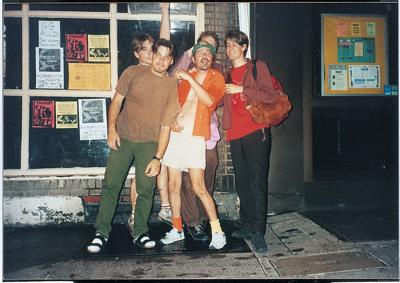


Pavement
Nearly 40 years after Pavement began, it’s hard not to feel a sense of retrospection about the great 1990s rock band, which settles into the Ryman for a pair of shows on Monday and Tuesday. From the beginning, when guitarists and songwriters Stephen Malkmus and Scott Kannberg formed the band in 1989 with drummer Gary Young in Stockton, Calif., Pavement’s music was a shadow version of classic rock. Pavement didn’t become indie-rock avatars in the way some critics and fans might have wished at the time. Their commitment to the rock aesthetic compelled them to create noisy songs that remained tuneful and inventive noise that was as welcoming as the tunes, and the words were like John Ashbery poems recast as jokes about rock history.
Pavement’s current tour comes 27 years after they released their final album, 1999’s Terror Twilight. Their history — and their increasing reputation as one of rock’s greatest bands — comes to light in director Jed I. Rosenberg’s 2023 film Louder Than You Think: A Lo-Fi History of Gary Young & Pavement and Alex Ross Perry’s experimental 2025 documentary-slash-biopic Pavements. Louder Than You Think doubles as a primer on the band’s early days, when their cassettes were reviewed in fanzines, and as a character study of Young, who left the band in 1993. Pavements makes its case for the high quality of Pavement’s songwriting, which gets interpreted throughout the film by a group of singers younger than the band itself.
By the time Terror Twilight hit the stores, I’d been a fan since 1992, when their debut album Slanted and Enchanted was released. Recorded with Young, Slanted sounded like the work of pop adepts who had listened to Captain Beefheart, The Fall, Jim Croce and Can. “Trigger Cut” quoted Croce’s 1972 song “Operator (That’s Not the Way It Feels),” and the album’s melodicism cut through the lo-fi engineering.
I liked the follow-up, 1994’s Crooked Rain, Crooked Rain, which contained the fan-favorite single “Range Life.” The album’s popularity seemed to presage a career for Pavement as indie stars who looked good in music videos. Crooked Rain also features one of the most powerful songs in the Pavement canon, “Unfair,” which sports glassy guitars and a Malkmus lyric about loathing Southern California. As he sings: “Up to the top of the Shasta gulch / To the bottom of the Tahoe lake / Man-made deltas and concrete rivers / The south takes what the north delivers.”
For some observers, Crooked Rain remains the band’s high point. Drummer Steve West, who replaced Gary Young, edged the band toward a more conventional style than they’d favored with Young. West’s solid beats, which the band poked fun at in 1997’s “Westie Can Drum,” underpin 1995’s Wowee Zowee. I think it’s their most capacious, surprising album. However Malkmus managed to access the post-Gram Parsons country rock of the album’s “Father to a Sister of Thought” and “Black Out,” he revitalized the genre.
Wowee Zowee didn’t further their commercial aspirations, and it sold less than its predecessor. I saw them in Atlanta in summer 1995 when they were touring as part of the Lollapalooza music festival. I don’t remember them being underpowered, but I wouldn’t say the festival atmosphere was ideal for contemplating such a cerebral band. Wowee Zowee was cut in Memphis at Easley McCain Recording, and I heard parts of it as homages to Alex Chilton, one of Malkmus’ avowed influences. The opener, “We Dance,” took off from Big Star’s Third, while “Rattled by the Rush” evoked Radio City.
As Pavement moved further from their lo-fi beginnings, the band’s songs took on an ominous, late-afternoon quality. “Starlings of the Slipstream,” from 1997’s Brighten the Corners, compresses emotion into the space usually reserved for pop composers like, say, Brian Wilson. Like many of Pavement’s best songs — 1996’s “Give It a Day,” about Puritan clergymen Increase and Cotton Mather, comes to mind — “Starlings” is about trying to find your place in history, which might prove difficult.
Brighten the Corners and Terror Twilight have an end-of-era vibe that seems typical of albums and movies made in the late ’90s, from Tortoise’s 1998 TNT to 1999’s Being John Malkovich. Produced by Nigel Godrich, Terror divides Pavement fans. Some find his production obtrusive and the songs stitched together in a way that seems less organic than on previous albums. It contains the amazing “Speak, See, Remember,” which goes from a modified folk chord progression to electric guitars that evoke Beefheart’s Trout Mask Replica.
Terror Twilight is a fitting final installment in one of rock’s great catalogs. I’m aware that the band had issues with Godrich, and maybe the album turned out to be more of a tribute to Malkmus than it was to Pavement itself. Godrich’s high-definition sounds are an aural analog for transience. When the guitars wobble into the ether on “Ann Don’t Cry,” the effect has me crying, every single time.





Post a comment as anonymous
Report
Watch this discussion.
(0) comments
Welcome to the discussion.
Log In
Welcome to the discussion.
Keep it clean. Please avoid obscene, vulgar, lewd, racist or otherwise abusive language. Comments featuring hate speech or threatening or violent content will not be tolerated.
PLEASE TURN OFF YOUR CAPS LOCK.
Be truthful. Don't knowingly lie or mislead.
Be proactive. Use the “report” link on any comment that violates our comment policy.
Share with us. We'd love to hear your feedback.