
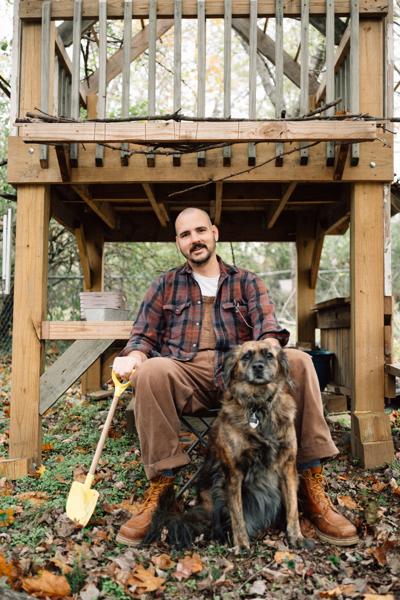

Nathan Evans Fox
Nashville singer-songwriter Nathan Evans Fox is well aware that his new record Heirloom, finished two years ago, carries significantly more weight in 2026.
“America has always had this class of folks who have experienced the cost of living in an empire,” Fox says. “That net is widening, and more and more people are being put in touch with that.”
Fox weaves the moral inheritances we all carry into the roots-rocking, banjo-laced, unpolished and unfussy sonic tapestry of Heirloom. Halfway through the album in the title track, he assesses his own. He reflects on the things — tangible and not — he wants to leave his new child, as he sings: “I’m looking for signs while we work for rich men / Biding our time till Jubilee comes.”
The stories at the roots of Fox’s songs are not new — not for humans in general, and not for him. Growing up on fourth-generation family land in Western North Carolina, he came to understand how military service, labor and policies decided by others have affected his family history. “I tell everybody at my shows that Uncle Sam is the real patriarch of most of our families,” he says, “and it’s certainly true in my family.” In the closer “I Know the End,” he confronts America’s perennial wartime and the way it shapes lives long after a given conflict is over and service members turn to other toil: “All that war and work came home every time.”
Those are the social and political planes Fox works in across his album’s 12 songs. State politics in his adopted home play a role, as he references Tennessee Gov. Bill Lee on “Landlords, Bill Lee, Etc.” and “Racecar.” The first song features recordings of Lee, as well as state House Majority Leader William Lamberth (R-Portland), made during speeches after the 2023 shooting at the Covenant School. “There’s a seat at the table,” Fox sings earnestly in the second of the two, playing on Lee’s ongoing refusal to participate in federal programs that provide assistance to families trying to keep their kids fed in the summer. “Don’t matter where you’re from / Everybody got a right to eat.”
Fox also deconstructs a strict evangelical upbringing and what it means to be a good human. Religious institutions meant to build up marginalized communities so often bring abuse and harm.
“There’s also a lot that I learned about the things that are capable of bringing people together,” says Fox. Thus, he centers his faith in a newly reconstructed understanding with “Hillbilly Hymn (Okra & Cigarettes),” a scorcher you might hear at a Friday night revival in rural America. Bluesy foot stomping drives a loose choir of voices, capturing the soul-connecting experience of honest faith rather than striving for vocal perfection. Naturally, there are also plenty of hard truths embedded in that communal feeling, as he sings: “Ain’t gotta act mean to be treated fair / All the living’s honest and dying too / Our bodies return as heirlooms.”
In conjunction with the album’s release, Fox recently launched The Anti-Confederate Southern History Reading Club on his Substack. It grew out of a deep conviction and moral responsibility to “look out for my people,” he says. “I want to be a good neighbor.”
As of this writing, 996 people have already signed up for the course, set from June 1 to July 22 and featuring readings from three books. Neal Shirley and Saralee Stafford’s Dixie Be Damned, Robin D.G. Kelley’s Hammer and Hoe and Danielle L. McGuire’s At the Dark End of the Street demystify the romanticized South through anti-Confederate politics and anticapitalism, while also touching on gender and Southern religion. “There’s a sense of kinship that’s really driving it,” Fox notes.
Between Heirloom and the Substack course, Fox dismantles perceptions of country folk, too. “The queerest spaces I’ve ever been in are country,” he says. “I was telling somebody about queering a lawnmower — the biodiversity of things is a queer ethic. That also extends out to your relationships with other people and to your gender identity. I know so many country folks who are gender-nonconforming without knowing it.”
Fox feels a responsibility to champion an alternative to popular conceptions of rural life.
“I look at what’s being sold now, and it’s just monocropped, suburban and gridded values. It doesn’t read as country to me because it’s so goddamn basic, predictable and repetitive.”




Post a comment as anonymous
Report
Watch this discussion.
(0) comments
Welcome to the discussion.
Log In
Welcome to the discussion.
Keep it clean. Please avoid obscene, vulgar, lewd, racist or otherwise abusive language. Comments featuring hate speech or threatening or violent content will not be tolerated.
PLEASE TURN OFF YOUR CAPS LOCK.
Be truthful. Don't knowingly lie or mislead.
Be proactive. Use the “report” link on any comment that violates our comment policy.
Share with us. We'd love to hear your feedback.