
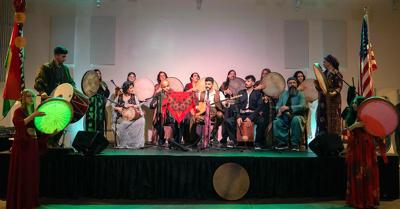


Kurdish Culture and Music Association Rhythm Group
“Music is the heart of Kurdish culture,” Asiye Taskin says as she welcomes me into the Kurdish Culture and Music Association’s office and studio space.
Taskin, the organization’s president and co-founder, and Rustem Ozer, a board member and technical support lead, both gesture around the room. Rows of dafs — frame drums used in a variety of musical traditions in the Middle East — hang on the wall, and elaborate Kurdish fabrics cover the couch. The back wall is lined with numerous portraits of famous Kurds, from dengbêj singer Şakiro to political leader Qazi Muhammad. Instruments are set up around the room in preparation for the KCMA’s upcoming third anniversary event on Sunday at Plaza Mariachi. The KCMA Rhythm Group has been practicing vigorously each week leading up to the concert. It’s just one example of the association’s dedication to creating cultural connection in Nashville.

Sitting over a bulky plate of shawarma in the back of Newroz Market, Shirzad Tayyar points to the front of the store. A cordoned-off corner of…
The space is a small slice of Kurdistan in Middle Tennessee. All the aforementioned items were shipped directly from the geocultural region. The largest community of Kurds in the U.S. lives in Nashville, and South Nashville is home to a bustling cultural and commercial district nicknamed Little Kurdistan, centered around the intersection of Nolensville Pike and Elysian Fields Court. While traditional Kurdish foods have become increasingly readily available, other kinds of authentic Kurdish goods are still not the easiest to find here.
“Whenever I come here, this is my therapy, you know?” Taskin explains. “Even on the busiest day, if I’m sitting down here, I feel so comfortable, so happy. And then all the stress for me is left behind that door.”
Beyond weekly rehearsals in preparation for the upcoming event, the association’s leaders are committed to maintaining education as a central part of their mission. From weekly daf lessons and classes in English as a second language to Kurdish language instruction and a newly launched Kurdish dance course, all KCMA events are free of charge and open to the public.
“It’s not just class when [they] come here,” Ozer says, referring to Nashville Kurds who come to classes at KCMA. “They feel like they are coming home.”
For Taskin and Ozer, the Kurdish Culture and Music Association serves a purpose that reaches beyond weekly lessons and annual events. Earlier this year, the organization launched a radio show by and for the Nashville Kurdish community, Dengê Kurdistan (Voice of Kurdistan), airing Saturdays from noon to 1 p.m. on community radio station WXNA. And their space functions as a gathering place where locals can maintain traditions, share stories and create relationships across generations. During any given week, children learning Kurdish rhythms might practice alongside adults reconnecting with songs from their homeland. Immigrants may find familiar sounds and faces, while other Nashvillians can take the opportunity to engage with a culture they may not know about. In a city where we celebrate our musical identity, the association offers a unique space where preservation, education and cultural exchange are actively happening side by side.
Turkey’s Bakur region is home to many Kurds and is known as Turkish Kurdistan. For many years the national government enforced assimilation tactics like a ban on using the Kurdish language in media or education. Under those circumstances, music evolved into a form of resilience, and for many Kurds today, music carries collective memory and maintains connection across generations. Music also encourages outsiders to learn about and experience the Kurdish culture that was once silenced.
People of a huge range of ethnicities and cultures call Nashville home, but it’s easy for Nashvillians to get isolated in their own social and geographical bubbles and overlook communities beyond their neighborhood or district. The KCMA is set on breaking down those barriers — not by political or religious means, but through music, a cultural practice that bridges gaps and welcomes people in.
“You don’t have to understand the language,” Taskin says, regarding Kurdish music. “You just have to feel it. … It’s going to take you somewhere.”
On June 28, the KCMA will celebrate its third anniversary by igniting a historic collaboration with the Nashville Symphony at Plaza Mariachi. The event marks the inaugural partnership between the orchestra and the local Kurdish community. The collaboration acts as a merging of cultures, with members of the Nashville Symphony performing Kurdish music alongside KCMA members. Other Nashville artists set to perform include Armenian American cellist Hannah Koshgarian, Vaveyla (a band that blends contemporary influences into traditional Kurdish music), Kurdish singer Yakup Çınar and the KCMA’s own Rhythm Group.
“If you don’t love it, if you don’t have hope for it, you cannot do anything,” Taskin says. “So our [anniversary] is just going to be one example of this — a sample of the love.”
Throughout their busy schedule, the KCMA remains focused on one mission: cultural connection. Whether it’s through in-person support or reaching out via email, the organization encourages Nashvillians to get involved.
“Whether you are Kurdish or not, this invitation is to learn, connect and celebrate the diversity that’s making this nation special,” says Taskin.
The KCMA keeps its doors open to everyone. As a reminder to celebrate cultural differences and encourage connection, Ozer offers one final message: “We are here.”




Post a comment as anonymous
Report
Watch this discussion.
(0) comments
Welcome to the discussion.
Log In
Welcome to the discussion.
Keep it clean. Please avoid obscene, vulgar, lewd, racist or otherwise abusive language. Comments featuring hate speech or threatening or violent content will not be tolerated.
PLEASE TURN OFF YOUR CAPS LOCK.
Be truthful. Don't knowingly lie or mislead.
Be proactive. Use the “report” link on any comment that violates our comment policy.
Share with us. We'd love to hear your feedback.