

Nuveen Barwari
About a year ago, artist Nuveen Barwari called up a friend she’s known since the fourth grade to make a confession. Her middle initial M. did not actually stand for Madison, as she had told everyone it did. It stands for Muhammad. “No fucking way!” her friend laughed, likely impressed at the tenacity with which children can cling to their stories.
Barwari isn’t sure why she picked Madison for her middle name, but a reference to the fourth American president and the so-called Father of the Constitution acted as a veil to protect her from the Islamophobia that she recognized even then. She was in kindergarten when 9/11 happened, but she was old enough to notice a shift.
“The number of hate crimes, and the fear, increased,” she tells the Scene. “Even today, when something bad happens, my family gets worried — ‘I hope the guy who did that wasn’t Muslim, because that’s going to be hard on all of us.’ ”
If you try to imagine what a heavy burden that could be for a 5-year-old, you might start to get a sense for where Barwari’s artwork comes from. A Nashville native, she currently splits her time between here and Knoxville, where she’s in graduate school at the University of Tennessee. Her family is Kurdish, and she moved with them to the Iraqi part of Kurdistan from sixth grade through 11th grade. Though that’s only a handful of years, they’re formative ones.
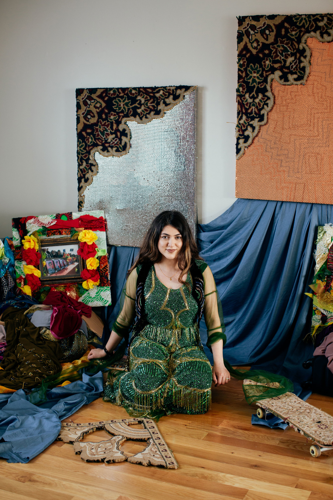
Barwari’s aesthetic of layered identity is deeply rooted. Take, for example, her use of Persian rugs in her artwork. An early piece she made as an undergraduate featured a skateboard with a worn rug affixed to the deck — a combination of her Kurdish heritage and the culture she grew up with in Nashville, which she describes as heavily influenced by the skater scene. She’s similarly drawn to the ideas of international markets as a place of overlapping commercial and social interaction.
“I’ve been using the structure of a bazaar to help me describe my practice,” says Barwari. “That’s simply the closest thing to reality to help me articulate what it is. The Merriam-Webster definition is something like, ‘a place in the Middle East that sells miscellaneous goods in stacks and rows.’ … But it’s more than just a place of commerce. Sure, there’s rugs and fabrics and spices, but people go to the bazaar for more than just things. Sometimes you go to the bazaar and you leave with so much more — there’s love, poetry, sorrow, protest. If you look at my work, it’s the same.
“The markets are a space of shared activity,” she continues. “I’ve found a great amount of comfort in these spaces, because they look and feel like the ones back home, but they’re not. Same with the materials that I use — they look and feel like the ones back home, but they’re not.”
Barwari describes her artwork as being assemblages of found objects, but she says the word “found” is a misnomer. “I honestly feel like the materials find me,” she says. That’s similar to the way identity is built, she says. “Making a home away from home results in a lot of settling for what is around you. I don’t have full agency in what I make in the studio, it really depends on the materials that have come to me.”
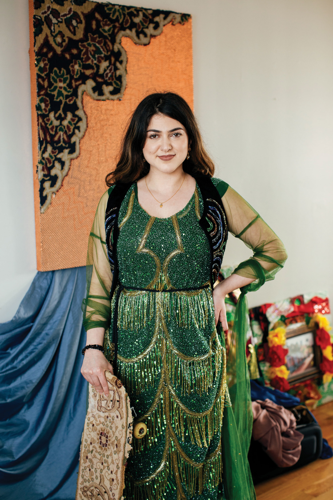
Other Kurdish families in Nashville donate to Barwari used rugs, which she uses as raw material in her work — ripped to bits, strung up with yarn, stacked into piles, layered with sequins or empty bags of Cheetos. She considers it a collaboration with the rugs, and with the patterns they create.
“Lately I’ve been looking at patterns as maps,” she says. “In Kurdish, it’s pronounced naxsh, which literally means pattern. But when you say naxsh de Kurdistan, that means the map of Kurdistan.”
The rug, for Barwari, is a symbol for her homeland, and it’s also a movable thing that can change identities depending on its placement. Sort of like the initial M., and how sometimes it stands for Madison, sometimes Muhammad.
Photographed by Daniel Meigs.



