

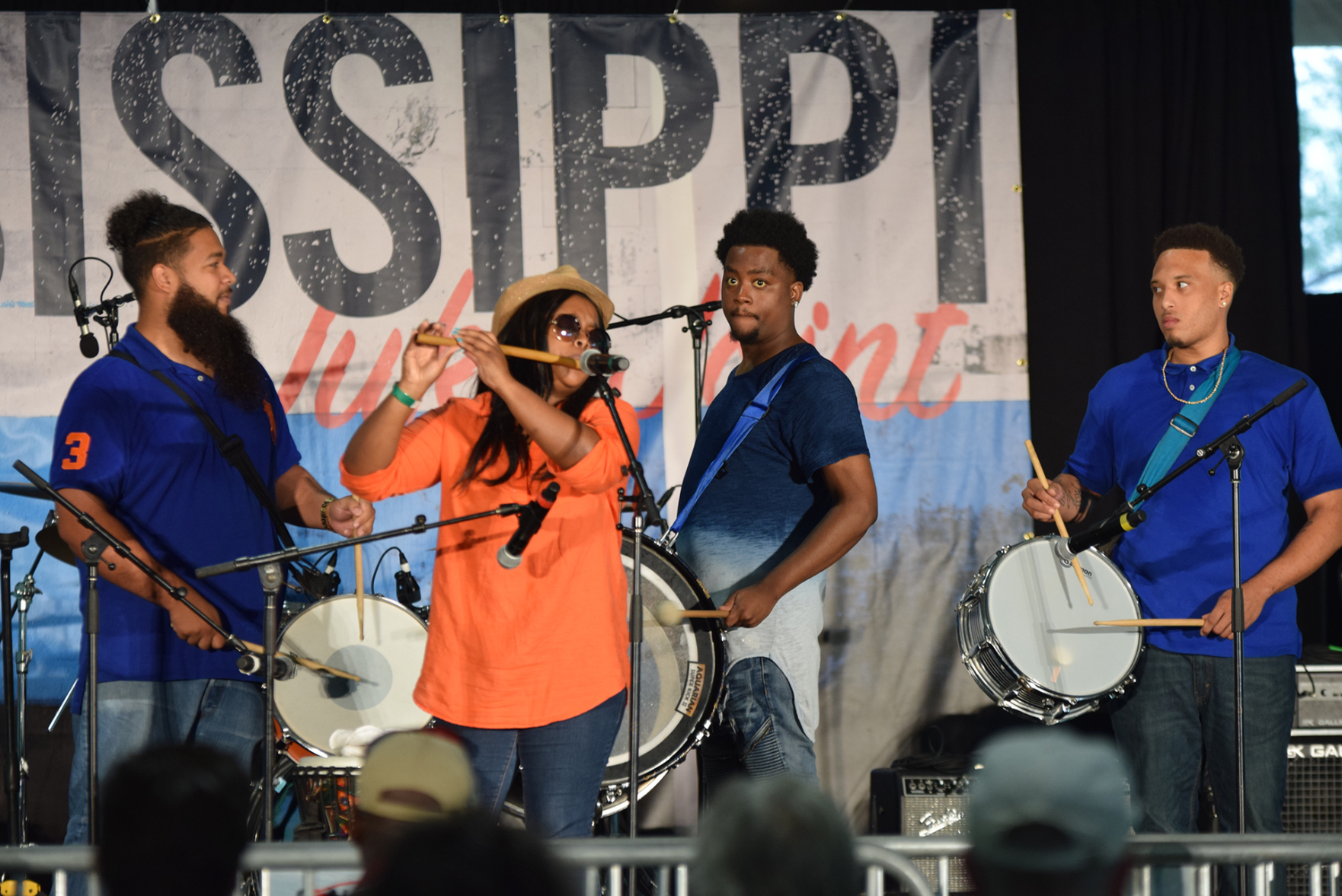
Shardé Thomas and the Rising Star Fife and Drum Band
A century after its heyday in its Mississippi birthplace, blues continues to evolve in unlikely places — including Mississippi. The circumstances that spawned blues in the early 20th century are mostly gone, and what remains of that culture can primarily be found in the physical landscapes of the Mississippi Delta and the state’s Hill Country, which is separated from the Delta by a few miles. So you could travel to Mississippi to see the landscape, visit tourist sites and hear re-creations of the old-time music. But this weekend, Nashville is the place to be, as a longtime annual event offers the opportunity to see Shardé Thomas and the Rising Stars Fife and Drum Band — the foremost living practitioners of a style that is even older than the blues, but which also draws from blues and popular music.
Thomas’ music recasts blues in a form that draws upon North American and African traditions, and it has nothing to do with nostalgia. She and her band will perform Saturday at An Ode to Otha, the 25th annual installment of an event that connects Nashville and Mississippi. The party celebrates the birthday of Thomas’ grandfather: legendary fife and drum master and Rising Stars founder Otha Turner, a sharecropper who lived in Tate County, Miss., and achieved worldwide fame before he died in 2003. Turner was awarded a National Heritage Fellowship in 1992, and saw his music used in Martin Scorsese’s 2002 film Gangs of New York. An Ode to Otha is organized each year by Nashville lawyer Bill Ramsey, a friend of Turner’s who shares his June 2 birthday.
The event is a benefit for the Second Harvest Food Bank and is a party and picnic complete with multiple bands, food and kid-friendly activities.
Ramsey’s annual celebration aims to carry on the spirit of Turner, who for decades oversaw picnics at his farm in the Tate County community of Gravel Springs. Ramsey had first seen Turner (who sharecropped on Ramsey’s grandfather’s plantation) play in Mississippi around 1960, when Turner’s music was known only to folk-music collectors. Eventually, Ramsey and Turner met, with the Nashvillian bringing Turner and Rising Stars to town to play as part of an early-’90s Tennessee Dance Theatre piece composed by musician Max Carl.
“Otha Turner was a force of nature,” Ramsey tells me from his Nashville office. “We used to go to that picnic down there, and I don’t even know how many people were there — 800, 1,000, 1,600 people. When Otha was there we never saw a fuss or a fight. If Otha heard about one coming up, he would just walk over there and stop it, by the force of his personality.”
Turner, who was born in Madison County., Miss., in 1907, personified a style of music that, like blues, blends African and North American approaches to rhythm and melody. Turner sang and played a homemade cane flute to the accompaniment of snare and bass drums. His approach was derived from a style of music that developed in the West African country of Senegal, and began spreading in America in the 1700s as African American slaves started performing in and forming military bands.
When I saw Turner perform in Memphis in the ’90s, he played staccato pentatonic melodies, while the drummers created patterns that often seemed ready to roll free of the bar lines. Turner’s music reworked blues songs like Willie Dixon’s 1955 “My Babe” and The Mississippi Sheiks’ 1930 “Sitting on Top of the World” into folk music. What mattered in Turner’s performances was pattern and repetition that encouraged movement — principles his granddaughter continues to honor.
“We like to keep it fresh, to interact with all ages in the audience,” Thomas says from her home in North Mississippi. Born in Senatobia, Miss., in 1990, Thomas began playing fife when she was 5, and took over leadership of Rising Stars after Turner’s death. She has toured with the band in Europe and recorded in Nashville with Americana duo Blue Mother Tupelo, who will also appear at the Ode to Otha picnic.
“We continue to do ‘My Babe’ for the old fans, and we might throw ‘Little Sally Walker’ in, or ‘Wild Thing,’ ” says Thomas. “Lately we’ve been doing [Elle King’s] ‘Ex’s and Oh’s,’ and the kids really love that one.”
Thomas has modernized one of America’s oldest musical forms, becoming an international star. She and her band may be the last surviving practitioners of this particular tradition in fife and drum music — a role she finds both satisfying and thought-provoking.
“I think if I ever stop, it will be the end,” she says. “That’s the scary part. I wouldn’t want that to happen. I don’t want somebody else to just pick it up and carry it — unless they carry it on the right way.”




