

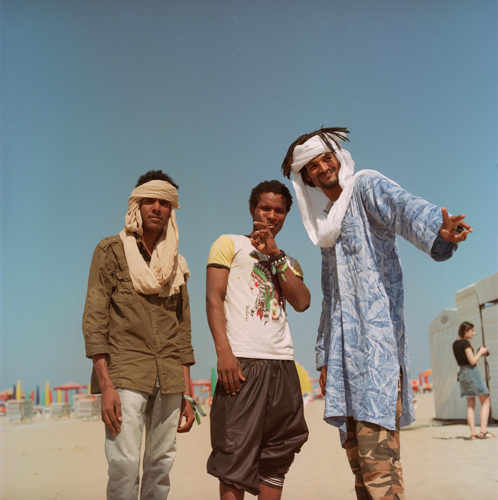



How do you describe truly captivating sounds without either sounding like you’re trying to sell something or you’ve lost your grip on reality? That’s a key consideration when telling someone about the work of Mdou Moctar, an astounding guitarist hailing from Agadez, Niger. For many years, musicians in that desert village have been making experiential music that reflects on both the nomadic roots of the Tuareg people who live in the region and the ways that technology can be used to enrich the creation, performance and distribution of art.
The Agadez sound is hypnotic and transcendent. It’s nimble and quick to evolve, alive in the moment, but also reverent of heritage. There’s a fascinating synchronicity between these electric-guitar-fueled desert-blues compositions and the fact that the primary venue for their performance is wedding parties — occasions when tradition extends its roots into the unknown, as the newly joined lives face an uncertain world that can spin them off in any number of directions. (There are several must-see videos of these parties on YouTube.)
If you’ve never heard Moctar, you should first know that he is an absolute badass player, and it’s no exaggeration to rank him among the best living guitarists. What Moctar does with his instrument requires a high degree of technical skill, but channels emotion in a way that’s impossible to quantify. It’s something akin to what the late Qawwali master Nusrat Fateh Ali Khan did with his voice, an instrument of praise and peace that can reshape consciousness as well as bring down the house with its ferocious passion.
Moctar has released several records through Chris Kirkley’s Portland, Ore., label Sahel Sounds. The label made a name for itself with its three-volume compilation Music From Saharan Cellphones, whose name references a primary way people in West Africa store and share music. Moctar’s track “Tahoultine” was on the first volume, and provided some Western audiences with their first exposure to him.
The film Akounak Tedalat Taha Tazoughai was the way in for many American audiences. That was definitely the case here in Nashville, where it garnered an ecstatic response at the 2015 Nashville Film Festival. A loose riff on Purple Rain — released with the English title Rain the Color of Blue With a Little Red in It, since there is no word meaning “purple” in the Tamasheq languages spoken in the film — Akounak keeps the iconography and basic structure of the 1984 classic starring Prince, but eschews the misogyny and sexual content. That actually makes it a great way to introduce younger audiences to the idea of Purple Rain without any trips to Lake Minnetonka.
The film is an ideal introduction to Moctar as a personality and musician as well. Because of the film, and the exposure it enabled, he’s been able to expand his reach exponentially. He’ll make his first visit to Nashville on Wednesday, thanks to the city’s most fearless and resourceful promoter, Chris Davis. Back in 2012, Davis booked a now-legendary show at VFW Post 1970 featuring Bombino, another phenomenal Tuareg guitarist, which helped grow a local audience for the sound of Agadez. And Moctar finally making his local live debut is one of those opportunities that come along once in a blue moon — with a little red in it.
Email music@nashvillescene.com



