
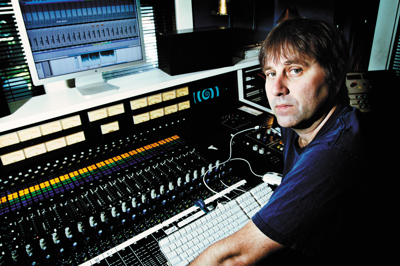


Mark Nevers at Beech House Recording, 2006
“The Beech House is actually just a part of the whole Nashville experience,” producer Mark Nevers says about the renowned Music City recording studio he closed earlier this month. The closing comes after 30 years of hosting a remarkable assortment of rockers, folkies, soul singers and country legends.
The disappearance of Beech House Recording marks the end of an era of Nashville music that saw local rock bands (many of whom Nevers recorded at the unprepossessing bungalow he converted into a studio) begin to achieve international prominence. It’s a sad time for Nashville music fans, but the Arizona-born producer, who is moving Beech House to Pawleys Island, S.C. — a small town about 70 miles up the coast from Charleston — takes a sardonic view of the situation.
“I was gonna mow the yard one last time and let it die in dignity,” Nevers tells the Scene. “But I thought maybe it’d be better to let it just haunt for a while and scare the neighborhood before the lawyers come and erase everything I’ve ever done, like Tibetan sand art.” He isn’t exaggerating: Nevers says the house at 2021 Beech Ave. will be torn down in the next few months to make way for new development. As he says, he tried to make a deal that would have preserved the house itself, but the realities of Nashville real estate quashed that notion.
I first met Nevers in 2006, when this paper asked me to profile him. Interviewing him at Beech House, I found Nevers funny, caustic and knowledgeable — a punk acolyte who viewed country music as a combination of high art and lowbrow folly. A few months after the Scene piece ran that spring, I returned to Beech House to talk to him about his production of country singer Charlie Louvin’s Charlie Louvin, a record that features guest stars Marty Stuart, George Jones, Tom T. Hall, Bobby Bare Sr. and Elvis Costello, who contributes vocals to Louvin’s rendition of “When I Stop Dreaming.” Nevers’ production turned Charlie Louvin into an uncommonly nuanced country record, and the album garnered a 2007 Grammy nomination for Best Traditional Folk Album.
Born in 1964 at Luke Air Force Base near Phoenix, Nevers enjoyed a peripatetic childhood before his family settled in Myrtle Beach, S.C. He weathered experiences as an engineer on country sessions at Franklin recording studio The Castle that would color his perceptions of Nashville’s greatest export, and he quit the music business once in 1995 to work as a chef. Returning a few years later to toil again in the trenches of big-time big-hat country, he felt the indignity in working in a place where, as he told me in a 2012 interview, no one ever remembered his name.
Nevers left mainstream country for good during the Castle sessions for Australian singer Jamie O’Neal’s 2000 single “There Is No Arizona,” which topped the country charts that year. “We were so happy when she wasn’t singing, because the guitar solo was comin’ up,” he told me in 2012. “Then she would start screamin’ up on it, and it just got to be ridiculous. We were mixing that song all day — ‘There’s no Arizona, there’s no Sonoma’ — and I just didn’t go back after lunch.”
Drawing upon his time working on mainstream country hits, Nevers would create a post-countrypolitan sound at Beech House on later recordings by Bobby Bare Sr., alt-country singer Will Oldham and, perhaps most famously, pop-country avant-gardists Lambchop. A versatile producer and engineer, Nevers also recorded gospel music in the ’90s, capturing performances by such vocalists as O’Landa Draper and Shirley Caesar.
You can hear gospel influences in Nevers’ production of Lambchop’s 2000 track “Up With People.” While recording had gone on in the space since Nevers moved in during the ’80s, he cites that song as the first true Beech House production, in which he and composer Kurt Wagner created abstract pop that is festooned with handclaps and disturbing youth-camp vocals. Nevers also recalls working with songwriter Vic Chesnutt, who died in 2009.
“We’ve still got a whole record that’s not been released,” says Nevers. “It’s called Preachy, and it was done over the last 10 years before he died, just little chunks at a time. It was kind of his atheist record.”
In addition to recording Chesnutt, Nevers cut records at Beech House by idiosyncratic rock band Silver Jews, Alabama punk rockers Dexateens and country singer-songwriter Laura Cantrell. He may be best known for his work with Lambchop, which includes production on their lauded 2012 full-length Mr. M. But he seems equally proud of his production of Oldham’s 2004 release Sings Greatest Palace Music, an homage to ’70s country cut with a crew of veteran Nashville session musicians. Meanwhile, Nevers’ 2006 album with Music City post-formalist indie rockers Lone Official, Tuckassee Take, has gained a reputation as one of the finest rock records ever cut in Nashville.
Nevers says he plans to concentrate on mixing and the occasional recording project at his new location in South Carolina. For now, he’ll retain the Beech House name, but that could change sometime down the road. I ask him to sum up his time in Nashville, and he gives it to me straight.
“What was it I said the other day about my Nashville experience? ‘It’s been good: I recorded George Jones sing and I smoked Neil Diamond’s weed.’ It’s been all right. ”
Check out a playlist of 15 tracks chronicling Nevers' work at Beech House.
Email music@nashvillescene.com



