

It’s rare that the first four seconds of a record can not only articulate a thesis but also come to define an era. The Ronettes’ “Be My Baby” does it. Aretha’s “Dr. Feelgood (Love Is a Serious Business)” does it as well. “Dre Day” by Dr. Dre, and Radiohead’s “The National Anthem” accomplish this too. But in the long, long ago of 1988 — as if to find the unexpressed common ground between “Venus in Furs” and “I Feel Love” — one of these moments came to define an era, a sound, a philosophy, a whole bunch of cyberfetish/click-and-drag club nights, and a vibe that still persists. It’s three words in five syllables and the naughtiest, most throbbing synths you’ve ever heard — “Dar-ling come heeeeee-re,” and then it’s all over for these hoes. And yet, it had just begun.
When Psychic TV was talking about Thee Infinite Beat, when Prince talked about grinding on “Darling Nikki,” what they foresaw (and foreheard) was the sound of Lords of Acid’s “I Sit on Acid.” Jump forward to today, and to put it bluntly, we have the architects of the modern apocalypse trying to figure out if the LLMs they’ve created have developed consciousness — though they never stop to think whether we know if machines fuck. “I Sit on Acid” is our proof that they do. The Lords started as one of many projects for the great Maurice Engelen (also known as Praga Khan and Somora, among many other noms de disco), along with Jos “Chris Inger” Borremans, the late Koert “Harry Van Oekel” Hendrickx, Nikkie “Jade 4U” Van Lierop, and eventually Olivier Adams. The sound of Belgium’s New Beat was created in bedroom studios with lots of friends, with new concepts and identities proliferating all over the place.
How do you talk to Maurice Engelen and keep your cool? Thankfully, I never had any cool to begin with. So I approached my recent Zoom interview with the dance-music legend — ahead of the group’s Oct. 29 Nashville show at Hit Parader, on Part 2 of the Cheeky Freaky Tour with the Bad Babysitter herself, Princess Superstar, as well as Tony & The Kiki and Mz Neon — from a place of dance-floor respect.
Earlier this year another New Beat musician, Annick “Miss Nicky Trax” Vermeulen, passed away, and Engelen posted a brief excerpt of behind-the-scenes footage in tribute. In the clip, Vermeulen and a friend — the frontperson of a short-lived group called Boy Toy, possibly Van Lierop but not confirmable to any journalistic standard — are dancing and getting their look together backstage before a live performance (a “live PA” if you’re old-school) at the well-known Destelbergen club Boccaccio Life. The music is pumping: You can clearly make out Plastic Bertrand’s “Plastiiic” and Brandon Cooke featuring Roxanne Shanté’s “Sharp as a Knife.” In less than 30 seconds, all the years fell away, and this little slice of life planted the seed for this interview. Our conversation has been edited for length and clarity.
I love all the news footage of that era that’s available, and documentaries like The Sound of Belgium. But that little video made the music of my youthful rebellion feel defiantly alive. You’ve made so many amazing records with so many different collaborators and under so many different names. Did you ever have any indication that you’d be touring the world with music like “I Sit on Acid” almost 40 years later?
No, not at all. I also ran the label Antler-Subway at the time, and “I Sit on Acid” was released at the peak of New Beat. It was just one of the projects we were working on at the time. We were all so creative and energetic, and it felt like we were starting something new every week.
But when I finished that record, it felt like at that time there were two big record shops in Belgium [whose staff] knew what was going to work and what was not going to work. And I went with the cassette tape to talk to the owners of Music Man [now Music Mania] in Ghent and to USA Import in Antwerp, and they said “It’s too heavy; it’s never going to work.” And I remember driving home and I was so depressed because I loved that song, and all the tension in the music. But eventually it did become a hit in Europe, [though] the New Beat sound died out. All the New Beat records stopped selling … except for “I Sit on Acid.” Because of the label, I was also seeing the orders for how many records needed to be pressed. Every month it was a few hundred more copies, and they were all going to America.

There was nothing like that record at the time. You had house records and interesting permutations of that sound. I had friends who weren’t really interested in dance music, but they knew “I Sit on Acid” and vibed with it. The This Is the New Beat compilation was essential to my experience with the way Belgium was shaping the club scene. Then the first U.S. pressings of “I Sit on Acid” had that incredible “Mixin’ Up the Acid” version that mixed in bits of other New Beat hits, which let the listener know what to look for.
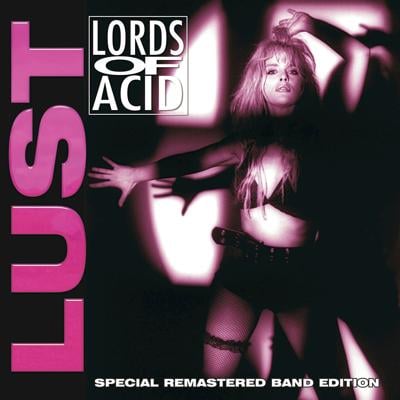
I got a call from Caroline Records, and they asked, “Can you guys make an album for Lords of Acid?” And I said, “We can do it, but we’ve got very little time between two tours.” So I called up my friend Olivier, and we recorded the Lust album from scratch in three weeks’ time. So we sent the record overseas to Caroline and went back on tour. This was 1990, pre-Internet, no cellphones. And the next thing we know we’ve sold several hundred thousand copies in America, and it’s all because of “I Sit on Acid.”
Lords of Acid has a fascinating legacy in America, especially with the second album, 1994’s Voodoo-U. As a distributor you had Rick Rubin’s rave imprint WHTE LBLS, and then there was all the controversy over the key art and some of the lyrics. There were earlier controversies with porn samples in some of the bigger New Beat tracks, but had you ever experienced anything like what happened when America started freaking out about Voodoo-U?
We’re European, and we didn’t think it would be that big a deal. We’d had some sexy lyrics and samples, some of Karen Finley’s “Tales of Taboo.” People were dancing in the clubs, and not overly concerned with any overly horny lyrics. But with Lust and Voodoo-U in America, we would have some complaints, but also a lot of reviews that would say, “Spare us this filth.” This was the time of the Explicit Lyrics stickers — which were like big promo for us, because when you forbid something, it just works as extra promotion.
To this day on Discogs, they still hide the covers for the Belgian 12-inch of “I Sit on Acid” and the Coop cover for Voodoo-U until you sign in and prove you’re over 18. It’s kind of amazing that these records still hold that kind of power — just in their imagery, before you even get to the music. In light of this background, what sort of mindset do you have to adopt to make a new Lords of Acid record? Mundo Bizarro (out now on Metropolis) is your first since 2018, and “Dopamine War” and “You’re Obscene” are my favorites on it.
I see it as the soundtrack to the very strange world that we’re living in now. Everything has become very surreal, it’s hard to know what’s real, or deepfake, or just social media. And I wanted to make an album about it, but I didn’t want to make it depressing. So I made it colorful and funny and dirty — and sometimes completely over the top. But that’s how it feels at this moment.
Over time, the amount of gear you have to carry on tour has diminished significantly. You’re not having to lug around vans full of sequencers and processors and racks of synths.
Nowadays you can store your sounds and plug-ins on MiniDisc or USB stick, you can use your mixer for a lot of the programming, you can set up your lighting — and it is easier. I can remember back in the day, playing shows and having to have the exact right samples. And I remember my old Akai sampler, having to load 25 diskettes worth of sounds into that sampler before the show started.
There are quite a few legendary anecdotes about how on the Sign “O” the Times Tour, Prince and his synth tech had to post big notes on their Fairlight CMI that said “Remember Source Discs and Keys.”
And when the electricity would fail or fluctuate, and you’d have to start loading again for 20 minutes. Or using analog synths onstage, like the old ARP 2600 — where you would take it from the car to the venue, and if it was cold it would detune, so you would have to retune everything before getting underway. … It’s much easier now.
I started making a list of my favorite tracks you’ve been involved in, and I had to stop after 30. These are songs I keep in my DJ crate, that I still play out — and there are so many. These are records that have made impressions on all sorts of people throughout the years. I mentioned that I was going to talk to Praga Khan, and without hesitation I would get back “Injected With a Poison!?!” That was the sound of 1992 at Show Choir camp. Here in Nashville, we had an amazing drag performer named That Girl, The Politically Correct Sex Kitten. She would perform Lords of Acid’s “Pussy,” and she turned it out and made it a local club anthem. Looking back on it all, what’s your favorite of all your records?
“Acid Queen” [from a pre-Lords of Acid project called Major Problem] is probably my favorite. I remember when that one came out, Renaat [Vandepapeliere, cofounder of the R&S label] said, “Wow, where did you get that sound from?” Because it has that special sound that you can never quite re-create, because of the analog synths we were using at the time. And the Rolands — we had to write out all the notes to program for the 303 and the 808. Back in the day you didn’t have too many sounds, not like now, and your choices weren’t about the sounds but what you could do with them.
My absolute favorite of all of your productions is Miss Nicky Trax’s “Acid in the House.” People today are blown away by it. It sounds like something from another world. It’s from Planet Belgium 1988, and it’s transcendent.
[Laughs.]
Luther “Uncle Luke” Campbell from 2 Live Crew is now a politician. The most depraved of hair metal bands are now corporate institutions. Death and entropy have unraveled so many of the subversive voices of the past few decades. And the Lords are still here, evolving, holding court, offering the sound of the synthetic reaching to encompass the moist and messy aspects of the human id. What began as one of myriad musical endeavors tapped into something in the subconscious of an entire generation, and now, here we are, closing in on four decades of expressing the sound of decadent global liberation.





Post a comment as anonymous
Report
Watch this discussion.
(0) comments
Welcome to the discussion.
Log In
Welcome to the discussion.
Keep it clean. Please avoid obscene, vulgar, lewd, racist or otherwise abusive language. Comments featuring hate speech or threatening or violent content will not be tolerated.
PLEASE TURN OFF YOUR CAPS LOCK.
Be truthful. Don't knowingly lie or mislead.
Be proactive. Use the “report” link on any comment that violates our comment policy.
Share with us. We'd love to hear your feedback.