

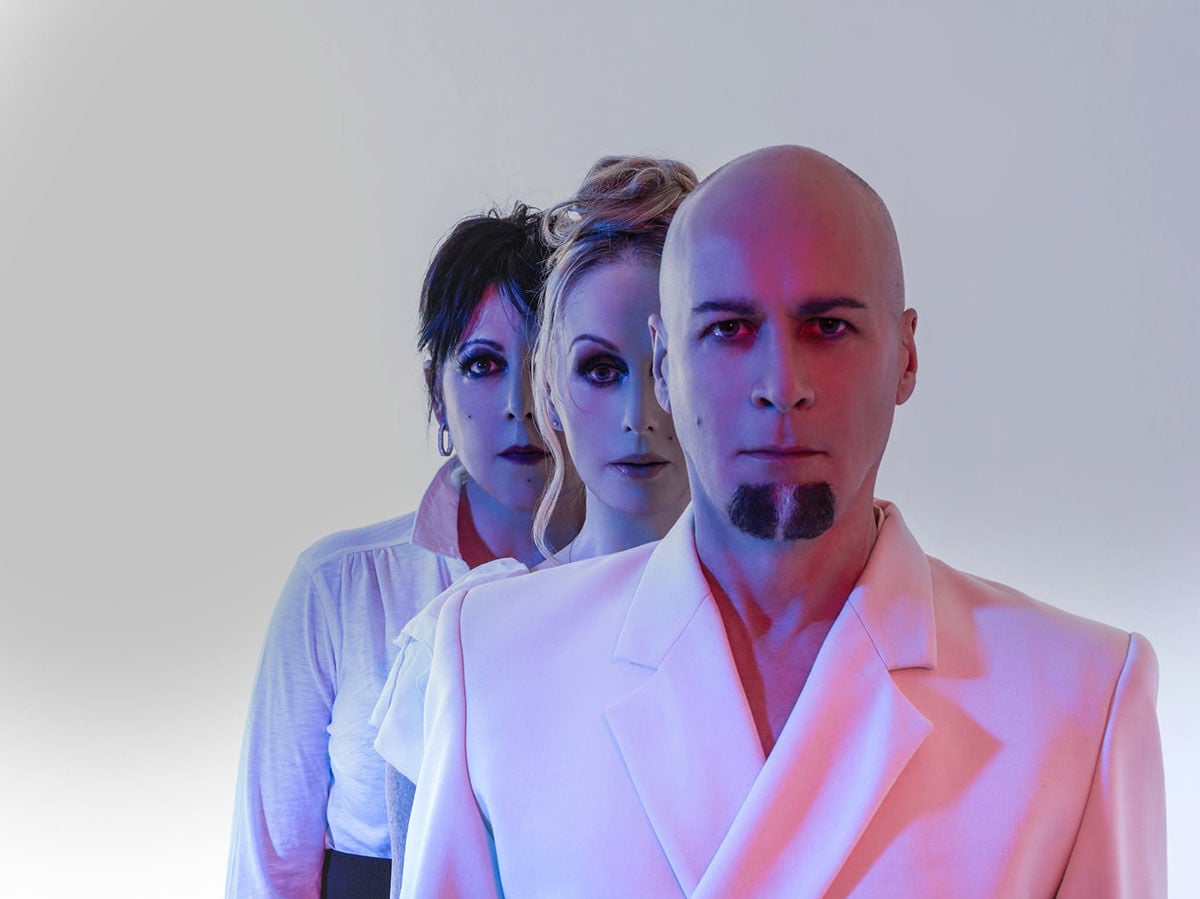
The Human League
With their career coming up on five decades long, The Human League is more than the Fleetwood Mac of electronic music — though that’s a fair and equitable comparison for beloved bands who completely reinvent themselves from the inside out with an infusion of new members and a shift in perspective. The group is part of the enduring scene of England’s Sheffield, the setting for the soul-shattering Thatcher-era film Threads that also gave us Def Leppard, Pulp, Whigfield, ABC, Cabaret Voltaire and Arctic Monkeys. Both The Human League and Heaven 17 (who arose from HL’s 1980 schism) have been part of the global pop music discussion across multiple genres for multiple decades.
Through it all, frontman Philip Oakey has been serving impeccable songcraft, visionary design, and a willingness to reflect and refract the world around with style, grace and an unflinching eye on global politics. Getting a chance to talk to one of the greats is always an intimidating delight. Oakey spoke with the Scene via phone earlier in the spring in advance of the band’s Opry House performance on Sunday, which will also feature Alison Moyet and Soft Cell. Our conversation has been edited for length and clarity.
I’ve never spoken to someone who had a No. 1 single in both the U.S. and the U.K. — which really meant something when “Don’t You Want Me” came out in 1981. What was it like for you to have a transatlantic smash hit?
Scary, because we [sensed] that we would stop being in charge of our own careers at that stage. We’d managed to do three albums more or less the way we wanted to do them. And we knew that we would start getting so much advice that it would be hard to ride that storm. And it did turn out that way. It was baffling, because we really did have about 10 years where we were a little lost. We knew we weren’t as good as people thought we were.
As chaotic as that time must have been for you, some of that work is incredible and endures. I’ve heard people cover “Louise” in dive bars here in Nashville, a big country music town, and it goes over like gangbusters.
I would love to hear that. … My girlfriend actually asked me about that last night — if “Louise” was meant as a sequel to “Don’t You Want Me.” And I said, “Yeah, it’s the same two people." Apparently that was the legend for a time.
Do you think it’s fair to call “Don’t You Want Me” the national anthem of the ache of love?
Yes. I don’t think anyone has ever said “ache” before. I’m always surprised that people don’t notice that it’s a power politics song. It’s a man trying to control a woman when he does not really stand a chance. And so often people will say, “Oh, it’s just a bit of a love song.”
The glorious, martial, cold sound of it reinforces that so well. It’s always an electrifying moment when you’re at karaoke, and you’ll see a couple sing it — and as they’re singing, they’re realizing what the song is really about, and you see it becoming awkward in real time, in a beautiful way.
There’s a lot awkward about us.

Checking in with the eminent singer and songsmith ahead of her Nashville debut at Marathon Music Works
“Together in Electric Dreams” is a beautiful song, an anthem really. I don’t know if this was the case in the U.K., but in the U.S., particularly during the HIV and AIDS plague years, a lot of DJs would play that as their last song of the night. It was a dedication to those lost and something aspirational, a hope for something beyond all this.
I don’t think anyone has ever mentioned that. I’m glad you said it. The basic story behind it was to do a happy song for the end of a film [Steve Barron’s 1984 Electric Dreams]. [Giorgio] Moroder wrote it and said to the director, “Who can sing this song in a way that will make people leave the cinema in a good mood?” And Steve Barron suggested me. So I’m glad it’s been more than that. In the wake of the COVID pandemic, a lot of people have forgotten the devastation that HIV and AIDS caused for so many communities. And anything that connects to remembering that is good.
Jumping around a bit, what’s the story with your appearance on “What Comes After Goodbye” by Respect?
I think they were just some people we knew. I had the world’s tiniest record label [Superealism], with one record by a gospel band called Eliakim, and Malcolm [Walmsley] had produced the record. So as a favor a few years later, I said “I’ll sing on your record.” And I wish it had been more listened to.
Did you ever get to travel on the Concorde?
No, I didn’t, and I’m such a geek that the Concorde looms in my mind. Sometimes I think that’s what proves we’ve gone backwards, in that we used to have a really fast airplane, and now we don’t. And there’s something very sad about that.
That feeling definitely informs your track with the Pet Shop Boys, “This Used to Be the Future,” which I love and should have been a single.
I always wanted to try and do a ballad with the Pet Shop Boys. Whenever I would see Neil [Tennant] I would tug at his shirt and say, “We should be the new Righteous Brothers.” Maybe we’re not too old for that.
You’re all still working and making great stuff. I’ve always found it really funny that ZTT Records ripped off their record classification system from The Human League. It all has to come from somewhere.
Paul Morley, ZTT’s director of marketing and media, was one of our early champions, so they were very welcome to it. He definitely helped us, so we helped him.
He is a great writer — his collaboration with Grace Jones on her autobiography is stunning. On your ’90s run at EastWest Records, I want to thank you for introducing me to the work of Martin Freeland (Man With No Name), because that remix of “These Are the Days” was my way into Goa trance.
It’s fascinating and inspiring how The Human League’s songs have remained part of musical culture by your work being in dialogue with that of other musicians through the years. “Love Action (I Believe in Love)” is an anthem. But look at the way Utah Saints transformed it into their track “Believe in Me,” and then later incorporated “Love Action” into a remix of another of your songs, “Tell Me When.” Then “Love Action” became the cornerstone of George Michael’s “Shoot the Dog,” one of the most politically angry pop songs of the Tony Blair-George W. Bush era. That was a different time, but the work endures. Those songs are still with us. That art is still with us.
I don’t want to get too academic about it, but I think pop music is like language. The way that it develops and incorporates what came before. And then all of a sudden, 20 years later I realize I stole something from an Iggy Pop record at some stage and then just forgot. That’s why copyright in music sometimes worries me. I mean, I quite like earning money, but we all depend on the people that have gone before, and we owe it to the people that come after, to give them a chance to add their stuff to it. That’s my thoughts on pop music — it’s just people talking to people across the years.
I was going through my CDs in preparation for our conversation, and man, “Heart Like a Wheel” hits way harder these days. And sadly, that’s the world, I guess.
The longer you look at it, the more you start to think nothing seems to change. We think things are going in a peaceable direction, and they’re not. But I think there is some comfort there, because people have always survived. And the worst and scariest things that have happened, people have managed to survive.
The cycles of history can be comforting and terrifying. I am among many who are very psyched to see you and Susanne and Joanne when you come to Nashville.
We can’t wait. Nashville was the first place I ever saw fireflies. I had heard of them, but I was walking through Nashville, and I saw them flying around the trees, and I was amazed.



Post a comment as anonymous
Report
Watch this discussion.
(0) comments
Welcome to the discussion.
Log In
Welcome to the discussion.
Keep it clean. Please avoid obscene, vulgar, lewd, racist or otherwise abusive language. Comments featuring hate speech or threatening or violent content will not be tolerated.
PLEASE TURN OFF YOUR CAPS LOCK.
Be truthful. Don't knowingly lie or mislead.
Be proactive. Use the “report” link on any comment that violates our comment policy.
Share with us. We'd love to hear your feedback.