
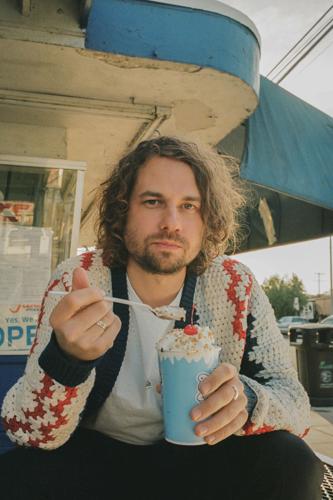


Kevin Morby is a prolific and widely traveled singer-songwriter, who has lived in places as varied as Kansas City, Los Angeles and Brooklyn. He draws a significant amount of inspiration from places he visits — their past and the history that they’re making right now.
In May, Morby released his seventh solo record This Is a Photograph, a folk- and soul-schooled collection of rock tunes heavily influenced by time he spent exploring Memphis. The hard-driving title track and a gentle collaboration with Nashville’s own Erin Rae called “Bittersweet, TN” are among the standouts of the 12-track set. Morby, who’s played Nashville several times over many years with various projects, will be back on Oct. 15, headlining at The Basement East with support from Cassandra Jenkins. We took the opportunity to catch up with him by phone on a rare day off between gigs.
When you’re playing different cities, are you taking time to explore in your off hours?
I feel like I’m a very external person when it comes to my relationship to the world. I do like to get out into it as much as possible. I don’t like to stay inside for too long a period of time — whether I’m walking or running, I really like to interact with my environment no matter what it is. I try to put in the effort to go out and make myself known to a place — that I’m open to being called to it — but I also feel like there’s something almost unexplainable, or hard to put into words, and a place every now and again will just really call me.
It’s sort of a circumstantial thing, at specific times in my life. A place will suddenly click and make a lot of sense to me, and it’ll be something that I really want to go and figure out, some mysterious quality that suddenly seems so appealing to me.
And at that point, you know a specific place will be in your future?
Yeah, for sure. I read this book about Oklahoma City a couple years ago called Boom Town. [Author Sam Anderson] said this thing, that when he landed at the airport in Oklahoma City to write, he said that there was a barometer or a needle that started to resonate inside of him that he didn’t even know was there. And I thought that was such a good and apt way of talking about that feeling where suddenly without trying, or really realizing, this energy starts to build. You get this buzz where you’re like, “Oh, I need to explore this place.”
Was that what it felt like deciding to go to Memphis?
I’ve been touring since the early 2000s, and a big thing that’s happened with almost every American city in most of the markets I’ve been touring in is that they’ve all sort of become the same. And ever since the iPhone and Uber, or these scooters you can take everywhere, there’s just this certain sort of style with these cities that have gotten the same makeover. I found myself missing how cities used to feel where they felt a little grittier but full of opportunity, specifically for the arts.
I was missing that. And I went through Memphis, and the moment I was there, I recognized it as a place that felt like it was one of those cities that I used to go to. It was how cities used to feel five or 10 or 15 years ago. I had this thought: Memphis — you never hear about shows being here. You never hear about too much going on here. Or at least I don’t. It’s kind of what [the author] gets out in Boom Town: I just felt this needle start to resonate in me. I was like, I wanna play a show here and I wanna come back here and explore it. I found something and I needed to explore it.
I understand what you’re saying. There’s a joke among me and some friends who grew up in Nashville that Memphis is the Nashville we remember. It reminds us so much of Nashville 15 years ago.
It’s a combination of so many factors.
Where were you staying and hanging out?
I was downtown at the Peabody Hotel. It was COVID — this was all in 2020, but I’ve returned a lot since. If I’m naming my favorite spots, I love Earnestine and Hazel’s; I call it my favorite bar in America. I love all the touristy stuff. I love the Civil Rights Museum. I love Sun Studios; I recorded part of my record at the Sam Phillips Recording Company. I’d spend a lot of time at the Crosstown Concourse. Obviously I love the Peabody. And I just love the river — you know, I just hang out at the river a lot.
I love river towns. You can always get your bearings by knowing where the river is. Some of those places that I just named, though, I wasn’t going into those when I was writing there because it was COVID. I would try to hang out more at the river, natural open spaces — where I didn’t feel like I would get COVID — that were very interesting to me. I’d weirdly hang out at the Memphis Zoo, too. There were a lot of different types of places I was hanging out at.
Any cities you want to spend time in next? Any on that list where you’re feeling that compass pull?
Not right now, honestly. I’m just out in it, touring the world right now. I’m going back to Memphis to do a photo show this winter and I’m really excited for that. I’d say my fascination still kind of lies in Memphis.
Actually I’ve been feeling a little bit pulled to, like, God’s Country — like Big Sky Country, Montana and all of that. It’s kind of an unexplored place for me: Idaho, Montana, just out there where it’s super wide-open. That’s been a place I’ve been feeling a little pulled in that direction recently. It’s certainly a place that is a contender on my next place to go do some writing.
Erin Rae, who you worked with on “Bittersweet, TN,” is very familiar in Nashville. I’m curious what relationship you have with Nashville now as an artist or tourist.
I remember I played Nashville a couple of years ago and I thought to myself, the amount of industry people here and the amount of friends that I have here, it feels like I’m in New York or Los Angeles. It’s just grown so much. And I know that comes with a lot of mixed feelings. The plus side for me, as an outsider, is, you know, my shows have grown there. And I have so many friends there, so going there is really fun.
Do you remember your first time in Nashville?
It was a long time ago. I think it was my band Woods, probably in 2009. It was so much more desolate than it is now. I remember playing at that venue The End — there was a really wild sound guy, who I’ve heard since passed away, trying to sell us cocaine — and I remember walking to a sushi place that had a picture of Harmony Korine on the wall. I remember thinking: “Nashville is mysterious. And kind of amazing.”
Did you make trips over here while you were making This Is a Photograph?
I took a few trips out there, and Erin Rae and I made a music video out there. And then also, before I recorded the record, I was going out there to show her the song and rehearse the song before we took it to the studio. We have the same booking agent, Adam, who lives in Nashville.
As far as I can tell, Bittersweet is not a real place in Tennessee. Is it a hypothetical or constructed feeling of a place?
I meant for it to be a metaphor, a way to say “America” without saying “America.” I liked the name of something called “Bittersweet, TN,” that represented all the beautiful and ugly things about the United States.
Were there places in your mind you were importing from?
Honestly, the Memphis area and West Memphis, Ark., going into Memphis. Mississippi — I would drive to Clarksdale a lot going down Highway 61. That part of the country carries such a weight. Cotton fields, which have such a heavy history in this country. The river, which means so many things at once. I just feel like that part of the country highlights a lot of beautiful things and our ugly history. That’s what was in mind.
Also the drive from Kansas City to get to Memphis — just a really pretty drive through Missouri and Arkansas. The landscape is beautiful, but especially during COVID, there was so much Trump propaganda, and you see the ugliness and the beauty. That drive and Memphis as the destination.
You seem pretty in tune with space and geography, cities and the state of America. You hit on a lot of things we’re talking about a lot in Nashville, especially with creativity amid a massive influx of money and development.
I feel like I caught the tail end of cities being bombed out from the ’80s and ’90s and white flight out to the suburbs. And I grew up in the suburbs, but then became very interested in the city. I really saw the high turnover going from these bombed-out places where I got my start playing on my first shows, in abandoned warehouses where cops wouldn’t come to bother you or whatever.
Those places now, they’re like luxury condos, and it’s just a wild thing. The thing is, you gotta just keep your mind open. There’s always gonna be a new thing or the next thing. I think, weirdly, the suburbs in this country and small towns — because they’re more affordable and these vacant places — will just sort of naturally become the next cultural hubs in a weird way. And I just have to be open to that.



Post a comment as anonymous
Report
Watch this discussion.
(0) comments
Welcome to the discussion.
Log In
Welcome to the discussion.
Keep it clean. Please avoid obscene, vulgar, lewd, racist or otherwise abusive language. Comments featuring hate speech or threatening or violent content will not be tolerated.
PLEASE TURN OFF YOUR CAPS LOCK.
Be truthful. Don't knowingly lie or mislead.
Be proactive. Use the “report” link on any comment that violates our comment policy.
Share with us. We'd love to hear your feedback.