
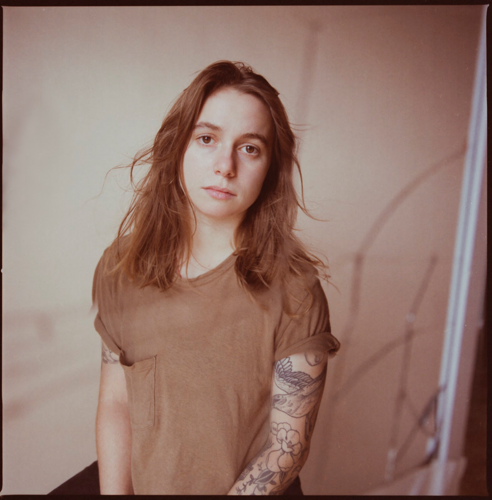
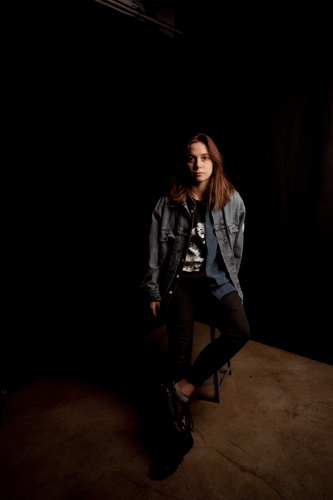
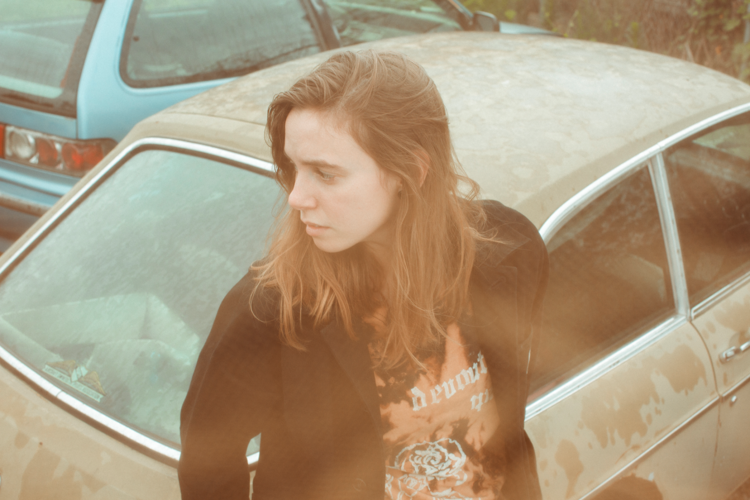


Julien Baker's 2015 debut Sprained Ankle made the songsmith an instant sensation. Baker was an undergrad at Middle Tennessee State University at the time, writing emotionally charged, Telecaster-and-pedalboard-powered tunes from her unique point of view as a queer punk rocker from a Christian family raised in Germantown, Tenn. — a Memphis suburb and a conservative pocket in a county that leans blue.
For Baker, Sprained Ankle attracted a congregation of folk, indie, emo and post-rock appreciators, striking a particular chord with other young adults from religious backgrounds striving to define spirituality for themselves. She and her band — a mix of Music City and Bluff City players that includes guitarist Mariah Schneider, bassist Calvin Lauber, keyboardist Noah Forbes and drummer Matthew Gilliam — have also endeared themselves to Gen-Xers with Jawbreaker and Death Cab for Cutie covers. In a KEXP session taped recently at Third Man Records, Baker busted out a haunting solo rendition of Soundgarden’s “Fell on Black Days.”
Baker signed to esteemed indie label Matador Records for her second LP, 2017's Turn Out the Lights. In 2018, she also formed boygenius with contemporaries Lucy Dacus and Phoebe Bridgers. The trio's self-titled EP led to a sold-out live debut at the Ryman.
With this raft of accomplishments, it's easy to forget that Baker is only 25. In 2018 and ’19, after touring boygenius and before starting on her third solo album Little Oblivions — released Feb. 26 — she moved to Nashville full-time and finished the English degree she'd put on hold when Sprained Ankle caught on. Outside of class, she spent time with family, rehearsed with her band and demoed new songs. Where Turn Out the Lights was turned around quickly, as second albums often are, this material got to marinate a while before Baker and Lauber headed into Memphis' Young Avenue Sound to lock in definitive versions.

Songwriting-wise, Little Oblivions doesn't mess with what's been proven to work. Emotional tours de force like the sweeping opener “Hardline,” soulful “Faith Healer” and spare, piano-driven “Song in E” are quintessential Baker. But the 12-song record has a different energy and tonal language from her others, crackling with a hard-edged, unprocessed sound that suits the material and the moment. Even with Baker playing nearly every instrument herself, it's more band-in-a-room than band-in-a-box.
Read our interview with Baker below, conducted Monday ahead of the release of Little Oblivions as the remnants of the mid-February ice and snow finally melted away.
Congrats on the release — I hope the snowstorm didn't wreak too much havoc on your plans.
My bandmates and I did have one taping to get to, for a ticketed streaming event. Thankfully we were able to carry our gear through the snow and make it.
How'd it go?
The thing about livestreaming that's so jarring for me is having the option to do another take. This set, there were a bunch of mistakes, but I didn't want to go back and redo them even if theoretically I could. You [can] be so much more of a perfectionist in this context.
Are you a perfectionist?
If you looked at my room and my laundry you wouldn't think so [laughs], but with music I've always been that way.
Between boygenius and Little Oblivions did you feel any outside pressure to stay touring — even at the risk of your own health and mental health — just to not lose momentum?
The pressure was internal. At the end of 2018, when I was done with the boygenius tour, people on my team — my manager, my booking agent — were like “You should take a break.” I did, and I had a hard time. I didn't have the inertia of being constantly on tour, and there were just a lot of things I hadn't coped with. It was evident to everyone way before me that it wasn't healthy for me to stay touring, but I wanted to keep going because I didn't know what else to do. I was so mad! I was pissed. I was like: “I tour. I am a musician. Riding around in a van playing music has been the most important thing in my life since I was 16. I don't know what else to do.” But it ended up being necessary and helpful.
The past year seems to have forced a lot of us to figure out who we are outside our work.
Completely. Productivity is a function of anxiety. We have this innate admiration for hard work as a character trait. It feels comfortable to be working on something, to have a task. But the dangerous thing about that is, it starts this backwards reasoning where the task is what you do, why you're important, your identity. It's a valuable thing to reaffirm your worth outside of what you make.
Did the experience of playing and touring with boygenius make you want to move on from the solo-artist vibe?
When I came off the road, wasn't touring and was just a person going to school — trying to get my degree so I would have a skill, because I didn't know if music could even be my job anymore — I was still making songs. When the stakes of living up to that preconceived notion were removed, I was allowing myself to just make the kind of music I wanted to make. Not to say what I was doing before was disingenuous, but when you have a public self that is parroted back to you all the time, it reinforces the notion of what you are, the space you live in. So I just dropped out of that space. I wasn't promoting a record, wasn't touring, wasn't tweeting about my new tune or the article that got written about me.
It's almost a revelation, then — that it turned out you still love it so much, the craft of it.
Exactly. The thing I've been hustling to do for years, what I wanted so bad, it happened. … But it turned out when that all went away, I still just enjoy playing an instrument. I don't want to say it rekindled my love for music, as if I'd ever lost it, but I think it got complicated by other elements [of] being a performing artist. Now, in quarantine, I sit at home and learn new chords on piano, and I love that. I feel empowered making music with less constraints.

Outside music, what's been some art — film, TV, literature — you've enjoyed recently?
I read [Viet Thanh Nguyen's] The Sympathizer. Well, I listened to it. I've been doing a lot of running because now I have time; I listen to audiobooks. I got to a point where I was so entrenched in my own music and I'd spent months listening back to mixes, picking apart every detail, that my music brain was just fried. It was comforting to be read to. The Sympathizer is about a double agent, a communist escapee immigrating to the United States. It's fiction, but it's about this person who existed in two realms — with two opposing ideologies, with two different groups of people — and what that single individual's experience was. I think about that a lot, how our ideologies define us. It won a Pulitzer Prize, and I get why.
Did any records by other people influence certain production choices on Little Oblivions?
Live in Berlin, by Torres [aka Mackenzie Scott]. I listened to that obsessively when it came out. It made me realize how much that artist had informed my music. I've been a fan of hers since her self-titled record. The aggressive, angular sounds on [Little Oblivions] — the idea that ugly sounds could be used in an otherwise beautiful song to give it dissonance and character — were something I first heard modeled by Mackenzie in Torres. She released her album Sprinter when I was touring Sprained Ankle, and I was blown away. It's a songwriter record, but it has so many little sounds that only happen once, that seem chaotic at first — but the more you listen, the more you see that they were very meticulously placed. Her palette of sounds and willingness to make things uncomfortable were things I admired.
As Phoebe Bridgers' friend and bandmate, I have to get your take on the SNL guitar smashing.
Dude. I don't understand how it could've been seen as anything other than awesome. The people being like, “Won't anyone think of the guitars?” Seriously? Phoebe calling David Crosby a little bitch might be one of my favorite things that I've been alive for. So funny. It's felt like sort of a social experiment reading the reactions. People being shitty about it … just say you hate women and move on. That might seem extreme, but literally all of the heroes of music who've been put in this hall of glory for what true artistic passion is did this same thing. Then Phoebe did it, used it as a tool in a new context of performance, and you don't like it? Fucking mind-blowing to me. I've said enough. [Laughs]
When Carly Rae Jepsen released her single “Julien” in April 2019, you tweeted about working on a song called “Carly” in response. Did that ever materialize?
[Laughs] No, but straight up, I'd lose my mind if I ever got to work with Carly Rae Jepsen. I love her. Now that I've made a record with drums, maybe the fourth album will be my full-on pop record.



Post a comment as anonymous
Report
Watch this discussion.
(0) comments
Welcome to the discussion.
Log In
Welcome to the discussion.
Keep it clean. Please avoid obscene, vulgar, lewd, racist or otherwise abusive language. Comments featuring hate speech or threatening or violent content will not be tolerated.
PLEASE TURN OFF YOUR CAPS LOCK.
Be truthful. Don't knowingly lie or mislead.
Be proactive. Use the “report” link on any comment that violates our comment policy.
Share with us. We'd love to hear your feedback.