
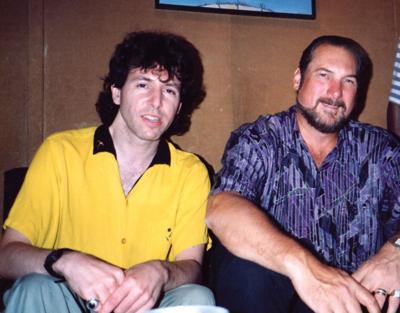


Jon Tiven and Steve Cropper in 1992
Even a short list of legendary music figures Jon Tiven has produced, had songs recorded by or otherwise worked with is impressive — mentioning Don Covay, Ellis Hooks, Wilson Pickett, Alex Chilton and Steve Cropper barely scratches the surface. But Tiven’s also a composer and multi-instrumentalist whose performing and recording career includes power-pop bands like The Yankees and Prix as well as his own ensemble The Jon Tiven Group. Tiven, who grew up in New Haven, Conn., was even a music journalist in his youth, with bylines in publications like Rolling Stone, Creem and Melody Maker.
In the wake of 9/11, Jon and his wife and fellow musician Sally Tiven made the call to relocate from New York to Nashville, where he previously had positive recording experiences. Tiven’s most recent project was producing Friendlytown, an album for the aforementioned legendary Stax Records guitarist and producer Steve Cropper. Released in August, the record features Cropper’s latest band The Midnight Hour and includes guest appearances from Queen’s Brian May and ZZ Top’s Billy F. Gibbons. I caught up with Tiven in a pair of recent interviews for some perspective on the release and his prolific career. Our conversation has been edited for length and clarity.
How does Friendlytown differ from things that you’ve done with Steve Cropper in the past?
In 2019, quite by accident, some of the things we started as song demos [on an earlier project] became masters when I brought my old writing partner Roger C. Reale into the picture to finish off our instrumentals, and Steve fell in love with his voice. Voilà, we had a creative basis for making [Cropper’s 2021 album Fire It Up].
When we got the opportunity to make a follow-up to that album, Steve and I were getting together to write instrumentals, but this time we knew who was going to write the words with us and sing it, so that gave us a lot more of an idea of what we had to do. And we had a drummer, Nioshi Jackson, who did some recording on Fire It Up, and then a live performance, which got us personally and musically tight after we were about halfway into the writing process.
Steve indicated to me he’d like another guitarist to play with and play off, and sure enough I ran into Billy F. Gibbons in Trader Joe’s and reintroduced myself. … He smiled and asked what I was up to. “Playing bass, writing and producing on a new Steve Cropper album.” His eyes smiled and he said, “I’ve got a song for you.” I said, “It’s not going on the record unless you play on it.” He said, “That can be arranged.” The next day and for several days thereafter Billy, Cropper and I camped out in the studio in my house and wrote a few, three of which ended up on the record.
How did you transition from writing about music to producing it?
I had a band in the early ’70s that [Rolling Stones manager and producer] Andrew Loog Oldham put in the studio to make demos. We garnered some interest from Paul Nelson at Mercury Records. He was going to put us in the studio, but then he got fired because the New York Dolls didn’t sell. So I started making home recordings as I was taking a break from college. When I finally gave up on the idea of completing college, I was offered a job working A&R publicity for Chess Records in New York. So at age 20, I moved to Manhattan. A few months later, they shuttered their NYC offices, but kept me on working from my apartment. I had continued to write songs, even though I’d pretty much given up on being a recording artist, and some of them were not bad. When Alex Chilton called me and asked me to produce him [on 1975 sessions released in 1981 as Bach’s Bottom], I wasn’t about to say no.
What are the biggest changes you’ve seen in the music business?
Chaos. I remember when Andrew Loog Oldham told me that we were better off when the hundred-dollar handshake ruled the business, and I thought that was cynical thinking. But now I’m on his side of that argument. The levels of payola are very confusing, and I don’t have time to figure out that maze.
What are your greatest challenges as an independent producer?
To find labels for my projects. I was never an insider, so I don’t have anybody calling me, asking me what’s my latest hustle. I’ve got a few new young artists I’m trying to help out, but it’s hard to convince a label to take a chance on an unknown.
You’ve been in town for more than 20 years. What positive things have you seen in local music, and what would you like to see improve?
I like the collaborative nature that Nashville seems to encourage. There’s a lot of talent here that needs other elements to complete the picture, and it’s nice when those elements are allowed to come together. Most of it is by accident; it would be great if there was more rhyme or reason to it. I’m sure there are a lot of young talented people who aspire to be great soulful artists, and I’d sure like to nurture some if they can find me. I’m not that difficult to get to, kids!





Post a comment as anonymous
Report
Watch this discussion.
(0) comments
Welcome to the discussion.
Log In
Welcome to the discussion.
Keep it clean. Please avoid obscene, vulgar, lewd, racist or otherwise abusive language. Comments featuring hate speech or threatening or violent content will not be tolerated.
PLEASE TURN OFF YOUR CAPS LOCK.
Be truthful. Don't knowingly lie or mislead.
Be proactive. Use the “report” link on any comment that violates our comment policy.
Share with us. We'd love to hear your feedback.