
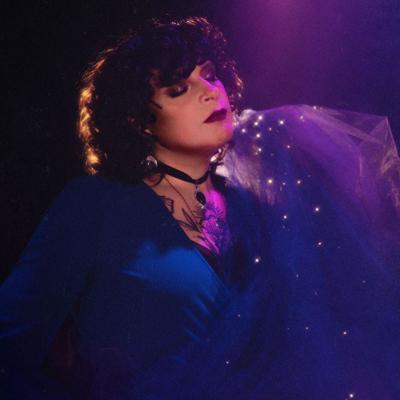

Jessye DeSilva
There’s a sparkle in Jessye DeSilva’s eyes when we meet over Zoom. Since her first single “Worry” in 2019, she’s transformed right before our eyes into a bewitching reveler of folk and Americana music laced with a deep, rich darkness. On her new album Glitter Up the Dark, out everywhere April 3, the Boston singer-songwriter conjures up odes about the queer experience. She searches through her own life for the light and dark, weaving them together into viney foliage, dressed with thorns and luscious petals. It’s as much about queer joy as it is queer pain.
DeSilva enlisted Aaron Lee Tasjan as her producer. Tasjan, whose cosmic country has made waves throughout Nashville and beyond, leaves his psychedelic fingerprints all over the album. Opening cut “The Real,” featuring a guest vocal from Lafemmebear, radiates whimsy and grit, setting the stage for DeSilva’s strongest, most adventurous record to date.
“I knew that Aaron was often drawing from sound references that I wasn’t even totally into,” says DeSilva. “I wanted someone to both see my influences and honor them, but also to bring in stuff that I hadn’t even really dreamt of.”
Writing the record came during DeSilva’s personal breaking point. Unsure about her gender transition, she poured her heart and soul into songs such as “Forever in Drag” and “Life on Earth,” enlightening glimpses into human existence and the pressures of queerness. “I was just not ready to step into womanhood and acknowledge that part of me,” she says. “But I was also really struggling. I almost retreated into masculinity.”
When it was time to record, she had just come out as trans, having started hormone replacement therapy only a few months prior. You can hear a clear emotional shift in the way she phrases her lyrics and paints in brighter, more confident aural colors. “We’re all hurled into this world naked and afraid,” she sings with a sharp heaviness in “Forever in Drag,” a song that takes a deep dive into her journey to this moment. “We try on so many things for the sake of the parade.”
As bitter as it may seem, the song serves as a “meditation on the joy of owning the way that you present yourself, the way you adorn yourself,” she says, “but then also looking at that as armor in a lot of ways.”
In “Eldritch,” she grounds herself in Lovecraftian horror, including “the old ones that have been in the earth long before humans and Christianity,” she explains. “It’s terror that’s just simmering there.” The closing song, a progressive version of “Something Wicked” (which DeSilva previously released on her EP Hover), also harkens to folk horror through macabre strings that dig and scratch in search of primal strength. “We are carried by the wind, and we will always be,” she howls. Adia Victoria and Butch Walker can be heard faintly ripping backing vocals to shreds, like two ghosts yearning for the afterlife.
DeSilva declares that she, and every queer person like her, isn’t going away anytime soon. Glitter Up the Dark arrives at a particularly tiring time for queer people. Among the many policies lobbied against the trans community, President Trump enacted a passport policy requiring all passports for transgender, nonbinary and intersex people to include only the gender signifier they were assigned at birth. The Supreme Court later granted the Trump administration a stay of the preliminary injunction in Orr v. Trump.
“I really struggled last year with the barrage of anti-trans [legislation] that happened after the inauguration,” DeSilva says with a sigh. “My own passport was being held hostage by the State Department for six or seven months, and I pulled out of a tour with Aaron. I didn’t perform much last year. My relationship to the world feels painful and scary, and also filled with a lot of anger.
“But my relationship with myself and my sense of who I am and my everyday life are better than they’ve ever been, which feels very weird. I would rather be in a really good place at a really shitty time than in a really shitty place at a really shitty time.”
Jessye DeSilva walks in the footsteps of Stevie Nicks and Sheryl Crow with a cape flourish and deep admiration. You can find their influence — and that of artists like Tori Amos and ’90s establishment-crushing songwriters such as Sarah McLachlan — all over the record. From the exuberant “Punk Rock Joy” to the guitar-bound hippy song “Fringe,” DeSilva masters the art of a fine-tuned craft. “Check your look, and get your ass out on the dance floor,” she sings with great force in the latter. Queer liberation comes in all forms, and sometimes what you really need is “a leather harness,” she sings with a wink you can practically hear.



Post a comment as anonymous
Report
Watch this discussion.
(0) comments
Welcome to the discussion.
Log In
Welcome to the discussion.
Keep it clean. Please avoid obscene, vulgar, lewd, racist or otherwise abusive language. Comments featuring hate speech or threatening or violent content will not be tolerated.
PLEASE TURN OFF YOUR CAPS LOCK.
Be truthful. Don't knowingly lie or mislead.
Be proactive. Use the “report” link on any comment that violates our comment policy.
Share with us. We'd love to hear your feedback.