
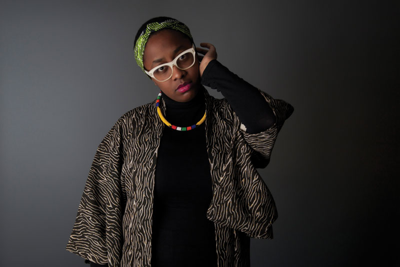


Even in jazz, an idiom where individuality is expected and demanded, Cécile McLorin Salvant truly doesn’t sound like anyone currently active — her choices of material and her performance approach set her apart. Born to a French mother and Haitian father in Miami in 1989, Salvant began her classical voice studies at age 8, and her transition to jazz came in her late teens while she studied at the Darius Milhaud Conservatory in Aix-en-Provence, France. Word about Salvant began to spread after her 2010 LP Cécile, which matched her with the Jean-Francois Bonnel Paris Quintet. That same year, she won the Thelonious Monk International Jazz Vocals Competition in Washington, D.C., and she’s been a sensation on the jazz circuit ever since.
But Salvant is much more than a lyric interpreter. She composes music and lyrics, and not only performs in English but French and Spanish as well. Her competition victory earned her a deal with Mack Avenue Records, and subsequent LPs have cemented her place among jazz’s premier stylists while reaffirming the qualities that make her special.
Though she’s not yet 28 years old, Salvant mixes the precise diction of an opera star with the swinging ease of a veteran jazz stylist. Salvant is an accomplished scat singer, but she does it sparingly, and she doesn’t rely on vibrato or melisma for effect. She rarely performs songs in a traditional or conventional manner, landing on stunningly low notes and then holding them longer than you’d anticipate. She might soar into the upper register and savor every second, delaying her return to the main melody until the last possible moment. Or she’ll wrap a song with a majestic, swooping flourish that didn’t seem like it could work rhythmically, given the way she paced her performance.
While Salvant cites Sarah Vaughan and Billie Holiday as major influences — and in earlier periods tried to sound exactly like them — now she’s careful to avoid being too derivative. Throughout her LPs — especially 2015’s For One to Love, which won the Grammy for Best Jazz Vocal Album — Salvant has honed an approach that simultaneously reflects many of the precepts jazz fans love without abandoning her classical background.
“I never wanted to sound clean and pretty,” Salvant told Fresh Air’s Terry Gross in 2015. “In jazz, I felt I could sing these deep, husky lows if I want, and then these really tiny, laser highs if I want, as well.”
Salvant also delights in finding unusual material. She does a marvelous version of the Burt Bacharach/Hal David song “Wives and Lovers.” She told Gross she chose the song because she was having a hard time finding feminist tunes that worked, so instead she opted for explicitly sexist songs. “Of course [finding those] was a lot easier,” she said. “And that song happens to be so catchy, and I love that song, and I think it’s hilarious.”
Similarly, you won’t hear many singers in any genre willing to tackle a Bert Williams tune, let alone one originally performed in blackface. But Salvant’s compelling performance of his piercing, evocative “Nobody” (the lyric of which was written by Alex Rogers) from the 1906 stage show Abyssinia magnifies even further how heartbreaking it had to be for a black person to appear onstage in a fashion that openly mocked their heritage and dignity. Hearing her turn the song into an anthem of defiance is an incredible experience.
Even though she’s now enjoying widespread critical acclaim and growing fame, Salvant understands she’s capable of doing even greater things. The jazz world and the music universe as a whole are eagerly awaiting her next chapter.
Email music@nashvillescene.com



