
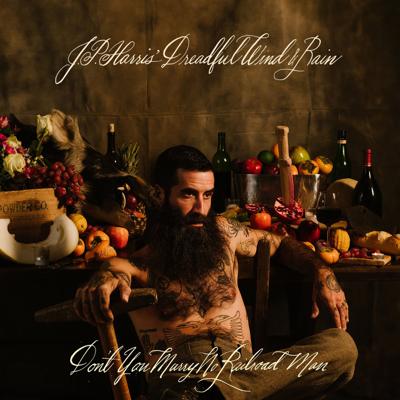

My first thought when listening to J.P. Harris’ new release Don’t You Marry No Railroad Man was, “This is like if Colter Wall and Jean Ritchie’s ‘Barbary Allen’ had a kid.” And sure enough, Harris does his own semi-spooky rendition of the Appalachia-by-way-of-British Isles classic folk tune “Barbary Ellen” — more on the different spellings in a bit — on his latest album.
Don’t You Marry No Railroad Man is a project of Harris and former Old Crow Medicine Show fiddler Chance McCoy, recording under the name J.P. Harris’ Dreadful Wind and Rain. The record sounds a lot like where it was made. Harris is best known for the honky-tonk sound showcased on releases like his 2012 debut I’ll Keep Callin’. He teamed up with McCoy, and they holed up in McCoy’s backwoods studio in West Virginia. The two nearly ran the local meadery dry, according to Harris, because the closest grocery store was more than 45 minutes away.
“Studio” is a generous term, says Harris, who says McCoy called him halfway through his trip from Nashville to Monroe County, one of the least populated in West Virginia, and told him there was a problem with the electricity in the building. The rumor is that the pair put in some hard work to make the shack into a studio, but Harris, a carpenter for almost 22 years, sets the record straight.
“I’m a real stickler for not letting people embellish stories,” Harris says. “This is the second time in my recording career I’ve worked in a studio under very shoestring conditions and gone back to update it later for further recording endeavors.”
Harris says other Nashville musicians are booking time slots at the spot, now called Hunter Springs Studio. But when he and McCoy were there, the minimal accoutrements of the space were just right for the sound they were looking for, a mix of McCoy’s old-time fiddling and Harris’ clawhammer picking on a fretless banjo — a style Harris says went out of vogue before the Industrial Revolution. Unlike many old-time and bluegrass recordings, McCoy’s fiddle really isn’t the lead instrument on this album, so it’s more accurate to describe it as “fiddle accompaniment.”
The album opens with “House Carpenter,” a fitting choice given Harris’ occupation. According to Mainly Norfolk, an extensive folk-music database, the 16th-century ballad was originally called “The Daemon Lover.” It tells of a woman lured to her death by the devil himself. It’s been passed down into the Appalachian collective consciousness, and like most old-time pickers, Harris can’t remember quite where he learned it.
The sparse and eerie “House Carpenter” is a perfect complement to “Barbery Ellen.” The song is the closest thing to “well-known” you’ll find on the album, and that’s by design. Harris says he wanted nothing you might call “a standard” on the record, and picked exclusively deep, old Appalachian cuts. He also explains his spelling deviation: “I sang it from memory, which is more true to form to how old-time is supposed to go.”
The track list is filled out with equally sad tales like “Otto Wood,” which follows a desperado to his death at the hands of police. The often-woeful lyrics are balanced out by McCoy’s upbeat sawing, which gives Don’t You Marry No Railroad Man a handful of welcome danceable moments, as on “Closer to the Mill.”
Harris left school after eighth grade, but his clear love of history, lore and music guides every aspect of the record. His appreciation of art history influenced the album’s cover. It features Harris, shirtless, sitting in a wooden chair against a lush backdrop of fruit, wine and cheese. If you found yourself thinking “This is a painting,” you’re paying attention: It is. Photographer Libby Danforth helped Harris bring his vision to life.
“Caravaggio was deeply troubled,” Harris says of the 16th-century Italian painter whose life and work inspired the album art. “He painted at the largest churches in Italy, but he also killed people.”



