
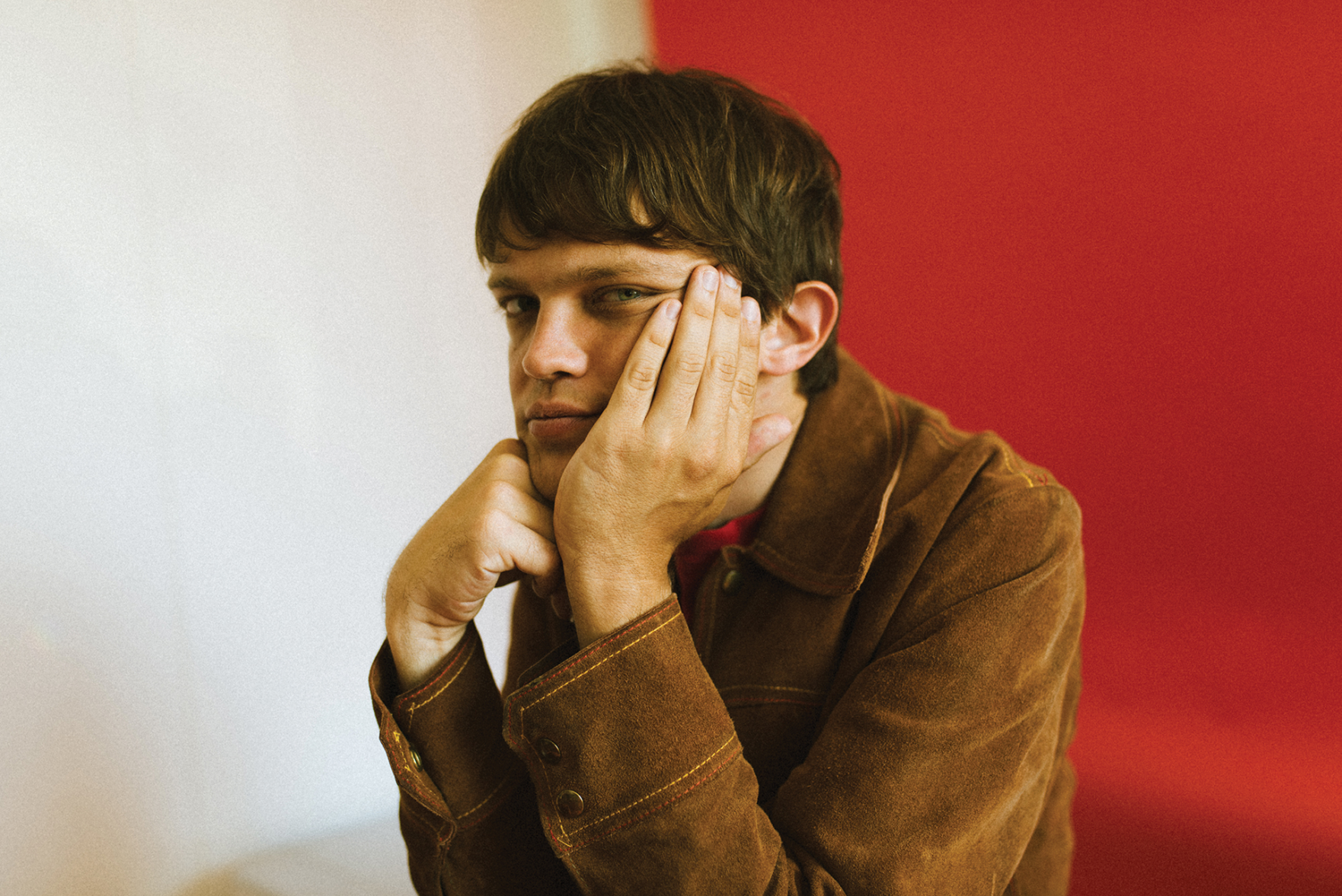


William Tyler’s new full-length Goes West travels just ahead of the long shadow cast by 20th-century music, but it’s not the sort of critique of past glories that you might expect from such a thoughtful artist. The Nashville native moved to Los Angeles two years ago, and he retains his association with Music City, where he made his name as a solo guitarist, bandleader and member of countrypolitan-pop band Lambchop. Goes West is cosmopolitan Americana that flirts with ideas of New Age music without giving in to them.
Tyler, who is 39, recorded Goes West last year at Portland, Ore., studio Flora Recording & Playback with producers Bradley Cook and Tucker Martine. It’s one of his most intricate records to date, but it doesn’t represent a major departure for an artist who has always strained against common perceptions about the role of a solo guitarist. Tyler’s latest music references singer-songwriter pop while alluding to the nonlinear writing of European composers who worked at the beginning of the 20th century.
“I’m really interested in classical composition,” Tyler tells the Scene about the genesis of Goes West by phone from a tour stop in Portsmouth, N.H. “I was listening to a lot of piano-based stuff, like Satie, Debussy, Chopin, Bartók and some of the more classically inclined stuff on Windham Hill, like Michael Hedges and Alex Di Grassi. If anything, [Goes West] is a naturalist record — it’s more about open spaces, nature and the spaces between cities.”
You can hear the influence of Debussy’s chromaticism throughout Goes West, which detours around standard triadic harmony to arrive at stops that seem planned only in retrospect. Like most of Goes West, “Fail Safe” contains piquant shifts in emphasis, and plays an implied 6/8 feel against a solid 4/4 foundation. In many ways, Tyler’s new music riffs on the usages of Late Romanticism, as if American composer Edward MacDowell’s 1898 piano work “Sea Pieces” had been internalized by a postmodern musician conversant with both Joni Mitchell and krautrock.
Goes West hews to Tyler’s earlier work on acclaimed records like 2010’s Behold the Spirit and 2016’s Modern Country, but his move to Southern California seems to have influenced some of his artistic decisions.
“Modern Country is a very maximal, arranged record with lots of overdubs, lots of guitar parts and lots of layers,” Tyler says. “But the songs are more like themes, with a couple of exceptions. With this album, I wanted to playfully touch on the whole moving-to-California thing without being too precious about it. I don’t think this record’s necessarily an escapist record, but there’s not a meta theme behind it.”
There may not be an explicitly political message in Goes West, but Tyler’s latest compositions honor the concept of mutability, a very American condition. The record’s opener, “Alpine Star,” moves from section to section with fluid ease. Tyler, who disavows a connection with what he calls the school of “post-Takoma” guitar exemplified by the recordings of Takoma Records founder John Fahey, slips in a brief section during “Alpine Star” that recalls the raga-influenced playing of ’60s guitarist Peter Walker.
Still, Tyler takes a breezy attitude toward form in Goes West, which billows and contracts in unpredictable ways. “Fail Safe” contains playing that suggests Tyler has been listening to Piedmont-style blues guitar along with his Debussy recordings. Meanwhile, “Venus in Aquarius” begins with a decorous melody that gives way to a dark recapitulation of its theme, embellished by supernal keyboards.
In fact, Goes West may be Tyler’s most elusive record to date. You may detect an undertone of disquiet as it proceeds, but it’s kinetic travel music that seems far less insular and city-bound than the efforts of Debussy and Satie, who expressed a vision of modern life that now seems, by contrast, contemplative and directed inward. Tyler, who tells me he remains ambivalent about Los Angeles culture even as he acknowledges his desire to experience it firsthand, has created a Tennessee-to-California idiom that places musical traditions in new contexts.
Tyler balances conservatism and innovation like a true Southerner, but Goes West seems timeless and placeless, making it a part of a lineage of American music that searches for landscapes that lie just beyond the literal — and metaphorical — horizon.
Goes West ends with a track titled “Our Lady of the Desert,” which features sensitive playing from another great American guitar eclectic, Bill Frisell. It’s the most uncomplicated track on the record — a simple theme played with impeccable taste by two seekers of the truth who sound comfortable with where the journey to find it will take them.



