

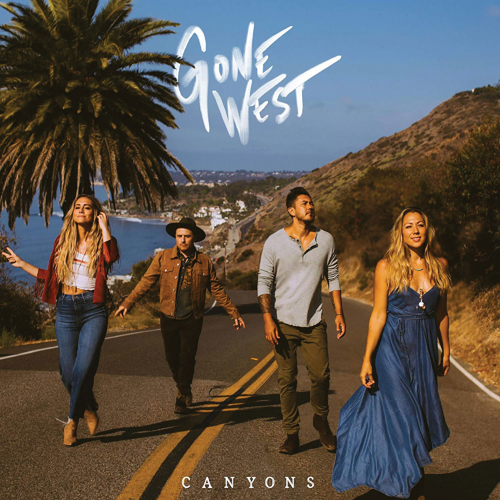


To understand the country band Gone West, you must understand its members. This is true with any group, certainly, but it’s especially applicable in this case, with this merging of four equally genius — and already established — musical minds.
There is Justin Kawika Young, a native Hawaiian and a self-professed ’90s R&B aficionado who, as a solo artist, topped the radio singles charts in his home state 11 times with his own brand of island soul. And there’s Nelly Joy, a native Texan who moved to Music City right out of college and wrote her way to country music success. Her songs have been cut by Kelly Clarkson, Big & Rich, and The JaneDear Girls, the duo she formed with Susie Brown that scored a Top 20 hit on the Hot Country Songs chart with 2010’s “Wildflower.”
Joy’s husband, Iowa-born Jason Reeves, is equally adept with his pen. The Grammy-nominated singer-songwriter has written for or with Demi Lovato, Kenny Rogers, Louis Tomlinson of One Direction and, of course, Gone West’s fourth member, Colbie Caillat. Caillat soared to pop stardom on the Reeves co-write “Bubbly,” a breezy, acoustic jam that’s both the sonic embodiment of her Malibu roots and the lead single from her 2007 debut album Coco. Caillat has since gone on to sell some 6 million albums worldwide (Coco alone was certified double Platinum for more than 2 million U.S. sales) while pocketing two Grammy Awards, including one for Album of the Year, courtesy of her collaboration with Taylor Swift on Fearless.
Collectively, the now-resident Nashvillians are Gone West. They are the personification of the term “supergroup,” and after three years of writing, producing and recording, they’ve woven the seemingly disparate musical styles and sensibilities gathered and refined over 15-plus years into their first full-length project, Canyons, released in June.
“When I listen to the record, it really is a true collaboration,” Young says. “I hear Nelly’s pop and country hooks, and the little tasty things that she adds. I hear Jason’s poetry and his guitar licks. Colbie’s been the true north, making sure that we stayed on track on the sound that we initially wanted to go for, and you can hear my Hawaiian influence on some of the songs. I think it’s really cool to be able to hear all of the different things in a song, but have it come together in a cohesive way.”
This cohesion isn’t just apparent in the music — in the crisp vocal harmonies or the seamless blending of their instrumentation. It is who they are, these longtime friends who were partners in life before they ever united in music.
But, of course, there was always music.
The first time I met the members of Gone West, nearly two years before I spoke to them for this piece, it was at an impromptu hang at Colbie and Justin’s Brentwood home. There were around 20 of us there, eating and drinking and laughing until the platters of grilled chicken and veggie burgers were pushed aside and the guitars pulled out.
Everyone took their places: Young on keys, Caillat on the mic, Joy and Reeves on guitar. They drafted a rhythm section from their group of talented friends — one picked up the bass and another volunteered on cajon — then they rocked into the wee hours, cycling through some 112, some Bob Marley and some original songs, too. Joy had her twangy lilt and Young had his delicious runs, and all the while they seemed to be creating their own genre of sorts, this amalgam of pop and R&B, country and reggae.
Reeves shares the history of these jazz-style jam sessions and their prominent role in Gone West’s musical foundation: “The whole way we started doing this, together, as friends, was at house parties in California, just casually making music for love. That’s the spirit that we really want to keep central to what we’re doing.”
I didn’t know it at that gathering two years ago, but the group had already written its first official Gone West song. “It’s all been very natural and organic, where each step kind of led to the next,” says Young. “Even in our first session, it was like, ‘Let’s just put a session on the books and see what happens.’ Then it was like, ‘Let’s do one more and see what happens.’ It’s been nice to just be in the moment and let the experience lead us to where we should go, instead of trying to predetermine a destination.”
That first session resulted in “When to Say Goodbye,” a sultry but bittersweet ballad about a relationship that’s run its course. “Not only do I really love how the song turned out,” Reeves says, “but it’s really rare that a first attempt works out that well, and it really inspired us to write more songs. I also think that it’s cool when we all come in and are singing four-part harmony. It showed us what our band could sound like.”
If “When to Say Goodbye” is the hope of what was to come with Gone West, “Tides,” the final track on Canyons, is that hope’s brazen manifestation. “It’s about riding the ups and downs without resisting,” Young explains. “So the meaning of it is important and central to the record, and the sound of it just feels very much like who we are.”
The harmonies on “Tides” are as perfect as they are elsewhere on the project, but the song is particularly meaningful in how it showcases each member of Gone West. Every voice has a chance to stand alone and shine before blending again in stellar background arrangements set atop soulful guitar riffs. And the give-and-go is easy here — too easy, it seems, for a band with this kind of individual fire power. Still, says Caillat, it’s genuine.

“All of us in the band never usually ask to sing, we’re always forced to by the others,” she says. “We’re not like other bands that fight for the spotlight.”
There’s another reason that “Tides” is a noteworthy addition to this album, released in this genre — a genre that has, for far too long, presented itself as the domain of mostly white artists. The outro, featuring a melodic chant in native Hawaiian by Young, is a reminder that country music is America’s music — of, by and for all Americans.
Writing and recording Canyons in Nashville, with Nashville songwriters, musicians and producers, has naturally imbued the project with traditional country elements. The banjo, the steel guitar and the rich storytelling are all there. Indeed, Gone West’s invitation to play the Grand Ole Opry last summer is validation of the band’s country core. Yet in the crafting of this project, Young, Joy, Reeves and Caillat never felt any pressure to diminish their uniqueness in an effort to fit in some Nashville box. In fact, Joy, the Gone West member most firmly rooted in country tradition, believes that each of their experiences has perfectly positioned them for this place, in this space.
“The first time I heard ‘Bubbly’ was actually on CMT,” she says, “and I think country listeners loved it because it’s kinda genre-less. It’s just great, timeless, acoustic music. And if you go back and listen to Justin’s older Hawaiian records, they literally sound like old-school country in all the right, good ways. We tried to pull as much as we can from those influences, and we made an album that we love. We honestly didn’t put it into a box or call it anything, in particular, other than music that we love.”



