
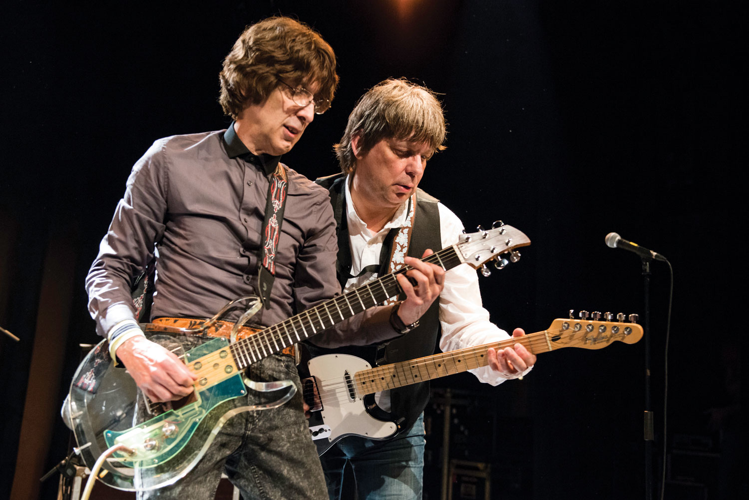


Flamin' Groovies' Cyril Jordan and Chris Wilson
Speaking to Flamin’ Groovies leader Cyril Jordan about making some of the most powerful post-British Invasion rock ’n’ roll of the past half-century, I perceive that he lives in the eternal present that rock bestows upon its most faithful practitioners. Jordan, who brings the storied California group to Nashville next week for its first Music City appearance, helped invent power pop in the late ’60s with the Groovies, and gave the form a postmodernist twist on the band’s now-classic 1972 song “Shake Some Action.” Listening to the voluble Jordan run through the history of modern rock as he saw it firsthand, I experience an out-of-body feeling, as if I’ve time-traveled back to 1964.
“Folk-rock is a Bay Area invention,” Jordan tells the Scene from his California home. “The British Invasion, what it did to San Francisco was that all these guitar players — these younger guys who were in high school bands, and these older guys who were beatnik folkies — all of a sudden switched over to electric guitar. When you’re a folk guitar player, you learn these little tricks, and it looks like you can really play.”
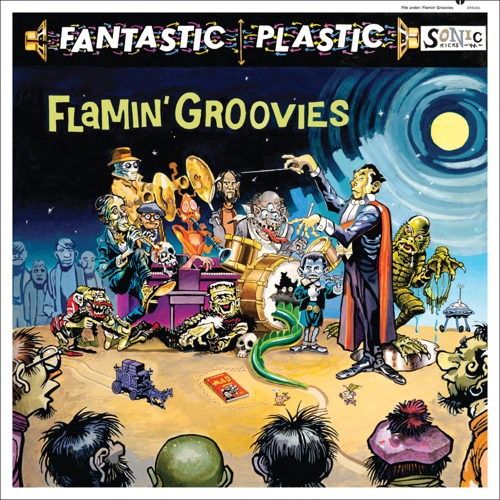
Jordan recalls folk-rock’s beginnings on Flamin’ Groovies’ cover of “Don’t Talk to Strangers,” originally recorded by San Francisco band The Beau Brummels in 1965. The track appears on the Groovies’ new full-length Fantastic Plastic, their first studio record since 1993’s Rock Juice. Like the rest of Fantastic Plastic and their ’70s albums Shake Some Action and Flamin’ Groovies Now (both of which were produced by Rockpile’s Dave Edmunds), “Don’t Talk to Strangers” demonstrates the continuing power of Americanized British Invasion rock.
Fantastic Plastic is an assured comeback record by a band whose history has been a series of creative disconnections, missed opportunities and spontaneous breakthroughs. Remarkably for a group that released its debut EP Sneakers in 1967, the present-day version of the Groovies includes two of the band’s three key members. Along with Jordan, who co-founded the band in San Francisco in 1965 with singer and guitarist Roy Loney, the group currently includes Massachusetts-born singer Chris Wilson, who replaced Loney when he left in 1971.
As Jordan, who was born in San Francisco in 1948, recalls, the original incarnation of Flamin’ Groovies brought a varied set of influences to bear on his beloved British Invasion music.
“I knew all the British Invasion licks, you know, but [Loney] was giving me an education in rockabilly,” says Jordan. “He got me learning James Burton, and then I started learning Scotty Moore. We grew out of a jug-band thing, but as we were cutting albums, we were evolving like crazy.”
Along with Loney, whose tongue-in-cheek re-creations of ’50s rock ’n’ roll characterize the Groovies’ 1969 LP Supersnazz and 1970’s Flamingo, Jordan created a hybrid style that anticipated roots rock, power pop and post-punk.
“Roy and I were influenced by two albums in particular,” Jordan says. “One was on RCA and part of their Victor Vintage series, and they were jug-band recordings from the ’20s. We’re talking incredible fuckin’ original versions of, like, [The Five Harmonicats’] ‘Sadie Green, the Vamp of New Orleans.’ There was another record on the London label, [1965’s] The Blues Came Down From Memphis, and it was all Sun Records 78 labels on the cover.”
Loney left the Groovies after they released their 1971 Teenage Head album. “All of a sudden I was faced with having to design the whole thing,” Jordan says. “Not only do I gotta write a killer song to stay at the level of quality Roy had brought us to, but I also gotta write a hit song so I can get a record deal. I worked on ‘Shake Some Action’ for about three months.”
Cut in April 1972 at Rockfield Studios in Monmouth, Wales — but not released until four years later on the album of the same name — “Shake Some Action” exemplifies one aspect of American takes on British Invasion rock. Jordan invents ingenious guitar licks that add an ominous tone to a song about self-determination. Along with 1971’s “Teenage Head” and the following year’s anti-drug tune “Slow Death,” the song is widely considered the pinnacle of the Groovies’ music to date.

Fantastic Plastic, which the group recorded over three years after Wilson rejoined the band in 2013, builds upon the Groovies’ ’70s work. They cover NRBQ’s “I Want You Bad” as effectively as they recast “Don’t Talk to Strangers,” and Jordan and Wilson’s “Crazy Macy” is as sly, underhanded and formally perfect as anything in their catalog. The band hasn’t forsaken Chuck Berry-style licks and Byrds-like harmonies, which makes them as anachronistic in 2017 as they were in 1972.
Jordan, who says he’s looking forward to his first visit to Nashville, remembers how the pop revolution of the ’60s impelled him and his contemporaries to do their best work.
“We’re talkin’, ‘You could get into the Top 10 and make millions of dollars,’ ” he says. “The inspiration besides that, the motivator besides making great money, was that you could blow Smokey Robinson’s mind.”
Email music@nashvillescene.com



