
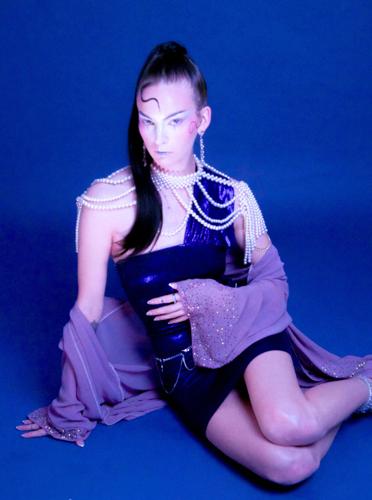



Eve Maret
Nashville experimental musician Eve Maret’s next album emerged as fragments — a melody overheard in a dream, a sudden late-night impulse at the synthesizer, a quiet moment of surrender where judgment fell away and instinct took over. What began as a natural, almost meditative process ultimately crystallized into something urgent and fully formed: Diamond Cutter.
The St. Louis native arrived in Nashville in 2012 as an outsider, quickly discovering a community with an affinity for creative people who go against the grain. She basked in the idea of being a musical rebel, creating an array of intriguing electronic sounds — both compositions and improvisations — in a town whose diverse music industry is still dominated by mainstream country infrastructure. She immediately dug in, flexing her muscles and making the most of Nashville’s ever-evolving DIY scene.
“Because the electronic and experimental community isn’t as large,” says Maret, “I feel like there’s more room for people to come in and create that community, and find those really authentic connections and build it from the ground up.”
Maret describes the process of creating Diamond Cutter — whose name comes from an ancient Buddhist text — as a passage of time rather than a concrete concept. Each song maps out a part of her life story. During the construction of most songs, she used her creative process to work through different ideas and beliefs circulating through her system at the time. However, some songs followed more of a far-out approach, in which Maret let whims and impulses guide her rather than clean-cut reason.
“I might have a dream where I hear certain words or a melody,” she explains, “and then I’ll sit down and be like, ‘Oh yeah … let me plug in my synthesizer and see if I could tap into that inspiration.’”
When creating from instinct, Maret initially treats ideas as urges. She lets them out, free of judgment, and then circles back around later to evaluate what she’s made. This process played a role in creating an album featuring myriad sounds and styles, from the acid-bass-driven, ’90s dance beat of “Hit U With a Banger,” to the ambiguous, spacious ballad “Gethsemani.” Throughout Diamond Cutter, Maret creates lush dreamscapes and techno trips that flow directly from her subconscious.
“It’s kind of like a meditative practice for me,” says Maret, “where I just honor whatever impulse I have in the moment and do my best to not think about what’s happening. And in the most honest way possible, just create based on whatever feeling I have in the moment.”
Halfway through, Diamond Cutter’s track list repeats. The first six tracks have vocals, while the final six are instrumental arrangements of the same pieces. The creative choice came in an attempt to appease Maret’s various artistic dimensions — in this case, her introverted, moody side.
The instrumental versions make a lot of sense upon closer inspection. On the surface, Diamond Cutter shares sonic qualities with the nebulous, experimental sounds of music by artists like Kraftwerk or Aphex Twin. However, at its core, the album captures nuances from classic compositions created in centuries past.
“I’ll listen to a lot of classical music — a lot of Bach, a lot of Debussy,” Maret explains. “I like taking inspiration from the textures and the atmosphere that come from those kinds of arrangements.”
Diamond Cutter is the type of album that settles in your gut, in a good way. In the same way that the songs poured from her soul, Maret hopes the album helps listeners soften into and embrace their own experience. Whether it’s through creating tenderness and vulnerability or offering a space for listeners to appreciate their lives a little bit more, she aims for her music to be felt.

Eve Maret
“I hope that it [cultivates a] space where, whatever is going on inside [a listener], it can be seen and appreciated,” she says, “and even alchemized and transformed into something that is beautiful.”
Following the album’s release on April 17, Maret says she will be “surrendering to whatever.” She doesn’t have any local shows on the books, and as of this writing, she plans to sit back and take it all in — allowing herself to just enjoy what she’s created so far.




Post a comment as anonymous
Report
Watch this discussion.
(0) comments
Welcome to the discussion.
Log In
Welcome to the discussion.
Keep it clean. Please avoid obscene, vulgar, lewd, racist or otherwise abusive language. Comments featuring hate speech or threatening or violent content will not be tolerated.
PLEASE TURN OFF YOUR CAPS LOCK.
Be truthful. Don't knowingly lie or mislead.
Be proactive. Use the “report” link on any comment that violates our comment policy.
Share with us. We'd love to hear your feedback.