
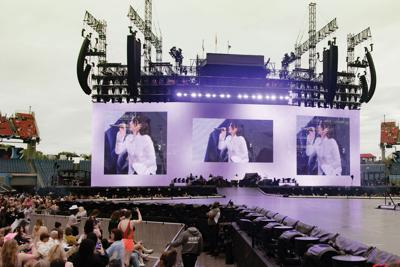

Security during one of Taylor Swift's concerts at Nissan Stadium in May 2023
One night in early October, Neko Case and her band had been onstage at Grundy County underground venue The Caverns for only a few songs when they stopped playing. According to accounts from fans in attendance who reached out to the Scene, as well as those posting on social media and Reddit, the widely loved singer-songwriter pointed out security staffers carrying guns whose presence made her deeply uncomfortable, and ended the show shortly after. Case’s team did not respond to a request for comment.
“No advance requests were made to adjust our standard security protocols prior to the show or during our pre-show security meeting and venue walk-through,” representatives from the venue tell the Scene, echoing a statement sent to Stereogum. “When the tour manager requested that our licensed armed security be moved to the back of the house, we immediately made that accommodation after determining that guest and artist safety would not be compromised. Unfortunately, we did not receive this request until after the show had begun. We were surprised and disappointed when the artist chose to end the performance early and not return to the stage. All ticket holders will be fully refunded.”
The event touched off a broader debate about what “safety” means today — and whether the systems designed to protect us can sometimes feel menacing.
In online spaces like Reddit, the arguments grumbled along for more than a week after the Case concert. Some blamed the artist for overreacting; others praised her for asserting a boundary many trauma survivors could recognize. A few dismissed the uproar as city-mouse hand-wringing. Others said The Caverns is safe, the venue’s rustic aesthetic part of its charm.
Similar conversations appear online regarding venues all over the United States. This episode in our backyard revealed a lingering gap between the machinery of safety and the feeling of being safe. To management at The Caverns, a familiar armed guard signified professionalism. To the artist, he represented danger. To the crowd, he embodied a larger confusion: Was this safety — or a threat?
Security specialists readily acknowledge the risks facing public venues. And recent research — along with even a casual look at the country’s roiling political climate — suggests that Americans’ perceptions of danger and their demands for protection increasingly fall along partisan lines.
Political scientist Eric Raile at Montana State University in Bozeman has shown that perceptions of risk and danger that once cut across party affiliation, such as those tied to public health and safety, have become bound up with political identity. In his study of pandemic-related attitudes, Raile found that “partisan risk positions correspond with partisan information sources,”with Democrats viewing the coronavirus as a primary threat while Republicans framed the greater risk to be restrictions on freedom or economic harm. Likewise, psychologist Mark J. Brandt, who teaches at Michigan State University, has found that the connection between perceived threat and political belief varies by context and that the type of threat often determines whether people seek protection through authority or resist it as overreach.
A visible gun is a Rorschach test for how we interpret power. In the din of the Reddit scrum around the Case show, one truth emerged: There is no universal definition of “security.”
For industry veterans like Jim Digby, who have spent decades managing the mechanics of safety, such ambiguity is nothing new — and it often comes with high stakes.

A closer look at the development of safety standards for live-event production
Inside the Industry
Digby’s perspective is shaped by firsthand experience with high-stakes incidents. He recalls being on tour with Metallica in 1992 when, at Montreal’s Olympic Stadium, singer James Hetfield was badly burned by pyrotechnics, which naturally ended the set early. Co-headliner Guns N’ Roses also cut their set short after Axl Rose stormed off the stage. The packed crowd of some 50,000 fans erupted into a full-scale riot, leaving about a dozen people injured and hundreds of thousands of dollars in damage. Digby later served as a stage manager at Woodstock ’99, where 200,000 people endured cascading operational failures amid sweltering heat. Not surprisingly, the gathering spiraled into the chaos — including multiple incidents of sexual assault — that was later chronicled in documentaries produced for HBO and Netflix, respectively: Woodstock 99: Peace, Love, and Rage and Trainwreck: Woodstock ’99.
Taken together, these incidents reinforced a sobering reality for Digby. Across much of the live-music industry, safety still relies more on instinct than on formal training or regulation.
“It is not standard in the United States for crowd managers to have any kind of safety, first-aid or conflict-resolution training,” Digby says. “In many cases guards have little or no preparation for what they might face.”
I can attest to that. One summer at Blossom Music Center outside Akron, Ohio, I worked security. I had just turned 18. I was rawboned and painfully out of my depth. But after a short security briefing, there I was, sashaying into the maw of 20,000 Waylon Jennings fans, splintered billy club in hand, wearing what could only be described as an oversized authority costume. I remember thinking, “I can’t believe they’re trusting me to do this.”
Lack of training, Digby insists, extends from frontline staff to senior management. “There [are] no prerequisite qualifications required to be in charge of putting on a mass gathering,” he explains. “I got on-the-job training over the last 40-plus years. But it’s not required.”
Despite that, Digby sees an industry that “does OK” today, but is doing so “in an unregulated form.”
From 9/11 to the SAFETY Act
High-profile incidents in the 1990s underscored gaps in safety, but the events of 9/11 radically reshaped the landscape. Federal policy attempted to codify preparedness, yet introduced new pressures and expectations for visibility. The newly formed Department of Homeland Security introduced the SAFETY Act, offering liability protection to venues that adopt approved security standards. The law encourages preparedness — but also incentivizes visibility. To prove compliance, operators have increasingly favored measures that could be documented: metal detectors, bag checks, armed presence. In effect, showing safety became inseparable from showing force.
For high-flyer acts like Taylor Swift, Beyoncé and Foo Fighters, security travels with the tour and is rehearsed, specialized and tightly controlled. But most artists don’t have that luxury. Their safety, and that of their fans, depends on whoever the promoter or venue hires that night.
Shared Responsibility
William Rathburn, a former LAPD deputy chief and later Dallas police chief, has watched the evolution of event security from the other side of the barricade.
In 1996, serving as security director for the Atlanta Olympics, he warned that Centennial Olympic Park was a “soft target” and urged mandatory bag checks. Organizers balked, worried about optics as Atlanta made its debut on the international stage. Eight days into the Games, a pipe bomb packed with nails and screws exploded, killing one woman, triggering another person’s fatal heart attack and injuring more than 100. The blast also upended the life of security guard Richard Jewell, who was wrongly accused of the bombing.
Rathburn notes that in a packed venue, a firearm isn’t as big a danger as the panic it can trigger. The instinctive rush to flee when you hear gunfire can injure far more people in the crush of a stampede than the weapon itself.
Rathburn has long argued that safety is a shared duty. Going back to 1976, as a young LAPD captain, he helped draft a memorandum of understanding for The Rolling Stones’ concert at the Los Angeles Coliseum. It detailed who was responsible for what — police, promoters, stage crew — and included a promise from the band that no inflammatory statements would be made from the stage. “The importance of that is sharing the responsibility,” he said.
Over the past decade, an organization Digby founded called the Event Safety Alliance has worked with the industry professional organization Entertainment Services & Technology Association to develop safety standards for live events. These are drafted by industry experts, opened for public comment and revised through a multiyear review and balloting process before adoption. They cover crowd management, security, fire safety, weather preparedness, rigging and temporary structures, and communications. They offer venues, promoters, and touring crews a shared framework for planning and operating safe shows. They emphasize that security must adapt to its context.
The challenge for every venue and performer is finding a balance that reassures without drawing undue attention. The October incident at The Caverns wasn’t a failure of planning, but a collision of past and present in a deeply divided world. And it is a reminder that safety isn’t just about preventing harm, but also about making space for human vulnerability. The show may have ended early, but the larger conversation it sparked is still unfolding.



Post a comment as anonymous
Report
Watch this discussion.
(0) comments
Welcome to the discussion.
Log In
Welcome to the discussion.
Keep it clean. Please avoid obscene, vulgar, lewd, racist or otherwise abusive language. Comments featuring hate speech or threatening or violent content will not be tolerated.
PLEASE TURN OFF YOUR CAPS LOCK.
Be truthful. Don't knowingly lie or mislead.
Be proactive. Use the “report” link on any comment that violates our comment policy.
Share with us. We'd love to hear your feedback.