
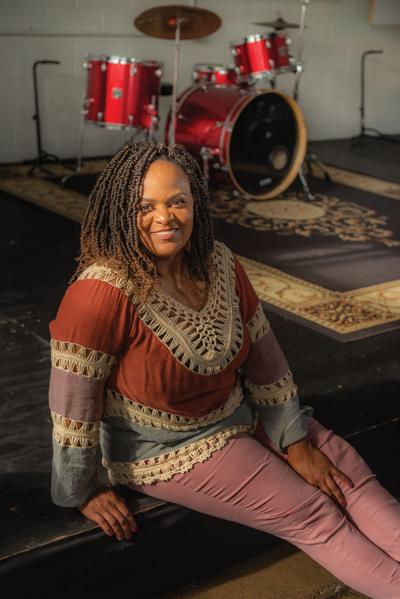

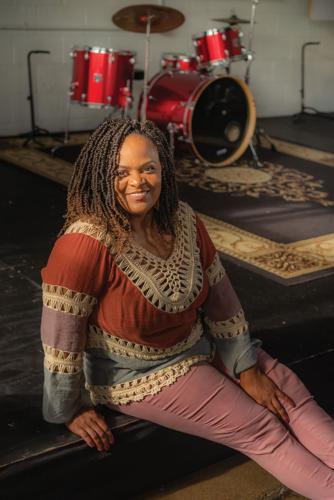
With a knack for developing partnerships between songwriters and publishers to launch music careers, Mimi McCarley is a pivotal entity who holds many roles in the Nashville music scene. She is inspired by artists who have the audacity to believe in themselves and assists them on their journey. She’s popularly known for partnering with Thalia “Muziqueen” Ewing in Nashville Is Not Just Country Music, an organization that aims to cultivate a diverse array of music in Nashville. Together they’ve developed into two powerhouses to know.
Growing up in the church in Dayton, Ohio, McCarley felt an attraction to music at an early age. She was exposed to funk music, gospel and Motown, but she had not yet become familiar with the business side of the industry. Then she attended a cooperative high school and majored in radio and TV broadcasting.
“It was a gang of creatives that had access to recording facilities and equipment, so we started experimenting,” explains McCarley. “That is where I got my background in radio, learning to be a program director, an on-air personality, a disc jockey and everything else under that umbrella.”
After enrolling at Dillard University in New Orleans, where she was granted an athletic and academic scholarship, McCarley realized mass communications studies would not lead her toward the music industry like she anticipated. She made a new friend from Murfreesboro who encouraged her to attend Middle Tennessee State University if she wanted to dive into music further. McCarley immediately took action and transferred to MTSU, where she hit the ground running.
“That was the game changer,” McCarley says, laughing. “I started meeting all kinds of people — MTSU is a breeding ground of talent — from songwriters, artists and professors to people who knew about the business.”
McCarley credits her easy transition to beloved entertainer and Murfreesboro legend Big Fella, who assisted in connecting her with the who’s-who of the campus. She knew her passion was in the business side of the industry, and she was intrigued by figures like Clive Davis, Berry Gordy, Diddy and Jay-Z — executives who could lift up talent in various communities and encourage its growth. While MTSU now has bridges from the school to the industry, when McCarley graduated, she was unable to find work in the music business and took a part-time job at a local pharmacy. Throughout that period, she worked with many creative talents and began managing artists. She found that her niche was bringing musicians together to build out albums. A few years later, she moved to Nashville with her family, and she found many of the relationships she built at MTSU were still bearing fruit.
“I kept running into songwriters who didn’t have music and producers that had the music but nothing else,” McCarley explains. “I started running digital mini camps where I invited artists and producers to get tracks completed and recorded within two weeks. From that process alone, we created over 40 songs, and I knew I was onto something.”
She admits to being naive about technical aspects of the business such as split sheets — tools for establishing parties’ individual ownership stakes in a song they made together — which made it difficult to utilize the tracks after the camp. Soon she was encouraged to reach out to Thalia Ewing, known to friends and colleagues as Muziqueen, who had established relationships with a variety of artists.
“After we met, we immediately clicked on an energy and music-business level,” McCarley says. “I told her I wanted to work with her clients and run a camp with her artists, and she was open and willing. Through that process we ran a camp and generated about 20 solid tracks with the new group.”
With the support of her husband, McCarley then took the risk of moving full time to music. After purchasing her first studio, McCarley sought out new goals in independent music publishing and writing music meant to be licensed for use in film or TV, or “music for sync.” She sacrificed an enormous amount of time and energy to this work, but within two years, she’d helped get more than 40 records finished. Then she and Muziqueen officially launched Nashville Is Not Just Country Music and the Urban Writer’s Round series in 2014, and soon after, the pair began to expand their work in music for sync.
“When Thalia and I made our business situation official, we went out and got a joint-venture deal with Riptide Music Group,” McCarley explains. “We started pitching songs there, and it was cool. But they were all the way in Los Angeles, so there was a bit of a disconnect [at first]. We started going to L.A. for more opportunities and were able to meet the president and other team members, and we built a good alliance in person.”
McCarley and Muziqueen pushed music constantly while also making sure clients like 2’Live Bre and Derek Minor had music to release. In late 2020, word came that they’d landed a sync placement for Minor’s “Who Gon Stop Us” in the widely popular basketball game NBA 2K Mobile. They celebrated the moment but also saw it as a sign to push their clients’ work harder than ever. The two try to impress on their artists that sitting on the sidelines while scheming the perfect plan slows down any professional momentum they might build.
“The best way to promote what you are doing is to put it out,” says McCarley. “If we are promoting you as a songwriter, you have to stay consistent.”
As two Black women taking on such an important industry role in the Nashville music scene as publishing — publishing rights are, after all, a key income stream for songwriters — McCarley and Muziqueen have faced an uphill battle to be taken seriously. However, they channeled their frustrations into working directly with artists in urban genres that have been neglected for years in Music City. With success stories like Minor’s in their portfolio, McCarley sees an even bigger win on the horizon: They’ve established an incubator for independent music publishers that also pitches individuals to labels as people in possession of a wide range of skills and a catalog of self-published music. They find that their clients appreciate their unique business model and choose them over a company that’s been around longer but doesn’t seem to be as energetic about innovative practices.
“What I like about publishing is you get paid when the artists get paid,” says McCarley. “It helped us dive into learning label deals, supporting artists properly and funding them in the process. The business changes, but if you aren’t afraid of continuing to build your craft as you go, you will be just fine. At the end of the day, in order to sustain an artist’s career, you have to find ways to make money for them.”
Throughout her career, McCarley has worked directly with artists to engulf herself in brand development, publishing administration and artist and label support. It’s a lot of plates to keep spinning, but she’s become well-versed in developing an array of potential streams of income while still supporting artists in the world of sync.
McCarley hopes to continue advocating for artists in a variety of markets while still being based in Nashville. She’s also joined We Own Now, a movement founded by Minor that focuses on promoting and supporting Black ownership — turning the consumer power of Black audiences into ownership power. In December, We Own Now will host a pilot discussion in Washington, D.C., focused on the wealth gap between Black and white communities, centered specifically on entertainment. McCarley has also established a partnership with Guidance Whiskey, owned by Jason Ridgel, to bridge the gap between spirits and entertainment. No matter what part of the entertainment world she sees an opportunity in, McCarley is going to find a way to elevate creative folks across the community who can take advantage of it.





Post a comment as anonymous
Report
Watch this discussion.
(0) comments
Welcome to the discussion.
Log In
Welcome to the discussion.
Keep it clean. Please avoid obscene, vulgar, lewd, racist or otherwise abusive language. Comments featuring hate speech or threatening or violent content will not be tolerated.
PLEASE TURN OFF YOUR CAPS LOCK.
Be truthful. Don't knowingly lie or mislead.
Be proactive. Use the “report” link on any comment that violates our comment policy.
Share with us. We'd love to hear your feedback.